The Proximity Play: Why a Bluetooth Dating Ring Is Actually a Masterclass in Cross-Border Product Validation
Every cross-border seller I know is chasing the same phantom: a product that people don’t just buy once, but talk about. We spend fortunes on Amazon PPC, Shopify retargeting, and TikTok influencer seeding, all to manufacture a sliver of organic word-of-mouth. The dirty secret is that most of our products are boring iterations—a better garlic press, a waterproof phone pouch, a candle that smells like “rainforest.” We’re not selling objects; we’re selling variations of objects. So when I see a launch like Destiny Rings, my first instinct isn’t to mock the hardware or question the Bluetooth range. My instinct is to study the mechanics of the launch. Here is a founder who has built a product that solves an emotional, high-frequency problem—loneliness and dating app fatigue—by combining a physical wearable with a real-time software trigger. For a cross-border operator, the lesson isn’t “go build a smart ring.” The lesson is about proximity as a value proposition and hardware as a Trojan horse for app adoption. If you can understand why this launch is generating engagement despite being limited to Hoboken, NJ, you can understand how to launch a niche product on Amazon or Shopify without a massive ad budget.
The founder, Jayson, isn’t selling a ring; he’s selling a moment. And that’s exactly what we need to be selling when we ship a box across an ocean. Let me break down what this launch gets right, where the economics get shaky, and what you can steal for your own Q3 playbook.
The Problem: Swipe Fatigue Is a Universal E-Commerce Metaphor
Let’s start with the problem Destiny Rings claims to solve. The maker explicitly states he built this because he was “tired of the swipe-scroll-repeat cycle” that dating apps trap you in—you match, text for weeks, and half the time never actually meet. He’s targeting the gap between digital intent and physical action. For the average consumer, this is a dating problem. For a cross-border seller, this is a conversion problem.
Think about your own funnel. A customer lands on your Shopify store via a Meta ad. They browse. They add to cart. Then they abandon it because they’re not sure about sizing, or shipping time, or whether the product will look like the photos. They need “real proximity”—a physical touchpoint, a reassurance that the item is real and will fit their life. We solve this with reviews, with UGC, with AR try-on filters. But those are still digital proxies. The Destiny Rings pitch cuts through because it proposes a physical bridge between two people who are already digitally matched. It forces the moment of truth.
The reason this matters to us is that the “swipe fatigue” he describes is the same fatigue your customers feel when scrolling through endless variations of the same Chinese-manufactured widget on Amazon. They are numbed by choice. They are tired of reading reviews that all sound like paid bots. They want a reason to believe. The Destiny Rings launch frames the problem not as “here is a better ring,” but as “here is a way to escape the loop.” As sellers, we need to frame our products as escapes from the loop of generic consumption—whether that’s a loop of bad coffee, bad lighting, or bad customer service.
How It Works: The Mechanics of the “Fate Check”
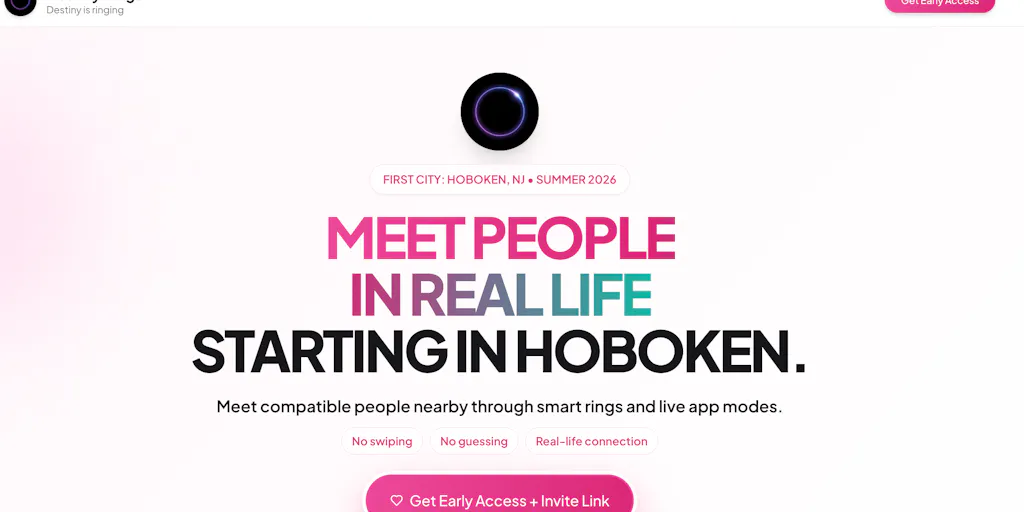
The core mechanic is simple: You wear a Bluetooth-enabled smart ring. When someone compatible is physically nearby—at a bar, coffee shop, or networking event—the app lets you know in real time. You can “Send a Signal,” run a “Fate Check,” and if it’s mutual, tap to reveal and start a conversation on the spot. There are three modes: Dating, Social, and Networking. This isn’t just a dating app; it’s a proximity-based social discovery tool.
For the cross-border audience, this is a brilliant product architecture lesson. The founder is launching with a “Go Live” mode that works without the ring. The app is live now, and the ring hardware is in “final validation.” This is the classic MVP (Minimum Viable Product) strategy—launch the software, test the engagement, validate the use case, and then sell the hardware as the premium upgrade. If you are launching a physical product on Amazon, you should be doing the same thing: launch a digital component or a “starter” version to test the market before you commit to a 5,000-unit MOQ.
Moreover, the differentiation from incumbents is stark. Compare this to Tinder or Bumble, which are built on the “swipe-scroll-repeat” model. They monetize through subscriptions that give you more visibility or more swipes. They don’t solve the “meet in real life” problem; they solve the “match” problem. Hinge tries to address this with “designed to be deleted,” but it still relies on you spending time in the app. Destiny Rings flips the script by making the hardware the signal. The ring is visible. It’s a conversation starter even before the app pings. This is what we call in e-commerce a “social proof object.” It’s the same reason why Apple AirPods became a status symbol—you could see them. The ring makes the user an active participant in the product’s marketing.
What Cross-Border Sellers Can Borrow: The “Proximity” Filter
Here is where I want to get specific about the takeaways for sellers. The most interesting feature discussed in the comments is how they handle dense/crowded areas. The founder mentions that in crowded areas, the app uses “signal strength and configurable detection range to filter out noise.” Instead of pinging you about everyone within 100 feet at a packed bar, it prioritizes people who are genuinely close—a few feet away—and compatible based on your preferences.
This is a data filtering problem, not just a dating problem. For us, this is the equivalent of geotargeting and inventory allocation. When you’re selling on Shopify or Amazon Seller Central, you don’t want to waste ad spend on people who are “nearby” in a digital sense but will never convert. You want to target people who are genuinely close to the point of purchase. This app’s “configurable detection range” is analogous to setting a tight radius on your Google Ads or using Klaviyo to send a push notification only to users who are near your physical pop-up store.
But more importantly, the concept of proximity can be borrowed for product design. Can you create a product that functions better when people are physically close? Think about smart home devices that sync when you walk into a room, or luggage with a “proximity alarm” that alerts you if you leave it behind. The “Fate Check” mechanic—where both parties must signal mutual interest before revealing identity—is a powerful double-opt-in mechanism. In email marketing, this is called a confirmation email or a double opt-in. You force the user to verify their intent twice, which drastically increases the quality of the lead. If you are running a DTC brand, consider implementing a “double opt-in” for your loyalty program or your SMS marketing. Don’t just let them sign up; make them confirm they want to hear from you. It reduces spam complaints and increases open rates.
Why Amazon sellers should care more than Shopify ones
Let me zoom in on the platform split. Shopify sellers are usually obsessed with AOV (Average Order Value) and LTV (Lifetime Value). They can afford to play the long game with email flows and retargeting. But Amazon sellers are playing a different game—one of ranking and velocity. For an Amazon seller, the “Go Live” mode is a lesson in review generation. You need to get the product in the hands of users before you have the final version. Destiny Rings is doing this by letting users try the app without the ring. They are building a community of early adopters who will be primed to buy the hardware the moment it launches.
If you are an Amazon FBA seller, your biggest bottleneck is often the initial review count. You can’t just launch a product with zero reviews and expect it to rank. You need to use the “Go Live” strategy: launch a digital companion, launch a “beta” version at a discount, or use a service like Helium 10 to run a giveaway program that generates early sales velocity. The proximity mechanic also applies to localized launches. Destiny Rings is launching in Hoboken before expanding to NYC. This is the “city-by-city” expansion model. Amazon sellers should do the same with their ad targeting—win the “Hoboken” keyword or the “Jersey City” demographic before you try to conquer the national “NYC” keyword. It’s easier to rank for “smart ring for dating in Hoboken” than it is for “smart ring.”
Where the math breaks: The hardware hurdle
Now, let’s put on my skeptic’s hat. The fundamental issue with Destiny Rings is the hardware barrier. The founder says the ring is in “final validation.” This is a euphemism for “we haven’t shipped it yet.” And that is where the cross-border reality hits hard.
First, the logistics. A Bluetooth-enabled ring is a complex piece of hardware. It requires a battery, a radio, a charging mechanism, and a waterproof casing. This isn’t a simple piece of jewelry you can dropship from Alibaba. You’re looking at a manufacturing cost of $30–$50 per unit, minimum, and that’s before you factor in the battery life issues. The founder mentions “Go Live” mode works without a ring, which is smart, but it also reveals that the core value prop—the passive proximity detection—is tied to a device that needs to be charged. If the battery lasts 24 hours, the user will forget to charge it, and the “magic” disappears.
Second, the network effect problem. A dating app is useless if there are no other users nearby. In Hoboken, this might work. But as they scale to NYC, they will hit the “cold start” problem. You need a critical mass of users and ring-holders for the “Fate Check” to work. This is the same problem that plagues social commerce platforms like Temu or SHEIN—they need volume to make the economics work. For a cross-border seller, this is a warning: don’t build a product that relies on a network effect unless you have the marketing budget to seed both sides of the marketplace. The “app-only” mode is a clever hack, but it removes the visual cue of the ring, which is what makes the product shareable.
Third, the privacy creep. In a crowded bar, the app uses signal strength to filter out noise. But how does it know who is “compatible”? It requires access to your location, your proximity to other phones, and your dating preferences. This is a privacy nightmare. As a cross-border seller, you have to be careful about data collection, especially if you are selling into the EU, where GDPR is strict. If you are building a “smart” product, you need to be transparent about data collection or you will face regulatory hurdles that kill your margins.
The “Borrow” Strategy: Turning a Social App into a Commerce Engine
So, what is the actionable takeaway for a DTC operator? It’s not to copy the ring. It’s to copy the engagement loop. The app has three modes: Dating, Social, Networking. This is a masterclass in product segmentation. Instead of trying to be everything to everyone, Jayson has defined three specific use cases with distinct user intents. For your e-commerce store, this means you should be segmenting your product lines by use case, not just by category.
Look at your catalog. If you sell outdoor gear, don’t just have “jackets.” Have “Trail Jacket (Hiking),” “Commuter Shell (Urban),” and “Powder Parka (Ski).” Each product should have a landing page that speaks to the intent of that specific segment. The “Networking” mode of Destiny Rings is essentially a B2B lead generation tool. If they can nail that, they could sell the hardware to conference organizers or corporate HR departments. Think about how you can pivot your product to serve a B2B use case. That often has higher margins and lower return rates than B2C.
Furthermore, the “Signal” and “Fate Check” mechanics are a gamified version of lead scoring. In B2B, you score leads based on engagement. Here, the “Signal” is a high-intent action. The “Fate Check” is a double opt-in. In your email flows, you should be tracking behavioral signals like “added to cart” or “viewed pricing page” and triggering different sequences based on that score. This is standard practice, but the ring makes it tangible.
Where I’d Push Back: The “Novelty” Trap
My main criticism is that this is a novelty product. The founder is honest about it being in beta, but the core mechanic—proximity detection—is a gimmick that might wear off. The comment from Jessica Gonzalez hits the nail on the head: “Technology that was created to help us meet people has actually pushed us further apart.” The app is trying to solve that by forcing proximity, but it’s still a screen telling you to talk to the person next to you. It doesn’t eliminate the social anxiety of walking up to a stranger; it just adds a technological buffer.
For cross-border sellers, this is the “gimmick vs. utility” test. Is your product a “Destiny Ring” (a cool gadget that solves a narrow problem) or is it a “smartphone” (a utility that solves a broad problem)? If your product relies on a single “wow” feature, you need to be prepared for the novelty to fade. You need to build a recurring revenue or recurring usage model. For the ring, that might be a subscription for “premium compatibility matching.” For your product, that might be a subscription for refills or consumables. If you sell a coffee maker, you need to sell the beans. If you sell a smart ring, you need to sell the data insights.
What I’d Watch / Test Next
If I were running a cross-border operation, here is what I would test this week based on this launch:
Test the “Go Live” MVP model. Before you commit to your next big inventory order, launch a “digital-only” version of your product’s value prop. If you sell a physical planner, launch a PDF version on Gumroad or Etsy to test the demand for the layout. If you sell a skincare device, launch a “guide” or “app” that mimics the routine. This validates the problem before you spend on tooling.
Implement a “Fate Check” for your reviews. Amazon is cracking down on incentivized reviews. Instead of asking for a review, run a “double opt-in” for your review request. Send an email asking if they are satisfied. If they say “yes,” then ask for the review. If they say “no,” redirect them to customer service. This improves your review quality and reduces the risk of negative reviews from mismatched expectations.
Segment your ads by “mode.” Look at your Meta Ads Manager or Google Ads. Are you targeting by demographic or by intent? Create three ad sets: one for “Dating” (looking good), one for “Social” (having fun), and one for “Networking” (career advancement). Even if you sell the same product, the copy and creative should speak to those distinct emotional drivers. The “Networking” angle often has a higher CPC but a much higher conversion rate because it’s a business expense.
Watch the logistics of the “ring.” If you are considering smart wearables or any product with a battery, study how Destiny Rings handles the “final validation” phase. The delay between the app launch and the hardware launch is a risk. If you can, always launch the “software” (the promise) before the “hardware” (the inventory). It gives you a buffer to adjust your supply chain based on actual demand, rather than forecasted demand.
The beauty of this launch isn’t the ring—it’s the sequencing. It’s the decision to build a community first and a product second. That is a lesson we can all take to the bank, no matter which marketplace we call home.