The agent that can’t check out is the new lost sale — and most cross-border stores have no idea it’s happening
For fifteen years, cross-border operators have optimized for two kinds of traffic: humans and Googlebot. We built entire tooling stacks around that binary — schema markup for the crawler, CRO for the human, a Klaviyo flow for the email address the human eventually surrenders. A third visitor is now arriving at your storefront, and it is neither. It’s an autonomous agent acting on behalf of a buyer — comparing your landed price against three competitors, attempting to sign up for your wholesale portal, or trying to complete a checkout on a client’s behalf. And here’s the uncomfortable part: when that agent fails, it doesn’t bounce with a 404 in your Shopify analytics. It silently tells its human “I couldn’t do that,” and you never see the lost order. Dedica, launching on Product Hunt, is one of the first tools aimed squarely at that blind spot. Whether the tool itself survives is a separate question from whether the problem is real. The problem is real.
What Dedica actually solves (and what it doesn’t)
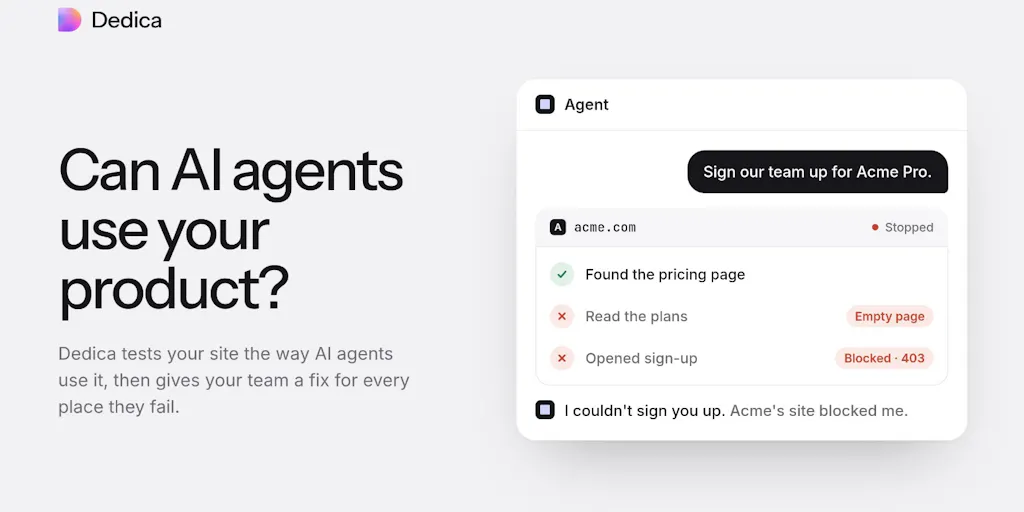
The origin story the maker Prajwal tells is the one every operator should internalize: an agent tried to sign a team up for a SaaS tool, found the pricing page, got an empty render because the plans only loaded via JavaScript, then hit a bot check at sign-up and gave up. No error was surfaced to the site owner. The agent simply reported failure to its user. That’s a silent funnel leak with no equivalent in your current analytics.
Dedica’s answer is a readiness audit: 125 checks across Discovery, Access, Usability and Payments, scored out of 100, free and no-signup, run in under a minute. The paid layer is a “fix kit” at $30 launch pricing, normally $50, one-time per site — one instruction file per issue, each describing what to change and how to verify the fix, formatted to drop into Claude Code, Codex, Cursor or Copilot. There’s also a public API and an MCP server so your own agent can run checks itself.
Notice what this is and isn’t. It is not an SEO auditor, and the maker is explicit about the distinction in the comments: regular audits cover SEO/GEO “which helps agents discover your website,” while Dedica focuses on whether agents “can see, use and pay on your website when they land there.” That’s a post-click, post-discovery problem — the part of the funnel where money actually changes hands. For a cross-border seller, that framing is the most valuable thing in the launch.
Why Amazon sellers should care more than Shopify ones — for now
Here’s a counterintuitive take. If you’re a pure Amazon FBA seller, Dedica is mostly irrelevant to you today, because Amazon controls the storefront and the checkout, and Amazon is building its own agent layer (Rufus, Buy for Me) on its own terms. You don’t get to fix Amazon’s agent-readiness; you get to live with it.
The operators who should be running this audit this week are the DTC and marketplace-adjacent ones: Shopify storefronts, headless builds, wholesale/B2B portals, and anyone running a brand.com alongside their Amazon listings. Why? Because those are the surfaces where you own the DOM, the checkout flow, and the bot posture — and those are exactly the surfaces where an agent hits a JavaScript-only variant selector or a Cloudflare challenge and dies quietly. The Shopify merchant with a custom headless front end and a wholesale application form is the highest-risk profile in cross-border right now, and almost none of them are measuring it.
How it differs from the incumbents you’re already paying for
The honest comparison set matters here, because “site audit” is a crowded category and the pricing conversation in the comments (“the price is too high… not sure how different it is from a regular site audit”) is the right one to have.
Against Semrush or Ahrefs: those tools are discovery-and-ranking machines. They’ll tell you your product pages aren’t indexed or your Core Web Vitals are poor. They will not tell you that your add-to-cart button is a div with an onclick handler that no agent can resolve. Different failure mode, different tool.
Against accessibility auditors like axe or Lighthouse: this is the sharpest comparison, and a commenter named Aleksandar Perak nails the gap — “a button that’s really a div with an onclick, or a custom dropdown that never exposes its options in the DOM” can pass an accessibility audit and still break an agent. Dedica’s maker says the score is “a composite of static checks and real agents trying to use your site,” which is the right architecture if it holds up. Static checks alone would miss exactly the edge cases that matter.
Against the emerging AEO/GEO tool category — the llms.txt generators, the AI-visibility trackers: those are about getting cited by an AI answer engine. Dedica is about getting transacted with by an AI agent. Discovery versus conversion, again. A store can score beautifully on AI-visibility and still have an agent fail at the payment step.
The genuinely differentiated piece is the fix-kit format: instruction files targeted at coding agents rather than a PDF report a human has to interpret. That’s a small but real workflow innovation, and it’s the reason a solo Shopify operator can act on the output without a developer in the loop.
Where the math breaks
Two soft spots in the model, from an operator’s chair.
First, the audit runs on the live URL, and there’s no Webflow integration yet — the maker confirms it’s “in the pipeline.” A commenter, Vijayanand Kailash, pushes further: “we need the audit at the code level. Web scraping is not reliable, mainly for AEO.” The maker concedes they’ve “been hearing this problem quite a lot” and are building a fix. Until then, you’re auditing a rendered snapshot, which means your staging environment, your A/B test variants, and your geo-targeted storefronts are all invisible to the check. For a cross-border operator running five locale-specific storefronts, that’s a material limitation.
Second, the scoring has a discovery gap that one commenter, Jirka Sedlák, hit in public: his site scored 50 and was flagged for having no MCP server and no OpenAPI spec — except he has both, living on an app subdomain with nothing on the main domain pointing to them. The fix, per the maker, is a link in llms.txt. That’s a useful finding and a fair resolution, but it tells you the tool’s discovery logic depends on well-known paths and declared links on the primary domain. If your agent-facing endpoints live elsewhere and aren’t declared, expect false negatives. Read your score with that in mind before you panic-fix.
What cross-border sellers should borrow from this, regardless of whether you buy
The tool is the least interesting part of the launch. The mental model is the asset. Four things I’d lift into your own operation this quarter:
1. Add “agent readiness” to your pre-launch QA checklist. You already test checkout on mobile Safari and a couple of Android browsers. Add a pass where you attempt the same journey as an agent: can it read the pricing table without JS execution, can it resolve the variant selector, can it get past your bot protection to reach the cart, can it complete payment. If any step fails silently, you’ve found a leak your analytics will never show.
2. Audit your bot posture against your agent posture. This is the tension nobody has resolved. Cloudflare and CAPTCHA are, per the maker, “one of the most common reasons agent can’t reach a website” — and agent accessibility is “one key metric” in the scoring. But you also can’t turn off bot protection; the scrapers and card-testers are real. The answer is segmentation: let declared, well-behaved agents through a verified path while keeping the hostile traffic blocked. That’s an infrastructure decision, not a marketing one, and it belongs on your platform team’s roadmap now.
3. Treat llms.txt and a published OpenAPI spec as storefront infrastructure. Not because every agent reads them today, but because they’re cheap to publish and they’re how you declare “here is what an agent may do with me.” The Sedlák thread is the tell: agents and auditors look for declared capability at predictable paths. Undeclared capability is, functionally, no capability.
4. Instrument agent traffic before you optimize for it. The maker’s own forum question — “are you seeing AI agents visiting your website yet?” — is the one to answer with data, not vibes. Segment your server logs for known agent user-agents and LLM crawler signatures. You can’t manage a funnel you can’t see, and right now most cross-border operators are flying blind on this segment entirely.
Where my judgment says it falls short
I’ll be direct about the weaknesses, because that’s what you’re paying me for.
The pricing conversation in the comments is a signal, not noise. A commenter named Mohammed says plainly the price is “too high” and asks for a discount; the maker points to the $30 launch rate. Thirty dollars per site, one-time, is trivially cheap for an established brand and oddly expensive for the long tail of solo Shopify operators who most need it — and the one-time-per-site model means you’re re-buying every time you ship a redesign or add a locale. For a cross-border seller running multiple storefronts, that math compounds fast. A subscription tier keyed to continuous monitoring would fit the actual need (agent behavior changes as agents improve) better than a one-shot audit.
The framework-agnostic fix kit is both a strength and a limitation. It means a Cursor or Copilot user can act on it without framework-specific guidance, but it also means the instructions can’t point at “the component in components/VariantSelector.tsx” — you or your agent still have to locate the code. For a Next.js team, that’s fine. For a non-technical merchant on a themed Shopify store, the fix kit may describe a change they can’t make without a developer anyway.
And the biggest caveat: this entire category is early and the ground is moving. Agent behavior standards aren’t settled, the discovery conventions (well-known paths, llms.txt, MCP) are still consolidating, and a score of 72 today may mean something different in six months as the agents themselves get better at coping with messy sites. Buy the audit as a diagnostic, not as a certification.
What I’d watch / test next
This week, three concrete moves.
First, run the free audit on your primary storefront and your wholesale/B2B portal — the no-signup, sub-minute scan costs you nothing but attention. Read the score as a starting hypothesis, not a verdict, and specifically check whether any “missing” findings are false negatives of the Sedlák variety (capability that exists but isn’t declared on the main domain). Second, pull your server logs and segment for agent and LLM-crawler user-agents over the last 30 days — if you can’t find the segment, that’s your finding. Third, write down your current bot-protection rules and mark which ones would block a legitimate, declared buying agent; that list is your next platform ticket.
Then watch the roadmap. The Webflow and code-level audit gaps the maker acknowledged are the tells for whether Dedica becomes a real infrastructure tool or stays a launch-day score generator. And watch the incumbents — if Semrush or Ahrefs ships an “agent readiness” module inside their existing subscription, the standalone audit category gets repriced overnight. For now, the problem is real, the tool is a reasonable first pass, and the operators who instrument agent traffic earliest will be the ones who understand their next funnel before their competitors even know it exists.