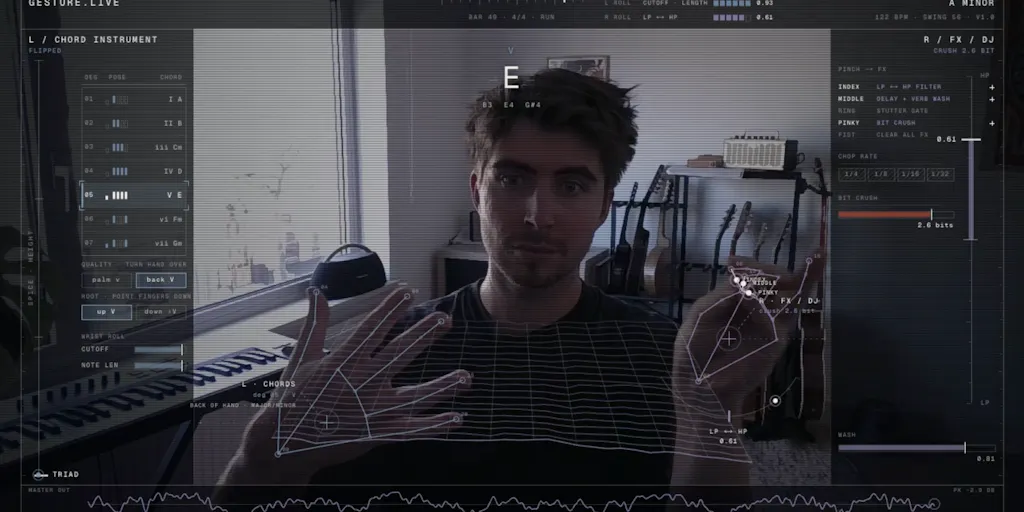
If you sell physical goods across borders, a webcam-controlled music instrument looks like a toy. That is exactly why you should study it. The product and company both named gesture.live launched in 2026 as a free browser tool for playing chords, bass, drums, and effects with your hands in front of a webcam. For an Amazon FBA operator, that sounds far from a sourcing spreadsheet. But this toy contains a sharper product-page thesis than half the Shopify stores I audit: the product that wins is the one that makes a stranger feel competent fastest. And the comment thread under its launch already documents the two objections that will decide its future — latency and lighting — which is exactly the early feedback most cross-border brands never capture before spending a five-figure inventory PO.
The problem it actually solves is interface risk, not music
Every cross-border seller knows the failure pattern: traffic is fine, add-to-cart is fine, the product arrives, and then the customer can’t figure out how to use it or why it matters. Returns spike. Reviews say “cheap” when they actually mean “unfamiliar.” That is interface risk. gesture.live attacks it by stripping the interface down to a webcam. The launch page tagline is “Play live electronic music with your hands using your webcam”. It doesn’t say “learn to play.” It doesn’t say “download software.” It says use your hands and your camera. Under the hood, the launch page’s Built With section lists Vercel, Tone.js, and Mediapipe — all browser technologies. The promise is instant competence: move a hand, get music.
For a cross-border seller, the translation is simple. Your product page should answer the question “What can I do with this?” in the first five seconds, not after a second A+ image. The best way to communicate a physical product’s value is to show someone using it in the exact context where the magic happens. If a webcam synth can make a music novice feel like a performer, your blender can make a frozen-smoothie user feel like a nutritionist — but only if you show the hand, not the hero shot.
The “one free hand” design principle
The maker listed on the launch page, Robin van Soelen, is open about where the idea came from. In his comment he shouts out indecisiveeric.com/gesture-synth, which went viral on Instagram, and says he is using the same chord language but compressing it to one hand so the other hand is free to play melodies, add drum and bass patterns, and control effects. That one sentence is a complete product strategy.
Incumbents give users two hands on the core action. gesture.live takes one hand out of the chord and creates space for a second, creative action. For cross-border e-commerce, this is the difference between a listing that says “easy to use” and one that gives the user a second free hand to do something aspirational. When you design a landing page, a product insert, or a TikTok demo, ask: if the primary action takes one hand, what does the customer’s other hand get to do? The second hand is the wow.
How it differs from the obvious alternatives
The Product Hunt page places gesture.live in Music Generation, a category with heavy hitters. Looking at the Similar Products rail, Jamboree is a multiplayer synthesizer, Incredibox is a polished drag-and-drop beatbox toy, and Lyria Camera by Google DeepMind turns your camera into an instrument. What separates gesture.live is the split-control interaction. Jamboree and Incredibox are about arranging; gesture.live is about performing. The chord language is compressed into one hand specifically so the other hand can do something live — melody, drums, bass, effects. That is not a feature addition; it is a different mental model. The product is closer to a musical instrument than to a music toy.
Cross-border sellers should copy that distinction in their own positioning. If your product has a similar alternative in the market, don’t fight on the spec list. Find the single interaction that changes the mental model and make it the headline. A “kitchen scale that talks to your phone” is weak. A “kitchen scale that leaves one hand free to pour while the other holds the recipe” is a mechanic.
Why Amazon sellers should care more than Shopify ones
This sounds like a Shopify lesson at first. Shopify brands can embed demos, install 3D viewers, and use custom interactions. Amazon Seller Central pages are more constrained. But that is exactly why Amazon sellers should care more: constraint forces compression. The main image is already a five-second demo. If a customer can’t tell what the product does by the main image, the listing lost before the click. gesture.live works because one frame of a hand over a webcam communicates an entire interaction. The Amazon equivalent is a main image that shows the product mid-use — a hand pressing, slicing, snapping, clamping — rather than a hero shot on white. And in the first seconds of the video, show the hand, not the logo. You can carry the same logic into a TikTok Shop livestream, where the demo is the product.
What cross-border sellers can borrow from gesture.live’s playbook
First, launch with a free tool when you want to learn faster than you sell. The page lists gesture.live as Free, with no disclosed paid tier. Free is not a business model, but it is a user-acquisition experiment. If you sell physical products, you can build a free browser tool that simulates your product’s core decision: a shade finder for cosmetics, a tape-free measuring tool for furniture, a washer-size calculator for bedding. Use it on Shopify as a conversion aid, or run it as a lead magnet and capture emails with Klaviyo.
Second, steal the mechanic, then improve one variable. Robin credits a viral Instagram experiment as the starting point. He didn’t start from a blank page; he took a mechanic that was already working and compressed it. Cross-border sellers should stop feeling guilty about studying existing viral products. The skill is finding a product with a “gesture-synth” engine — a proven interaction people already enjoy — and making it one-hand simpler, faster, cheaper, or more niche.
Third, read the launch comments as a focus group. The Product Hunt thread under gesture.live contains two objections that would cost a team a fortune to discover later. One commenter asks whether note-ons are quantized, then names the core problem: webcam tracking at 30fps means 30ms of jitter before the audio thread hears you, and “you start feeling timing errors well under that.” Another commenter asks whether hand tracking holds up under stage lighting or dim, colored light, because that is “the real test of whether this leaves the bedroom-producer use case.” The maker answers honestly: chords are quantized to the grid, the melody is real-time, and live performance has not been tested yet. In one thread you have the product roadmap, the risk register, and the go-to-market constraint. Most cross-border brands spend thousands on a product photoshoot and never get feedback this sharp.
Where the math breaks
For all the strategic signal, gesture.live has not proven it is a business. I don’t know its pricing because the page only says Free; no business model is disclosed. I don’t know retention numbers because the launch page doesn’t show them. What I see is a lovely instrument with three structural limits a cross-border seller should recognize before copying the playbook blindly.
The 30ms problem
This is the best comment on the page. A commenter on the launch thread points out that webcam hand tracking is 30fps on a good day, so there is 30ms of jitter before the audio thread hears you, and “you start feeling timing errors well under that.” The maker’s answer is to quantize chords to the grid while keeping the melody real-time. That is a sensible compromise, and the commenter’s follow-up is the killer: the maker doesn’t feel the latency because he built the mapping, but a new learner “reads the same 30ms as the instrument being unresponsive rather than themselves being early, and that’s the moment they close the tab.”
For cross-border e-commerce, this is the gap between what you think the product does and what the customer experiences. The empty cart starts not at the price page but at the first moment of friction. A 2% defect rate feels small to you, but to the customer it becomes “this brand ships broken stuff.” The math doesn’t have to be huge to break trust.
The stage-light problem
Another commenter asks the obvious but rarely asked question: “has anyone actually tried this on a small stage or at a house party yet?” The maker answers, “I haven’t tested it with a live audience yet.” That is the entire product-market fit story in two sentences. The demo video looks great in a well-lit room at a desk; the real-world test is dim, colored stage lighting. For cross-border sellers, the equivalent is selling a “camping lantern” that was only tested on a kitchen table, or a “waterproof bag” tested on a bench instead of a river. The launch video sets expectations; the field test sets the refund rate. If you don’t know the lighting conditions, you don’t know your market.
The free-tier trap
The page says Free. There is no disclosed paid tier, no obvious enterprise angle, and the launch stats — a day rank of #20 with 100 points and 97 followers — are respectable but not breakout. I have seen enough Product Hunt launches to know that a free tool with a magical demo can become a portfolio piece, not a company. For a cross-border seller, the lesson is sharper: free tools should be the top of a funnel, not the end. If you build a free sizing calculator, put an email capture on it. If you build a demo that goes viral, route it to a product page. If gesture.live never adds a paid layer — MIDI export, multitrack recording, live-performance mode — it will remain a beautiful lead magnet for the maker’s next thing. That’s acceptable. But don’t copy the free without copying the funnel.
What I’d watch / test next
I’d watch whether gesture.live’s users start posting performances. If people share clips of themselves playing, that is a signal that a free webcam tool can be a distribution engine — and it’s the same signal that tells you a physical product has earned its UGC moment. It will also tell me whether the stage-light objection is fatal or just a roadmap item.
This week, do three things. First, open gesture.live and play for ten minutes. Write down the second where it stops feeling magical; that is your conversion drop-off in miniature. Second, audit your product page’s first five seconds: if no text survived, would a stranger know what to do with your product? If not, make a 15-second hand-demo video and put it at the top of your Shopify product page. Third, pick one existing viral product in your niche and change one variable — not a copy, but a compression. Launch it as a test drop, and put whatever you learn into an email capture via Klaviyo. gesture.live is not your competitor; your own interface is.