The Attention Economy Finally Gets a Weather Forecast — And Cross-Border Sellers Should Pay Attention
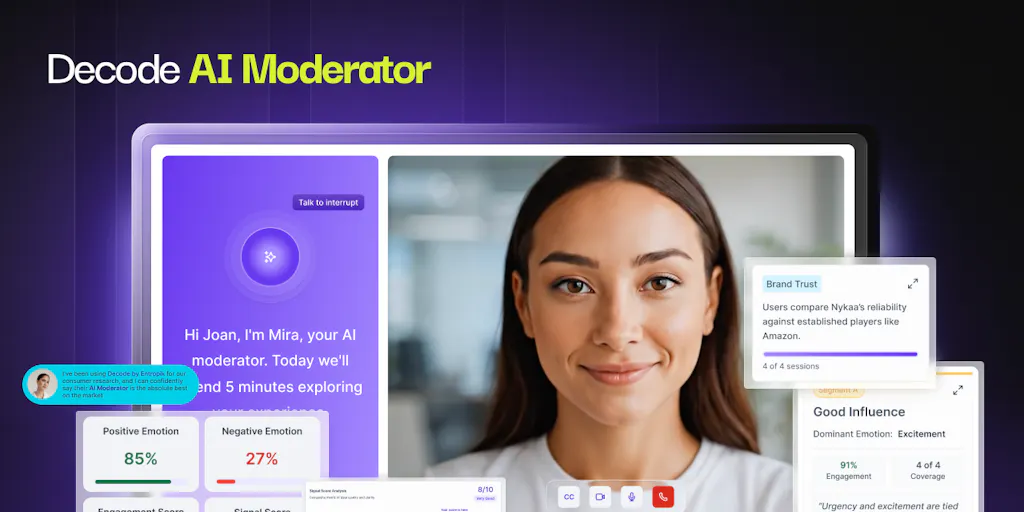
Cross-border sellers burn cash on creative testing the way inland sellers burn cash on shipping. Every ad account I audit — Shopify DTC, Amazon Sponsored Brands, TikTok Shop video, Temu listing images — has the same graveyard: three to five creative variants, a Friday launch, and a Monday morning where one version wins and nobody can explain why. The cost of guessing wrong is brutal when you’re paying in USD, shipping from Shenzhen, and answering to a CFO in another timezone. So when a tool promises to forecast attention and emotion on a creative before it goes live — without a panel, without a two-week research study — my ears perk up. That’s exactly what Decode by Entropik is pitching with its AI Creative Insights launch, and it deserves a closer read than the typical Product Hunt fanfare.
What Problem This Actually Solves (And Why It’s Not Another “AI Ad Generator”)
Let me be blunt about the category. Most “AI creative” tools in the e-commerce stack are generators — AdCreative.ai, Pencil, Creatify — they spit out variants and call it optimization. That’s not the problem. The problem is selection. You can generate 200 variants in an afternoon and still have no idea which one will stop a scroll on Instagram Reels in Berlin versus TikTok in Jakarta.
Traditional pre-testing — the kind Nielsen and Kantar sell — solves selection but costs weeks and five figures. So most cross-border sellers do neither. They ship on gut, and gut is expensive when your CPMs are already inflated by the fact that you’re advertising to a market you don’t live in.
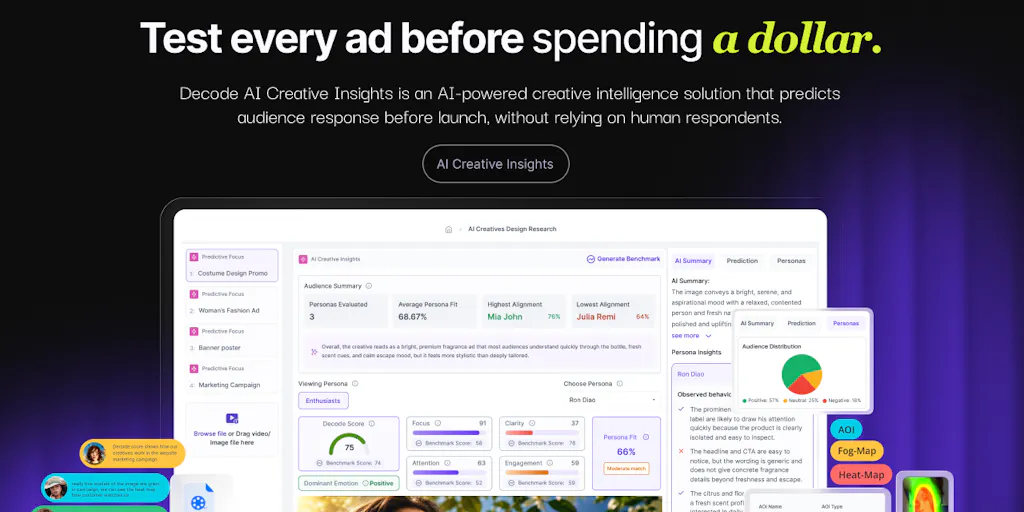
Decode’s AI Creative Insights sits in the gap. Upload a video, banner, social asset, or OOH creative, and within minutes you get four outputs, per the launch post: where eyes land first and what gets missed; how people feel second by second and where they drop off; what to change, why, and the expected impact; and how your creative stacks up against your category. That’s a pre-testing workflow compressed from weeks to minutes.
The founder, Lavakumar E, frames the pain sharply: “three versions of an ad on screen, a launch on Friday, and a room full of smart people debating which one ‘feels right.’ Someone senior makes the call. The budget goes live. Two weeks later, the numbers tell you whether you guessed well.” If you’ve run a cross-border ad account for more than a quarter, you’ve lived that exact scene — except your “room full of smart people” is a Slack thread spanning three time zones, and the senior person making the call is often the one with the least platform-native intuition.
Why Amazon sellers should care more than Shopify ones
Here’s a nuance the Product Hunt thread doesn’t surface. Shopify DTC operators can iterate creative cheaply — swap a thumbnail, rerun a $50 test, read the CTR. The cost of a bad creative is low and the feedback loop is fast. Amazon sellers live in a different regime. Your Sponsored Brands video, your A+ content module, your main image — these are semi-permanent. Changing a main image resets your listing’s ranking signals in ways that can take weeks to recover from. Amazon’s own creative acceptance policies also reject assets for reasons that have nothing to do with performance.
That asymmetry means Amazon FBA brand owners have more to gain from a pre-flight prediction than Shopify merchants do. If AI Creative Insights can flag that your hero image loses attention at the 2-second mark — before you upload it to Amazon Seller Central and trigger a listing edit — that’s not a marginal optimization. That’s avoiding a self-inflicted ranking wound.
The catch: I don’t see any evidence in the launch material that the model was trained on Amazon-specific attention patterns. More on that in the shortcomings section.
How It Differs From the Incumbents You’re Already Paying For
The obvious comparison set for a cross-border operator is threefold: traditional research platforms, platform-native testing, and the new wave of AI creative tools.
Versus traditional research. Decode is itself the parent platform — the launch post describes it as “the emotion and attention research platform trusted by 150+ global brands.” So AI Creative Insights isn’t a scrappy startup; it’s a productized, self-serve layer on top of an established research engine. That matters because the hardest part of attention prediction isn’t the UI, it’s the training data. Entropik has been collecting real attention and emotion data from real people watching real ads for years. That’s the moat, or at least the claim to one.
Versus platform-native testing. Meta Ads Manager and TikTok Ads Manager both offer A/B testing, but you pay for the privilege in real ad spend and you get the answer after the budget is gone. Google’s Video Intelligence and YouTube’s Brand Lift tools are closer cousins, but they’re locked inside Google’s ecosystem and priced for enterprise.
Versus the AI creative wave. Tools like Foreplay and Atria help you swipe and remix winning ads. Useful for inspiration, useless for prediction. Decode is making a different bet: that the model can tell you something about your creative that you don’t already know.
The most interesting technical detail comes from Sumit Singh Chauhan, VP of Machine Learning & Data Science, who answers the obvious skeptic question directly: “Can a model really know where people will look?” His answer: “Think of it like a weather forecast for attention. The model learns from real attention and emotion data, gathered from real people watching real ads. When you upload a new creative, it forecasts how an audience is likely to respond. And like a forecast, it’s a prediction, not a guarantee.”
That’s an unusually honest framing from a vendor, and it’s the framing I’d hold them to when you evaluate the tool yourself.
Where the math breaks
Here’s the operator’s version of that honesty. A weather forecast is useful because meteorologists have decades of ground-truth data and a stable physical system. Attention prediction has neither. Consumer attention shifts with platform algorithm changes, cultural moments, and seasonality — and cross-border adds a layer of variance that domestic tools systematically underweight.
If the model was trained primarily on US or Indian panel data, its predictions for a German-language TikTok Shop creative or a Japanese Rakuten banner may be directionally useful but numerically unreliable. The launch post doesn’t disclose the panel composition or geographic coverage — that’s a “not disclosed” I’d want answered before I trusted a prediction to gate a five-figure campaign.
What Cross-Border Sellers Can Borrow From This — Even If You Never Sign Up
You don’t have to buy the tool to steal its operating logic. Three things here are worth copying regardless of your stack.
1. The four-output framework is a better creative brief than most agencies write. Eyes-first, emotion-over-time, change-with-impact, category-benchmark. That’s a checklist you can run manually with a Hotjar heatmap on your landing page, a Meta Ads Library scan of competitor creative, and a stopwatch. It won’t be as fast, but it forces the discipline.
2. The “90% of creatives never get tested” insight is the real thesis. Sumit’s line — “It won’t replace testing with real people for your biggest campaign of the year. What it does is give the other ninety-plus percent of your creatives, the ones that never get tested at all, some evidence before they go live” — is the most operator-relevant sentence in the entire launch thread. Cross-border sellers don’t have a hero-campaign problem. They have a long-tail-of-listings problem. Your 47th Etsy listing photo, your 12th eBay variation, your Temu bundle image #9 — nobody is A/B testing those. If a cheap prediction tool can triage them, that’s where the ROI lives.
3. The persona-by-persona roadmap is the cross-border killer feature. The launch teases “Synthetic Audience, to compare reactions persona by persona” via early access. That’s the feature I’d actually pay for. Cross-border is fundamentally a persona-matching problem: your US buyer, your UK buyer, and your Australian buyer respond to different signals, and you’re often running one creative across all three because localization is expensive. If Synthetic Audience can predict “this creative wins with US Gen Z but loses with UK millennials,” you’ve just solved a localization triage problem that currently costs agencies thousands per market.
Why TikTok Shop operators should watch this most closely
TikTok Shop’s creative velocity is the highest in the cross-border stack. Winning videos have a half-life measured in days, and the platform’s algorithm rewards volume. That means TikTok Shop sellers are generating more creative, testing less of it rigorously, and burning more budget on losers than anyone else. A tool that triages creative in minutes — even imperfectly — has a higher expected value here than on any other channel. The TikTok Creative Center already gives you top-performing ad inspiration for free; Decode’s pitch is the other half of the equation — telling you whether your asset will perform, not just what’s working for others.
Where My Judgment Says This Falls Short
Three concerns, in order of how much they’d cost you.
First, the black box is still a black box. Lambert de beru asked the sharpest question in the thread: “using Google/Meta’s ad library to get an initial data baseline here? Curious to understand what this tool bases itself on to evaluate an ad.” No maker answered that question in the scrape. For a tool whose entire value proposition is predictive accuracy, the absence of a clear answer about training data provenance is a yellow flag. Ask before you buy.
Second, the free tier is a trial, not a workflow. The code PHCREATIVE gets you 5 creatives. That’s enough to form a first impression and not much else. Five creatives is roughly one week of output for an active TikTok Shop seller. Pricing beyond the trial isn’t disclosed in the launch material. For a cross-border operator running multiple markets, the unit economics only work if per-creative cost lands well below the cost of the ad spend it’s gating. Get that number in writing.
Third — and this is the structural one — prediction tools can breed false confidence. The weather-forecast analogy is apt in both directions. Forecasts are useful and they make people overconfident about days that turn out sunny when rain was predicted. If your team starts treating a Decode score as a veto, you’ll kill creative that would have worked in-market for reasons the model can’t see: a cultural reference, a platform trend, a competitor’s stumble. The right posture is triage, not gatekeeping. Use it to rank, not to reject.
There’s also a category-fit question. This tool is built for brand creative — video, banner, OOH. A huge chunk of cross-border selling happens on listing images and product photos, where the “attention” question is really a “conversion” question and the relevant benchmark isn’t emotion but click-through and add-to-cart. I don’t see evidence that Decode’s model is tuned for that use case. If you’re an Amazon FBA seller whose main creative asset is a hero image, this may not be built for you yet.
What I’d Watch / Test Next
If you run cross-border ads and want to pressure-test this category without committing budget, here’s my concrete week-one plan.
Run the free trial against a campaign you’ve already run. Take three creatives from a completed campaign where you know the winner. Upload all three to Decode using code PHCREATIVE. If the model ranks them correctly, that’s a meaningful signal. If it doesn’t, you’ve saved yourself a subscription. This is the single highest-value test you can run, and it costs you an afternoon.
Ask three questions before any paid conversation. (1) What’s the geographic and demographic composition of the training panel? (2) What’s the per-creative cost at your expected volume? (3) Does the model have any tuning for listing-image or product-photo creative, or is it video-and-banner only? If they can’t answer #1 clearly, walk.
Pilot it on one market, not all of them. Pick your highest-spend non-domestic market and run Decode predictions alongside your normal testing for 30 days. Track whether the model’s ranking correlates with actual CTR or ROAS. Don’t roll it out globally until you’ve seen that correlation hold in at least one market you understand well.
Watch the Synthetic Audience early access. That’s the feature with real cross-border leverage. If persona-level prediction works, it changes how you allocate localization budget. Email the address in the launch post, get on the list, and evaluate it the same way — against known outcomes, not vibes.
The category is real. The pain is real. Whether this specific product earns a line in your stack depends entirely on whether its predictions beat your gut — and that’s a question only your own campaign data can answer.