The Delegation Layer Cross-Border Sellers Keep Ignoring
Cross-border e-commerce has quietly become a software business. Your Shopify theme, your Amazon SP-API sync jobs, your TikTok Shop webhook handlers, your Temu feed parser, your returns portal — none of it ships a single unit, yet all of it decides whether you can list, price, and fulfill at speed. Most operators I talk to are now running AI coding agents like Claude Code, Cursor, or Codex against that backlog, and most of them are burning plan tokens on the boring 60%: parsers, API wrappers, small utilities. Codemind, launched by Andriy Morozov, is a bet that this boring 60% should be handed off to a second agent that writes, tests, and returns verified files — and only bills you when the build passes.
That framing matters more to a cross-border operator than to a typical SaaS team, and I’ll explain why below.
What Codemind actually solves — and who it’s really for
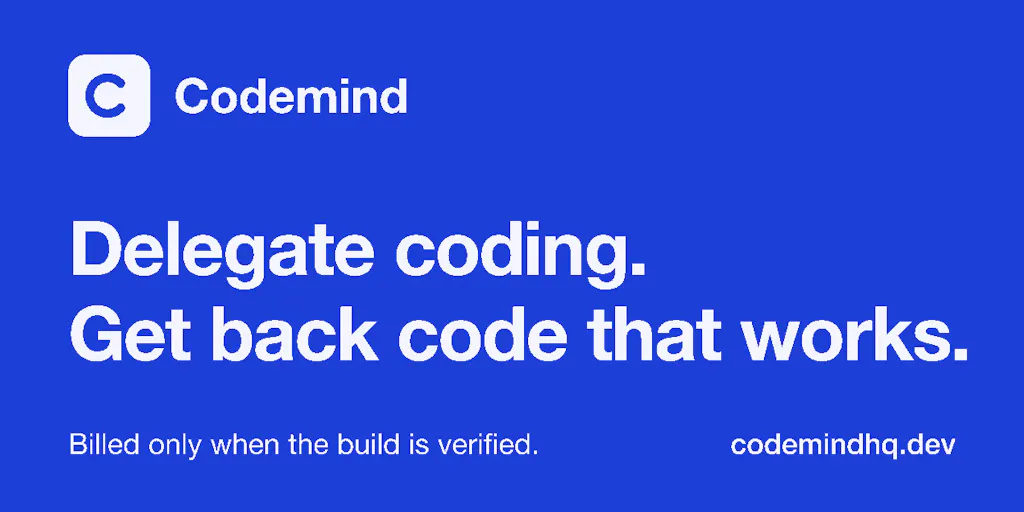
The pitch is narrow and specific: your main coding agent (Claude Code, Codex, Cursor, OpenCode) identifies a task suitable for delegation, specs it with acceptance criteria, and sends it over MCP to Codemind. Codemind writes the code, tests it against those criteria, and returns the files plus the test result. The maker’s own summary: “You are billed only for a build that comes back verified. A failed build is free.”
That last sentence is the whole product. Everything else — MCP transport, cloud execution, parallel tasks — is plumbing. The pricing model is the differentiator, and it’s a direct response to the failure mode every agent user knows: you burn tokens on a task, the agent confidently returns broken code, you re-prompt, you burn more tokens, and you still end up reviewing it line by line.
Codemind inverts the incentive. If the acceptance criteria are met, you pay. If not, you don’t. That’s a small but genuinely novel structure in the AI coding tooling market, where most competitors bill on tokens consumed or seats occupied regardless of outcome.
Why Amazon sellers should care more than Shopify ones
Shopify merchants with a decent app stack can often solve problems by installing something from the App Store — inventory sync, returns, subscriptions. The build-or-buy calculus tilts toward buy.
Amazon FBA brand owners live in a different world. Amazon Seller Central doesn’t have a clean app ecosystem for the things that actually hurt: custom repricing logic against specific competitor sets, SP-API report parsers that normalize the flat-file exports, catalog reconciliation scripts that catch suppressed listings before they tank a week of revenue. These are internal tools. They’re also exactly the kind of “obvious and boring” work one commenter described as the ideal delegation target — “parsers, small utils, api wrappers.”
That’s the cross-border angle. If you’re running multi-marketplace operations across Shopify, Amazon, TikTok Shop, Temu, SHEIN, Etsy, and eBay, your internal tooling surface is enormous and your engineering headcount is usually zero to two people. Anything that compresses the cost of building that surface is worth attention.
How it differs from the incumbents you’re probably already paying for
Let’s be honest about the competitive set, because “AI writes your code” is not a new claim.
Versus Cursor and Claude Code directly. These are the agents doing the delegating. Codemind positions itself as a subcontractor, not a replacement. The maker’s own analogy in the thread: Claude Code/Codex is the “Engineering Manager + Team Lead” and Codemind is the “Dev.” That’s a clean mental model, and it’s also a risk — you’re now paying two agents instead of one.
Versus GitHub Copilot. Copilot is autocomplete-plus-chat inside your editor. It doesn’t take a spec, execute in the cloud, and return verified artifacts. Different job.
Versus Devin and similar autonomous agent platforms. Devin sells you a whole autonomous engineer. Codemind sells you a task-level subcontractor that your existing agent orchestrates. The scope difference is real: Devin wants to be the primary interface, Codemind wants to be invisible infrastructure.
Versus Replit Agent or Lovable. Those are for people who don’t have an agent workflow yet. If you’re already in Claude Code, they’re the wrong shape.
Versus just running more parallel Claude Code sessions. This is the honest competitor. A competent operator can already spin up five Claude Code windows and get parallelism. What they can’t easily get is the verified-or-free billing model and the cloud offload. The maker explicitly calls out the laptop constraint — offloading “all the work to the cloud, so your laptop doesn’t crash when you code 100s projects in parallel.”
Where the math breaks
Here’s my skepticism, stated plainly. The “failed builds are free” model only works if the acceptance criteria are good. And the sharpest comment in the entire thread — from Leo Heo — nails the circularity: “if the main agent writes the criteria and also checks the result, isn’t it grading its own homework?”
The maker’s answer is that you can write the criteria yourself. Varun Jharkhandi asked the same thing directly, and got confirmation: “You write the acceptance criteria yourself, and they travel with the task.”
So the honest read is this: Codemind doesn’t eliminate the hard part of software work. It relocates it. The hard part becomes writing acceptance criteria precise enough that a cloud agent can verify against them without you. For a parser that turns an Amazon flat-file into normalized JSON, that’s easy — you know the input shape and the output shape. For a repricing engine that has to handle edge cases around Buy Box suppression and competitor stock-outs, writing the criteria is the engineering work. Delegating it doesn’t help.
Leo Heo’s own answer — “not anything where writing the criteria is the hard part, like a signup flow with edge cases nobody decided yet” — is the correct filter, and it should be yours too.
What cross-border operators should borrow from this launch
Three things, whether or not you ever sign up.
First, treat acceptance criteria as a first-class artifact in your internal tooling. Most operators I know write a Slack message to their dev (or to their agent) that says “make the Temu feed parser handle the new column.” That’s not a spec. Codemind’s model forces you to write down what “done” means before the work starts. Do that even if you’re using a human contractor or a single Claude Code session. The quality of your criteria is now the bottleneck on your build velocity, not the availability of coding capacity.
Second, separate delegation-worthy work from judgment-worthy work. The thread’s consensus is remarkably consistent: parsers, API wrappers, small utils — delegate. Signup flows, pricing logic with business edge cases, anything where “nobody decided yet” — don’t. Build a two-column list for your own backlog this week. You’ll probably find 40–60% of your internal tooling backlog is in the delegate column.
Third, watch the billing-model innovation, not the feature list. “Pay only for verified builds” is a template. Expect to see it appear in other cross-border SaaS categories — ad creative generation billed per approved asset, listing copy billed per indexed variant, translation billed per published locale. The shift from “pay for compute” to “pay for verified outcome” is the more important trend here, and it’s coming to the tools you already use.
The MCP angle is the quiet story
Codemind’s integration is over MCP, the Model Context Protocol. That matters because MCP is becoming the standard way agents talk to external services, and it means Codemind isn’t locked to one agent vendor. Claude Code, Codex, Cursor, OpenCode — all speak it.
For operators, the practical implication is that the tooling layer around your AI agents is now composable. You can swap the delegating agent, swap the executing agent, and keep the criteria. That’s a healthier architecture than a single-vendor lock-in, and it’s the reason I’d track this category even if Codemind itself doesn’t survive.
My honest read on where this falls short
I’ll flag four things.
The verification loop is only as good as the criteria. Already covered, but worth restating because it’s the load-bearing assumption of the whole product. The maker’s answer to the “grading its own homework” concern is that the user writes the criteria. True, but it pushes work back to the operator. For a solo Amazon seller who can barely write a regex, that’s a real barrier.
“Any scope of task” is doing a lot of work. The maker claims Codemind handles “any scope of task really, from pure function to a full product spec.” I’m skeptical. A pure function with clear I/O is a solved problem for any competent agent. A full product spec is where agents still fail, and the failure mode is usually ambiguous requirements — exactly the thing acceptance criteria are supposed to fix. The claim is directionally true but the value concentrates at the small-task end.
Pricing isn’t disclosed. The launch page says “billed only for a build that comes back verified” and mentions “usage credit” and a “Pro” tier with Swarm, but no numbers. Without pricing, you can’t run the make-or-buy math against just opening another Claude Code session. That’s a real gap for an operator trying to decide this week.
Swarm isn’t shipped. Parallel task execution — the thing that actually saves wall-clock time — is “coming next” and gated behind Pro. Today’s product is single-task delegation. That’s useful, but it’s not the transformative version.
A note on the Product Hunt signal itself
One thing I watch on launches like this: the quality of the maker’s replies. Andriy answered every substantive question in-thread, including the uncomfortable one about self-grading. That’s a better signal than upvote count. Compare it to the dozens of cross-border SaaS launches I’ve covered where the maker posts and vanishes. Engagement style predicts whether the product iterates or stagnates, and this one looks like it iterates.
What I’d watch / test next
This week, before you spend anything, do three things.
One: Open your internal tooling backlog and split it into “criteria are obvious” and “criteria are the hard part.” Whatever falls in the first column is your delegation candidate list — regardless of whether you use Codemind. That list is also a useful audit of where your engineering time is actually going.
Two: Take the single most boring item on that list — probably an SP-API report parser or a Helium 10 export normalizer — and write the acceptance criteria as if you were handing it to a contractor. Input shape, output shape, three edge cases, one failure mode. If you can’t write it in 20 minutes, that task isn’t delegable yet, and you’ve learned something.
Three: If the criteria came easily, go read the Codemind launch thread yourself and ask the maker directly about pricing and whether acceptance criteria can be edited mid-task. Those two answers determine whether it’s usable for a real operator workflow.
I’d also keep an eye on whether the “verified-or-free” model spreads. If it shows up in Klaviyo flows, ad creative tools, or listing optimization platforms over the next two quarters, that’s the signal that outcome-based billing has crossed into the cross-border mainstream. That would be a bigger shift than any single launch.