The silent regression problem every cross-border operator is about to inherit
If you run a cross-border store, you already have an AI agent problem — you just may not have named it yet. Whether it’s a Shopify support bot answering sizing questions, an Amazon Buyer-Seller Messaging auto-responder, a TikTok Shop comment moderator, or a Temu dispute-handling flow, the moment you let a non-deterministic model talk to real customers, you inherit a failure mode that traditional QA never had to handle: silent regression. You tweak one sentence in a system prompt to fix a return-window edge case, and without a single runtime error, three other flows quietly break. That’s the thesis behind QAgent, a new automated QA and regression-testing platform for LLM agents launched on Product Hunt by Abhiram Reddy.K. The product itself is aimed at AI engineers, but the underlying discipline — scoring an agent’s behavior against ground truth instead of eyeballing transcripts — is something cross-border sellers will need to borrow within the next twelve months, whether they build agents or just buy them.
What QAgent actually solves, and why “testing on vibes” doesn’t scale
The maker’s pitch is refreshingly blunt. As he puts it, we write 50 unit tests for a 20-line backend function, but when we ship a non-deterministic agent handling real customers, our “testing pipeline” is typing three prompts into the OpenAI playground, seeing it respond politely, and hitting deploy. That’s the “shipping on vibes” critique that another commenter, Gal Dayan, called uncomfortably accurate for where most builders are with agent QA right now.
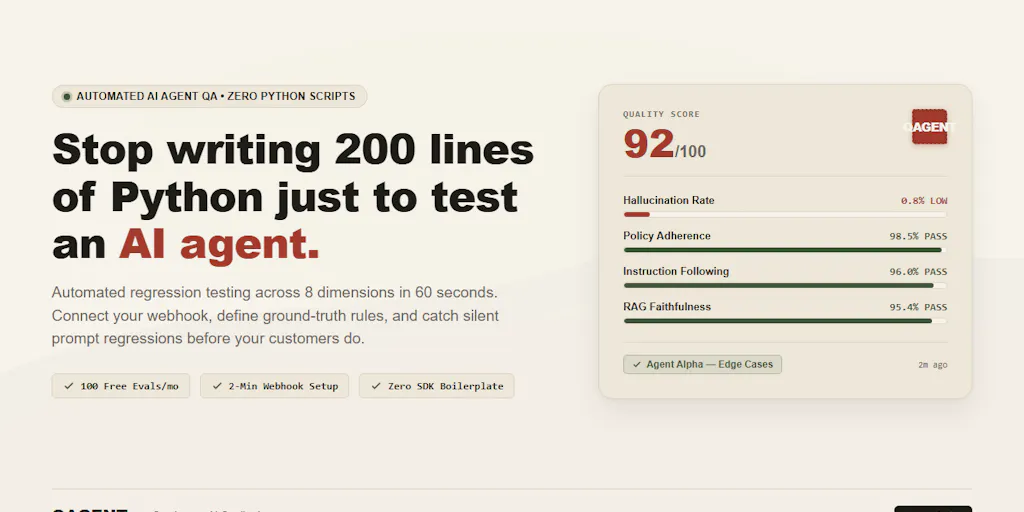
QAgent’s answer is a zero-SDK platform: connect your agent via webhook or API endpoint in what the maker claims is a 2-minute setup, then run automated parallel test suites that produce visual pass/fail scorecards. The evaluation layer covers eight dimensions — Answer Quality, Factual Groundedness, Policy Adherence, Escalation Correctness, RAG Faithfulness, Contextual Relevancy, Context Recall, and Multi-turn Context Memory. The free tier gives you 100 evaluations per month with no credit card required.
The most interesting number in the whole launch is buried in the maker’s second comment. He argues that if your agent is 95% accurate per turn, compounding failure means it has barely a 35% chance of finishing a 20-turn conversation without hallucinating or breaking rules. That single stat reframes every “our bot resolves 95% of tickets” claim you’ve ever heard from a CX vendor.
Why Amazon sellers should care more than Shopify ones
Shopify merchants usually run one storefront, one brand voice, one returns policy. Amazon sellers operate inside a policy environment where a wrong sentence in a Buyer-Seller Messaging reply can trigger a performance notification. If your AI responder promises an unauthorized refund window or an off-platform discount, you’re not just losing margin — you’re feeding the Amazon Seller Central metrics that decide whether your account stays healthy. Policy Adherence, the metric Gal Dayan said he’d actually pay for, is the Amazon seller’s version of survival insurance. A regression suite that catches “the bot quietly promised an unauthorized discount” before a buyer screenshots it is worth more to an FBA brand than to almost any other operator.
How it differs from the eval tools you’ve probably already trialed
The maker’s framing is that existing eval tools forced teams to write 300 lines of custom Python scripts, pip install heavy libraries, and sift through terminal JSON dumps — maintaining a second codebase just to test the first one. That’s a fair description of the current landscape. If you’ve looked at general-purpose LLM observability platforms, you know the pattern: powerful dashboards, steep integration cost, and an implicit assumption that you have an ML engineer on staff.
Where QAgent positions itself is closer to the “no-code QA harness” slot than the “observability platform” slot. The competitor set here isn’t really one product — it’s the DIY stack (a Python script plus a spreadsheet), the heavyweight platform (enterprise observability suites priced per seat), and the “just read the transcripts” approach that most cross-border teams default to because it’s free.
The honest comparison for a cross-border seller isn’t QAgent vs. another eval tool. It’s QAgent vs. the intern who spends Friday afternoon copy-pasting conversations into a Google Sheet. The latter is cheaper until it isn’t — until the day a policy violation ships to 4,000 buyers because nobody tested the prompt change.
Where the math breaks
The 95%-per-turn → 35%-per-20-turns math is directionally right, but it assumes independence between turns, which isn’t how real conversations work. A bot that drifts in turn 4 usually keeps drifting; failures cluster. In practice, the compounding is often worse than the naive multiplication suggests, not better. The counterargument is that most customer conversations are 3–5 turns, not 20, so the real-world failure rate is less catastrophic than the headline number implies. Both things are true. The point isn’t the exact percentage — it’s that per-turn accuracy is a vanity metric and conversation-level task completion is the one that maps to refund rates.
What cross-border sellers can borrow from this launch
You don’t need to buy QAgent to steal its operating model. Four things transfer directly to any cross-border team running AI in the customer path.
First, define ground truth before you define prompts. The reason policy adherence is hard to score is that most teams never wrote down what “correct” looks like. Before you deploy any agent — support, listing optimization, review response — write ten canonical conversations with the exact expected outcome. That document is your regression suite, whether or not you automate it.
Second, test multi-turn, not single-turn. The maker’s core critique is that single-turn benchmark scores do not translate to multi-turn reliability. If you’re evaluating a Klaviyo flow or a TikTok Shop DM bot by reading one reply at a time, you’re testing the wrong unit. Script five-turn scenarios: a sizing question that becomes a return request that becomes a discount ask.
Third, separate “sounds polite” from “follows policy.” The maker admitted fighting false positives where the evaluator would fail an agent just for phrasing things differently, and false negatives where a broken rule slipped through because the bot sounded confident. That’s the exact trap cross-border QA teams fall into when they review transcripts manually — tone bias. A confident, fluent answer reads as correct. It often isn’t.
Fourth, run regression tests on every prompt change, not every release. Prompt edits feel like copy tweaks. They’re not. They’re deploys. Treat them like deploys.
The tooling-stack angle
If you’re building a cross-border stack, the natural place for something like QAgent sits between your agent framework and your Shopify or Amazon integration layer. It’s not a replacement for Helium 10 on the listing side or Zendesk on the ticket side — it’s the QA gate that sits in front of both. The 8-dimension scorecard is essentially a test harness spec you could replicate internally, and the free tier of 100 evals per month is enough to validate whether the category matters to you before you commit budget.
Where my judgment says it falls short
Three honest concerns.
The 2-minute setup claim deserves scrutiny. Webhook-based onboarding is genuinely easier than SDK integration, but “connect your agent” hides a lot of work: you still need to define test cases, expected outcomes, and scoring rubrics. The setup is fast. The configuration isn’t. Any operator who’s integrated a new SaaS tool knows the difference between time-to-first-connection and time-to-first-useful-signal.
Policy Adherence scoring is only as good as your policy documentation. The maker’s own admission — that early evaluators produced both false positives and false negatives — tells you this dimension is the hardest to get right and the most dependent on how well you’ve specified your rules. For cross-border sellers juggling Amazon’s TOS, TikTok Shop’s content policies, and EU consumer law, “policy” isn’t one document. It’s a stack. No eval tool solves that for you.
The category is crowded and moving fast. General-purpose LLM observability platforms are adding eval features monthly, and the pricing pressure runs downhill. QAgent’s no-SDK, no-Python positioning is a real wedge today. Whether it’s a durable moat in twelve months is not disclosed, and I’d want to see the roadmap before betting a production workflow on it.
The buyer-side risk nobody mentions
Cross-border sellers increasingly buy agents rather than build them — from CX platforms, from agencies, from Shopify app vendors. If your vendor doesn’t publish eval methodology, you have no way to audit their regression discipline. QAgent’s launch is a useful reminder to ask that question in every vendor demo: how do you test prompt changes, and can I see your scorecard? The vendor who can’t answer is the vendor whose bot will promise a free return in German to a customer in France.
What I’d watch / test next
This week, do three things. One: pick your highest-volume AI touchpoint — support replies, listing generation, or review responses — and write down ten canonical conversations with expected outcomes. That’s your ground truth, no tooling required. Two: run a five-turn stress test on your current agent, deliberately probing edge cases around returns, discounts, and shipping promises, and score it manually. You’ll find regressions you didn’t know existed. Three: if the manual pass reveals real gaps, spin up the QAgent free tier and see whether automated scoring catches what your eyeballs missed — the 100 monthly evals are enough for a serious pilot.
What I’m watching long-term is whether eval tooling stays a standalone category or gets absorbed into the CX and commerce platforms cross-border sellers already pay for. My bet: absorbed, within eighteen months, and the sellers who built the ground-truth discipline now will be the ones who can actually audit whatever their vendors ship them later.