The provenance problem is coming for your AI stack
Every cross-border operator I know is quietly wiring large language models into the parts of the business that used to require a human to squint at a spreadsheet: supplier negotiation summaries, listing copy, ad-angle generation, returns triage, review mining. The pitch is always the same — the model reads the mess and hands you an answer. The problem is that none of these tools show you the path from raw evidence to conclusion, which is exactly the failure mode that gets sellers suspended, refunded, or sued. A recent Product Hunt launch called CodaBridge — built by Hyunil Kim on top of OpenAI’s Astra model — is nominally about sperm whale recordings. Ignore the whales for a second. The architecture underneath is the most useful thing I’ve seen this month for anyone running AI-assisted operations across marketplaces.
What CodaBridge actually solves, and why it’s not a whale toy
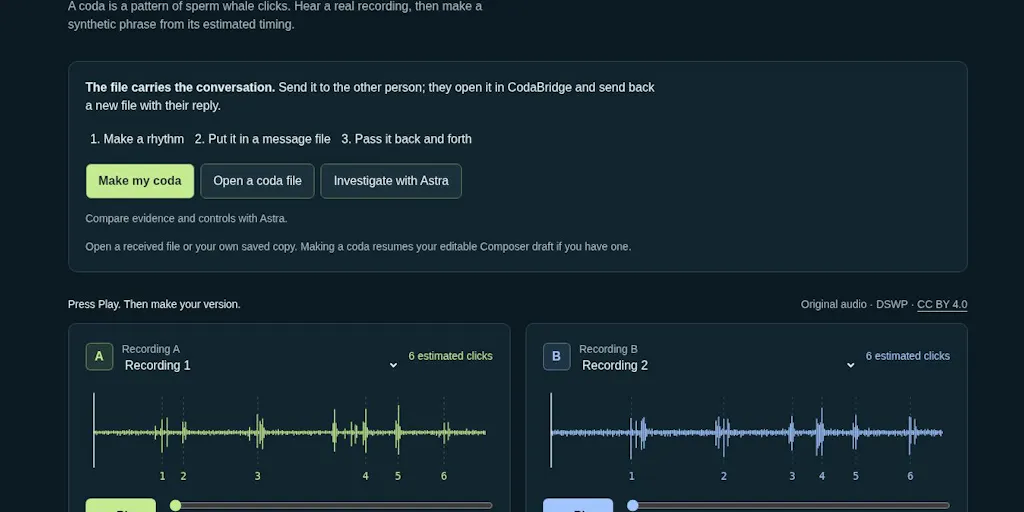
The maker’s own framing is that he wanted to explore scientific data “without letting the explanation outrun the evidence.” That sentence is the entire product. CodaBridge starts with real sperm whale recordings — you listen to them, shape a synthetic coda, compare timing patterns, then move into a “Context Lab” where you inspect annotated exchanges, controls, and prediction results. The AI can investigate those measurements through the tool’s evidence layer, but the source data, the measurements, the alternative explanations, and the uncertainty all stay visible and separated from the generated interpretation.
Read that again as a seller. You have a supplier dispute over a batch of units that arrived with a 4% defect rate. You have a marketplace performance notification citing a policy you’ve never read. You have a TikTok Shop ad account that got flagged for a creative you didn’t personally approve. In each case, the expensive failure isn’t that the AI gave a wrong answer — it’s that nobody can reconstruct why the answer was given when a human at Amazon, a chargeback processor, or a customs broker asks. CodaBridge’s design choice — keep evidence, measurement, interpretation, and uncertainty as separate visible layers — is a direct answer to that.
The maker is explicit that this is “not a whale translator.” Good. Because the value isn’t in the domain, it’s in the discipline of refusing to collapse the chain.
Why Amazon sellers should care more than Shopify ones
Shopify merchants live in a world where the worst outcome of a bad AI-generated product description is a low conversion rate. Amazon sellers live in a world where Amazon Seller Central can suspend a listing for a compliance claim, and the appeals process requires you to produce a documented root cause. If your listing copy, your A+ content, your backend search terms, and your ad copy were all generated by a model that can’t show its work, you have no root cause to produce. You have a vibe.
Same logic applies to TikTok Shop and Temu, where platform-side enforcement is fast and often opaque. The seller who can say “here is the source claim, here is the measurement, here is the interpretation, here is the uncertainty band” wins the appeal. The seller who says “the AI wrote it” does not.
How this differs from the AI tooling you’re already paying for
Most of the AI products sold into e-commerce right now are confidence-maximizers. Helium 10’s AI features, Jasper, and the long tail of listing-optimization copilots are built to produce an output that sounds finished. That’s the right design for a first draft. It’s the wrong design for anything that touches compliance, supplier disputes, or financial reconciliation.
Klaviyo’s predictive analytics, for comparison, at least shows you the segments and the inputs behind a predicted lifetime value — but even there, the “why” is a feature, not the spine of the product. CodaBridge inverts that: the “why” is the product, and the generated interpretation is the feature.
The closest analogue in the seller stack isn’t a marketing tool at all — it’s the audit trail you get from a proper accounting integration like A2X or a reconciliation layer like Synder. Those tools exist because marketplaces and payment processors will eventually ask you to prove a number. CodaBridge is applying that same instinct to AI reasoning itself.
Where the math breaks
Here’s my honest read on the economics. CodaBridge is a research-flavored product built for a scientific use case, and the compute cost of running an Astra-class reasoning model over every measurement, control, and alternative interpretation is not trivial. For a whale researcher publishing one paper a year, that’s fine. For a seller processing 400 supplier emails a week, the per-investigation cost has to fall by an order of magnitude before this architecture becomes default. The maker doesn’t disclose pricing, and I’d want to see that before recommending anyone rebuild their ops stack around it.
The second math problem: provenance is only valuable if the downstream system accepts it. Amazon’s appeals team doesn’t have a field for “AI uncertainty band.” Neither does a chargeback representment form. So the operator who adopts this pattern has to do the last mile themselves — export the evidence chain into a PDF or a structured doc that a human reviewer will actually read. That’s unglamorous work, and it’s where most provenance projects die.
What cross-border sellers can borrow from this
You don’t need to buy CodaBridge to steal its design principles. You need to change how you prompt and how you store outputs.
Separate the layers in every AI workflow. When you ask a model to summarize a supplier email thread, force it to output three distinct blocks: raw quotes from the thread, your interpretation, and a confidence level with named uncertainties. If your prompt template doesn’t have those three slots, you’re generating un-auditable content.
Keep the source artifact. Every AI output that touches money, compliance, or a customer-facing claim should be stored next to the input that produced it. In practice this means a shared drive or a lightweight database where the email, the PDF, the screenshot, or the CSV lives alongside the generated text — not just the text.
Name your controls. CodaBridge’s Context Lab compares observed pairings against controls. In seller terms, that’s an A/B test with a documented null hypothesis, or a supplier dispute where you have a control batch. Most sellers run “tests” without ever writing down what the baseline was, which makes the result unfalsifiable.
A sidebar on tooling choices
If you’re running any of this at scale, the storage and retrieval layer matters more than the model. A Notion database with a structured schema will beat a folder of Google Docs, and a proper vector store behind something like Pinecone will beat both once you’re past a few thousand documents. The point isn’t the tool — it’s that provenance requires a place for provenance to live.
Where my judgment says it falls short
Three things.
First, the demo domain is a liability for the seller audience. Sperm whale codas are fascinating and the maker clearly cares, but a cross-border operator skimming Product Hunt will bounce off “whale translator” framing before they get to the architecture. The maker explicitly says it’s not a whale translator — but the first thirty seconds of the pitch still read as one. If the team wants seller adoption, they need a seller-shaped demo: a supplier dispute, a compliance flag, a returns cluster.
Second, “Astra can investigate those measurements” is doing a lot of load-bearing work in the description without much specificity. I don’t know from the source how the model decides which evidence to cite, whether it can be wrong about provenance, or what happens when the source data itself is corrupted. Those are the questions a serious operator asks before trusting the layer. Not disclosed.
Third, the product is built around a contest — the GPT-6 Astra Challenge — which means the roadmap is partly shaped by a competition brief rather than by seller demand. That’s not fatal, but it’s a signal that the near-term feature set may optimize for demo-ability over operational robustness.
The incumbents won’t stay still
Shopify’s Sidekick and Amazon’s own seller-facing AI features are both moving toward “explain the recommendation” as a UX pattern, mostly because platform trust requires it. When those ship natively, the standalone provenance layer becomes a feature, not a product. CodaBridge’s window is the period before that happens — and the way to use that window is to own a specific vertical’s compliance workflow, not to stay general.
What I’d watch / test next
This week, pick one AI-assisted workflow in your stack that touches money or compliance — supplier email triage is the easiest starting point — and rewrite your prompt to force three outputs: verbatim source quotes, your interpretation, and a named uncertainty. Store the source artifact next to the output in a structured database, not a folder. Then run the same prompt against a second model and diff the interpretations. If the two models disagree on the interpretation but agree on the source quotes, you’ve just proven the architecture is doing real work. If they disagree on the source quotes, you have a data pipeline problem that no model upgrade will fix.
Watch whether CodaBridge publishes pricing and a seller-shaped case study in the next quarter. If they do, it’s worth a serious trial. If they stay in research framing, steal the pattern and move on. The provenance discipline is the takeaway — the product is optional.