Why an AI “Software Delivery” Platform Matters More to a Seller Than to a CTO
If you run a serious cross-border operation, your entire P&L is a race against entropy. You’re fighting listing suppression on Amazon, ad fatigue on Meta, chargeback fraud on Shopify, and the slow death-by-a-thousand-cuts of marketplace rule changes. The last thing you want to think about is whether your in-house dev team is shipping the new landing page fast enough. But here’s the uncomfortable truth: the bottleneck in your business is no longer capital or demand—it’s the speed at which your technology can adapt to the chaos. Every day you wait for a custom integration, a revised pricing algorithm, or an automated repricing rule is a day your margin gets arbitraged away by a competitor running a leaner stack.
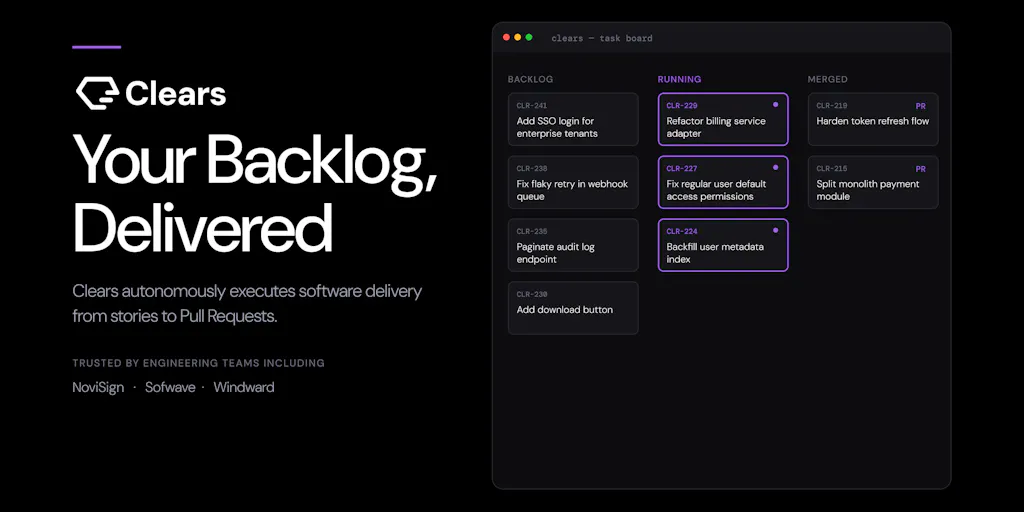
This is why I’m paying close attention to Clears, an agentic execution platform that launched on Product Hunt. It’s not another code generator. It’s not a chatbot that writes Python snippets. It’s an attempt to automate the entire software delivery lifecycle—the coordination, the context-gathering, the validation, the deployment—that normally eats 80% of your engineering time. For a DTC operator or a marketplace seller who has been burned by slow agencies or overwhelmed in-house teams, this isn’t a tech novelty. It’s a potential unlock for turning your backlog of “nice-to-have” automations into a parallel processing engine. Let’s dig into what Clears.ai actually does, who it’s really for, and whether you should care.
The Problem: We’ve Automated the Typing, Not the Thinking
The pitch from Tzahi Mor, co-founder and CEO, is refreshingly honest. He spent over a decade leading R&D teams and observed that developers using tools like Claude Code and Cursor were writing code faster, but organizations weren’t shipping faster. The bottleneck shifted from coding to execution. This resonates deeply if you’ve ever managed a remote team or outsourced development. The hard part of any project isn’t the syntax; it’s the context. It’s the tribal knowledge of why a certain API endpoint exists, what the edge cases are, and which stakeholder needs to sign off before you touch the payment gateway.
Clears tries to solve this by creating a “context layer” that indexes your repositories, Confluence pages, Notion docs, and even previous AI sessions and CI results. When an agent picks up a ticket, it doesn’t just read the description and start hallucinating code. It pulls relevant context from your entire organizational memory. This is a massive departure from the standard “AI pair programmer” model. Tools like GitHub Copilot are reactive—they help you write a function when you ask. Clears is proactive—it tries to understand the intent behind a ticket before a single line of code is written.
For a cross-border seller, this directly maps to your operational tooling. Imagine your backlog of requests for your tech team: “Update the shipping logic to handle Brexit VAT,” “Add a TikTok Shop pixel to the checkout confirmation,” “Fix the currency conversion glitch on the multi-currency page.” In a traditional setup, each of these requires a developer to context-switch, hunt through old Slack threads, and figure out which part of the codebase handles tax. Clears aims to automate that research phase, giving the agent a “reliable score” for risk and complexity before it even starts. It’s the difference between hiring a junior dev who guesses and a senior architect who asks the right questions first.
How It Differs From the Incumbents (And Why That Matters)
When you look at the current landscape of AI dev tools, you see a clear divide. On one side, you have the code generators like Cursor and GitHub Copilot. They live inside your IDE and are brilliant at autocomplete. On the other side, you have workflow automation platforms like Tines (ironically, promoted on this very Product Hunt page) which are excellent at connecting apps but not designed to write code or manage a software project’s lifecycle. Clears is trying to sit in the middle—and that’s a very crowded, very messy intersection.
The key differentiator here is the “risk/confidence scoring before autonomous execution.” A commenter on the launch page, Raj Nagulapalle, asked the exact right question: is the scoring static from the ticket description, or does the AI actually inspect the codebase to calibrate complexity? The answer from Daniel Nakash (Maker) reveals the core architecture: the context layer indexes data from previous runs, code reviews, and CI results. This means the scoring isn’t just a guess based on keywords. It’s a judgment call informed by your team’s historical velocity and the actual complexity of the code paths involved.
This is where I see the comparison to incumbents like Jira or Linear. Those tools are glorified to-do lists. They track tickets but don’t execute them. Clears is essentially trying to turn your project management tool into an autonomous workforce. It syncs two-way with your existing tools—so you don’t have to leave Jira—but it promises to actually close the tickets. This is a bold claim. Most SaaS tools that promise “AI automation” are just fancy macros. Clears is attempting to be a virtual engineering team member that never sleeps, never loses context, and can work on every ticket in your backlog simultaneously.
Why Amazon Sellers Should Care More Than Shopify Ones
Let’s get specific about the cross-border angle. If you run a Shopify store, your tech stack is likely simple. You have a theme, a few apps like Klaviyo for email, and maybe a subscription app. The backend logic is handled by Shopify. You don’t need heavy custom software. But if you’re an Amazon FBA seller or a multi-channel operator dealing with Amazon Seller Central and eBay, your world is different. You’re dealing with inventory sync across warehouses, repricing algorithms that react to competitors in real-time, and complex reconciliation between marketplace payouts and your accounting software.
These are not “website” problems. They are data pipeline and logic problems. They require custom scripts, API integrations, and constant maintenance. Every time Amazon changes a fee structure or eBay updates its API, your custom tooling breaks. This is the exact use case where an agentic platform like Clears shines. It’s not about building a pretty front-end; it’s about managing the messy, volatile backend logic that keeps your margins alive. A Shopify merchant might get away with no-code tools, but a serious Amazon seller needs a dev team—or an AI that can act like one.
What Cross-Border Sellers Can Borrow From This (Even If You Never Buy It)
You might be thinking, “I’m not a software company, why should I care about an AI for software delivery?” That’s a fair pushback. But the philosophy behind Clears is directly transferable to how you manage your own operations, even if you never connect it to your GitHub repo.
The first lesson is context over raw intelligence. The Clears team emphasizes that feeding the entire codebase to the AI is wasteful and counterproductive. They built a context layer to retrieve only what’s relevant. In e-commerce, we suffer from the same information overload. Your customer service team has thousands of chat logs. Your ad account has millions of data points. Your inventory reports are massive. The winners in this game aren’t the ones with the most data; they’re the ones who can retrieve the right data at the right time. When you set up your next analytics dashboard or your AI customer support bot, ask yourself: is this tooling smart about what context it pulls, or is it just dumping everything into a token window?
The second lesson is delegation with scoring. Clears scores tickets for risk and confidence before executing. This is a brilliant management framework. How often do we just “ship” a new ad creative or a new listing without scoring the risk? If you’re running a TikTok Shop, you know that a slight change in your product description can trigger a compliance flag. What if you had a system that scored the risk of every change before you hit publish? You don’t need Clears for that—you just need to adopt the mindset. Build a checklist that scores the risk of a listing change based on historical rejections, and you’ve built your own “confidence score.”
Where the Math Breaks: The Cost of Autonomy
Let’s get to the part where I play skeptic. The launch page is full of enthusiastic comments, but I see a few cracks in the foundation. First, the pricing is “not disclosed” on the page, which usually means it’s expensive. More importantly, the economics of running an agentic platform that indexes your entire Confluence, repository, and CI pipeline are concerning. Token consumption is mentioned as a challenge they’re solving, but the cost of running multiple “live agent sessions” for every ticket in your backlog will add up fast. For a small team, this could easily cost more than hiring a mid-level developer.
Second, the “validation” step is the hardest part of software delivery. The founder mentions that the AI can handle validation, but in my experience, automated validation is great for catching syntax errors and terrible for catching logic flaws. An AI might write code that passes unit tests but fails to account for a specific edge case in your shipping logic for a particular country. The risk isn’t that the code doesn’t compile; it’s that it compiles and does the wrong thing, costing you money in returns and lost customer trust. The “risk scoring” helps, but it cannot replace the judgment of a senior human who understands the business context behind the code.
Finally, there’s the integration paradox. They claim a “two-way sync” with existing tools and a 30-minute setup. That sounds great for a simple linear workflow. But the moment you have a complex monorepo with multiple services, or a legacy system that nobody understands, the context layer will be incomplete. Garbage in, garbage out. If your documentation is sparse (which it is, for most fast-moving e-commerce teams), the AI’s “context” will be thin, and its confidence scores will be unreliable. You’ll spend more time correcting the AI than you would have just coding the feature yourself.
The “Harness” is the Real Product
The most insightful comment on the thread comes from Larry Kim, who notes that the focus on the whole software delivery process—not just code generation—is the harder problem. The founder’s response hits the nail on the head: “Code generation is becoming the easy part. The harder problem is everything around it - context, coordination of human/agents, validation, and getting work all the way from requirement to production. That’s the layer we’re focused on.”
This is the “Harness” concept. It’s the idea that the value isn’t in the AI model itself, but in the process that controls it. For cross-border operators, this is a massive insight. You can have the best AI copywriter, the best AI image generator, and the best AI repricer. But if they aren’t coordinated—if your repricer doesn’t know about your new ad campaign, or your copywriter doesn’t know about the new product spec—you’re leaving money on the table. The future of e-commerce tooling isn’t about buying more point solutions. It’s about building a “harness” that coordinates your AI agents, your human staff, and your data.
This is where I see the potential for a tool like Clears to eventually pivot. Right now, it’s focused on software delivery. But the underlying architecture—a context layer, a risk scoring engine, and parallel execution—is exactly what a sophisticated DTC operator needs for their operations. Imagine a system that manages your entire marketplace presence with the same autonomy. It pulls context from your product data, your ad spend, and your customer reviews. It scores the risk of a price drop on Amazon based on your inventory levels. It executes the change and validates the impact on your Buy Box win rate. That’s the future. Clears is just the first visible iteration of that architecture.
What I’d Watch / Test Next
If you’re intrigued by this, don’t rush to sign up for a software delivery platform if you’re not a software company. Instead, test the concepts this week.
First, audit your context layer. Pick your most critical operational workflow—say, your inventory sync between Shopify and your 3PL. Write down where the “context” lives. Is it in a Google Doc? In your 3PL’s API docs? In your head? If the answer is “in my head,” you have a problem. Start documenting it. The AI revolution in e-commerce will only be as good as your documentation.
Second, build a risk-scoring rubric for your operations. Before you make any major change—a price increase, a listing tweak, a new ad creative—score it 1-5 on complexity and 1-5 on risk. If it’s high risk and high complexity, force a human review. If it’s low risk and low complexity, automate it. This isn’t about buying software; it’s about installing a discipline that makes AI automation possible later.
Third, watch the Clears integration roadmap. If they ever announce integrations with e-commerce platforms or data warehouses like BigQuery or Snowflake, that’s the signal to take a serious look. For now, treat it as a proof-of-concept for what your future ops stack might look like. The tools that win in the next five years won’t be the ones that write the best code or the best ads. They’ll be the ones that figure out how to coordinate all the messy, human, context-heavy work that happens around the creation. Clears is betting on that future, and despite the rough edges, I think they’re betting on the right horse.