The permission prompt is the real bottleneck in your AI stack
If you run a cross-border store, you already know the drill: you duct-tape together Shopify, Amazon Seller Central, a Helium 10 tab, a Klaviyo flow, and a TikTok Shop dashboard, then you start bolting AI agents on top to automate the boring parts. The boring parts are exactly where agents stall. Not on hard reasoning — on consent. You kick off a coding or ops task, walk away to chase a supplier or clear a Temu dispute, and come back to find the agent spent twenty minutes waiting on one permission prompt. That dead time is the tax nobody budgets for. Clair, built by Jeffrey Walter Mixon, is a direct attack on that tax.
What Clair actually solves
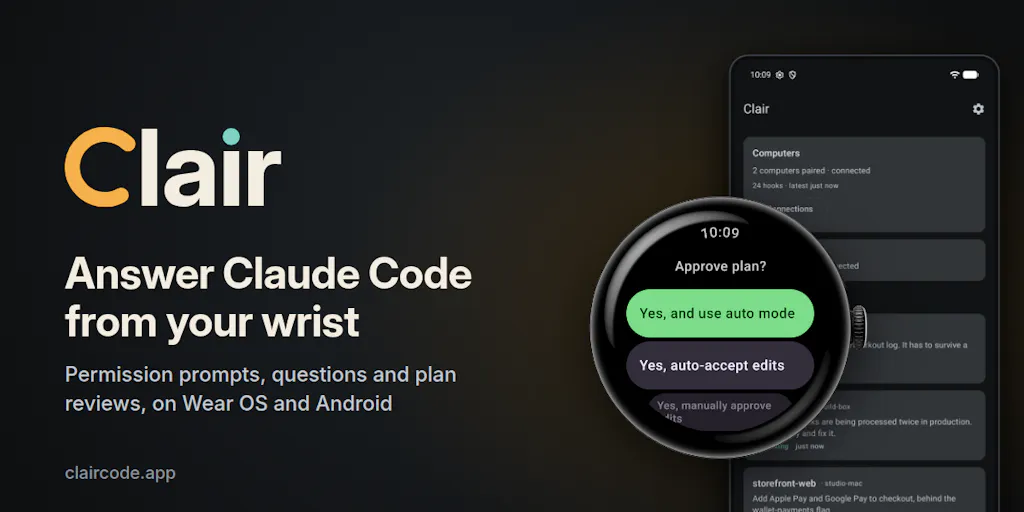
Clair is an Android and Wear OS companion app for Claude Code, the terminal-based coding agent from Anthropic. The maker’s own framing is the clearest explanation: he kept starting a Claude Code task, walking off, and returning to find it had spent the whole time waiting on a single permission prompt. Clair pushes those prompts to your Wear OS watch and Android phone so you can answer them from wherever you are.
What you can answer from your wrist, per the launch page:
- Permission prompts, with the exact command or edit shown in front of you. You can allow it once, for the session, or by the rule Claude Code suggests (something like “every
go testrun”), so it stops asking. Denials accept a typed or dictated reason, and Claude reads it. - Questions. Options arrive with their descriptions, or you dictate your own answer.
- Plan reviews. Approve the way the terminal would, or send the plan back with notes.
The terminal still works in parallel. Whichever answer arrives first settles the prompt, so you can approve one command from the couch and the next one at your desk. You don’t need a watch either — every prompt also reaches your phone, with Allow and Deny right in the notification.
Under the hood, a small agent on your computer (macOS, Linux, or Windows) connects through Claude Code’s hooks. It seals each prompt before it leaves your machine, and only your phone holds the key, so the relay in between can’t read a command or forge an answer. The relay does see some metadata to deliver messages — timing, size, IP addresses — and the listing spells out exactly what. Clair never asks for your Claude login, and it’s an independent app, not affiliated with Anthropic.
There’s a demo path that requires nothing installed on your computer: open Clair on your phone or watch and tap Try the demo. Three sessions on two machines will ask you things, and you answer them like the real thing. Pricing is US$24.99 a year after a 14-day free trial, and the trial doesn’t start until your first computer is paired. Without a subscription you can still follow along: sessions, the tile, the complication, and notifications keep working. On Wear OS 6 or later there’s also a watch face whose dials track your five-hour and weekly Claude usage.
The constraint is platform: Clair is Android and Wear OS only. The maker explicitly asks iPhone and Apple Watch users to say so in the comments if they’d use it — that’s the question he most wants answered.
Why this matters more to operators than to pure developers
The obvious audience for Clair is a developer babysitting a long refactor. But the more interesting audience is the cross-border operator who has started using coding agents for non-code work — bulk-editing product feeds, scripting CSV transforms for Amazon FBA inventory reconciliation, generating ad-copy variants, or scraping supplier pages for price comparisons. These tasks are exactly the kind that stall on permission prompts, because they involve lots of small, individually low-risk actions. A developer might tolerate one interruption per hour. An operator juggling a warehouse cut-off, a SHEIN listing refresh, and a customer-service queue tolerates zero.
The watch form factor is the actual product insight here. Not because watches are cool, but because the interruption cost of pulling out a laptop, VPNing into a remote machine, and finding the right terminal window is high enough that people just don’t do it. A notification you can resolve in four seconds on your wrist changes the math on whether an agent is worth running at all.
How it differs from the existing options
The incumbent alternatives fall into three buckets, and none of them do quite what Clair does.
Bucket one: the agent’s own built-in approval modes. Claude Code ships with permission configuration — allowlists, rule-based approvals, and modes that reduce prompting. This is the right long-term answer for repetitive tasks, and Clair even leans on it: the “allow by the rule Claude Code suggests” option is essentially the app helping you bootstrap your own allowlist from your wrist. But allowlists are a blunt instrument. If you allow every go test run, you’ve also allowed the one that runs against your production database because someone fat-fingered an environment variable. There’s a real security argument for keeping a human in the loop on anything that touches credentials, payment APIs, or inventory writes — and that argument is only compatible with automation if the human can respond fast. Clair is the “respond fast” layer.
Bucket two: remote terminal and notification tooling. The general-purpose answer is to run your agent inside tmux on a remote box and SSH in from your phone, or wire up something like ntfy or Pushover to ping you. I’ve done the tmux-on-a-phone thing. It’s miserable: tiny terminal, no structured prompt rendering, and every approval requires you to read raw output and type a response. Clair’s advantage is that it renders the prompt as structured UI — the command, the edit, the options with descriptions — rather than as a wall of text. That’s the difference between a tool you use and a tool you abandon after a week.
Bucket three: full cloud agent platforms. Products like Devin or the various cloud-hosted coding agents sidestep the problem by running the agent somewhere you’re not, with their own approval model. That works, but it means your code, your credentials, and your customer data live on someone else’s infrastructure. Clair’s architecture is deliberately the opposite: the agent runs on your machine, prompts are sealed locally, and only your phone holds the decryption key, so the relay can’t read a command or forge an answer. For a seller handling PII from Shopify orders or payment data from Stripe, that local-first posture is not a nice-to-have. It’s the difference between a tool your compliance person approves and one they kill.
Where the math breaks
US$24.99 a year is roughly the cost of two cups of coffee, which makes the ROI calculation almost embarrassingly lopsided — if you actually use it. The 14-day trial doesn’t start until your first computer is paired, which is a genuinely fair design choice: you can install the app, poke at the demo, and think about it for a month without burning your trial window. But the free tier is also generous enough that some users will never convert. Sessions, the tile, the complication, and notifications keep working without a subscription. If you’re the kind of operator who only needs to see that a prompt is waiting and then walks to your desk to answer it, you may never hit the paywall. That’s a real monetization risk for the maker, and an unusually good deal for the user.
The bigger math problem is hardware. Clair requires an Android phone, and the wrist experience requires a Wear OS watch. If you’re on iPhone — which, in my experience, is the majority of DTC founders and Amazon brand owners I talk to — you’re locked out entirely. The maker knows this; it’s the one question he’s actively soliciting feedback on. Until there’s an iOS and watchOS version, Clair is a tool for a minority of the addressable market, however enthusiastic that minority might be.
What cross-border sellers can borrow from this
Even if you never install Clair, there are three transferable lessons for anyone running agents across a cross-border operation.
Lesson one: treat human approval latency as a first-class metric. Most operators measure agent throughput — tasks completed, tokens burned, hours saved. Almost nobody measures the median time a task spends blocked on a human decision. In my experience that blocked time is often the dominant cost, especially for tasks that run overnight across time zones. If you’re running agents in a US-timezone window while you sleep in Shenzhen, every permission prompt is an eight-hour stall. Clair’s whole thesis is that shrinking that stall is worth more than making the agent smarter. I think that’s correct, and it applies to any approval-gated workflow — not just coding. Think about your Zapier or Make automations that pause for human review, your ad-spend approvals in Google Ads, your refund escalations in Gorgias. Where does work sit waiting for a human? That’s your real bottleneck.
Lesson two: local-first beats cloud-first when you’re handling customer data. The sealed-prompt architecture — agent on your machine, key on your phone, relay sees only metadata — is a pattern worth demanding from every AI tool in your stack. If a vendor can read your prompts, they can read your customer names, your supplier terms, your margin data. The fact that Clair’s relay sees timing, size, and IP addresses but not content is the kind of specificity I want to see in a privacy claim. Vague “we take security seriously” language from a SaaS vendor is not equivalent.
Lesson three: the notification layer is underrated product surface. The watch face that tracks five-hour and weekly Claude usage on Wear OS 6 is, on its face, a gimmick. But it’s actually a smart move: it turns a passive device into an ambient dashboard for a resource you’re paying for. Cross-border operators live on rate limits — API quotas, ad-spend caps, inventory thresholds, marketplace request limits. An ambient display of “how much of my budget have I burned” is a genuinely useful pattern, and I’d like to see more tooling adopt it.
Why Amazon sellers should care more than Shopify ones
Shopify operators tend to work in a browser, with apps that have their own UIs and their own approval flows. The work is visual and interactive. Amazon sellers, by contrast, live in a world of bulk flat files, Amazon SP-API calls, repricing rules, and reconciliation spreadsheets — exactly the kind of work that’s amenable to a terminal-based agent. If you’re scripting SP-API pulls to reconcile FBA inventory or bulk-editing listings across a hundred ASINs, you’re already in the target use case for Claude Code, and therefore already in the target use case for Clair. The Shopify crowd can wait for a web-native equivalent. The Amazon crowd is closer to the pain today.
Where my judgment says it falls short
The iOS gap is disqualifying for most of the market. I’ll say it plainly: shipping Android and Wear OS only in 2025 is a strategic choice that caps the addressable audience hard. The maker is upfront about it and is actively asking for iPhone demand signals, which is the right move, but until that ships, the majority of the operators I know can’t use this at all. If you’re on iPhone, don’t install anything — just go comment on the launch page that you want it, because that’s the signal that will move the roadmap.
It’s a single-agent tool in a multi-agent world. Clair is built specifically around Claude Code’s hooks. That’s a smart wedge — Claude Code has real adoption, and hooks give you a clean integration point. But operators are increasingly running multiple agents: Claude Code for one thing, Cursor for another, GitHub Copilot in the editor, plus whatever’s in their automation stack. A tool that only covers one agent is a partial solution. I’d want to know whether the architecture generalizes to any agent that can emit a webhook, or whether it’s tightly coupled to Claude Code’s specific hook model.
The security model deserves more scrutiny than a launch page can give it. The claim is specific and good: prompts are sealed before leaving the machine, only your phone holds the key, the relay can’t read or forge. But “sealed” and “only your phone holds the key” are the kind of claims that need a threat model, not a paragraph. What happens if your phone is lost or stolen? Is there a recovery path, and does it weaken the guarantee? What’s the key exchange protocol when you pair a second machine? Can the desktop agent be tricked into sealing a malicious prompt that looks legitimate on your wrist? These aren’t gotchas — they’re the questions any operator handling payment or PII data should ask before trusting a new relay in their stack. The launch page doesn’t answer them, and I’d want answers before I let this near production credentials.
The free tier may be too generous for the product’s own good. As noted above, sessions, the tile, the complication, and notifications all keep working without a subscription. I understand the reasoning — it’s a trust-building move for a tool that touches your terminal — but it’s hard to see how this converts casual users. The paid features are the answering capability, which is the whole point, so the free tier is really a monitoring tier. That’s a defensible freemium split, but it puts a lot of pressure on users needing to answer prompts away from their desk specifically. If you’re mostly at your desk, you’ll never pay.
What I’d watch / test next
Two concrete things this week. First, if you’re on Android and already running Claude Code for ops work, install Clair and tap through the demo before pairing anything — the demo needs nothing installed on your computer, so it’s a zero-risk way to evaluate whether the wrist interaction actually fits how you work. Then pair one machine and run a genuinely long task — a bulk feed transform or an SP-API reconciliation script — and measure how much less time it spends blocked. That number is the only thing that matters.
Second, regardless of whether you adopt Clair, go audit your own approval latency. Pick your three most-used automations and instrument how long tasks sit waiting for a human. I’d bet money the answer surprises you, and it’ll tell you whether you need a tool like this or just better allowlisting. If you’re on iPhone, the useful action is to tell the maker you want it — that’s the signal that determines whether an iOS build ever happens. And if you’re evaluating any AI tool that touches customer data, use Clair’s privacy specificity as your benchmark: if a vendor can’t tell you exactly what their relay sees, assume it sees everything.