The B2G Blind Spot Every Cross-Border Seller Eventually Hits
Most cross-border operators I know spend their intelligence budget on the same three surfaces: Amazon rank, TikTok Shop velocity, and whatever Meta’s CPM is doing this quarter. Meanwhile, a parallel demand channel — government procurement — sits in plain sight, worth trillions annually, and almost nobody in the DTC/FBA world touches it because the on-ramp looks like a 2009-era portal and a stack of apostilled paperwork. That is exactly the gap Sell to State is trying to wedge open. Built by Vlad Nadymov, it is a flat-priced search layer over government tenders, awards, suppliers, and buying agencies across 63 markets — pitched as “one query hits the tender, the firm that won it, and the agency that paid.” For a seller already shipping into three continents, that framing deserves more than a polite scroll-past. Here is why I think it matters, where it fits against your existing stack, and where I’d bet against it.
The problem is not data — it’s the login tax
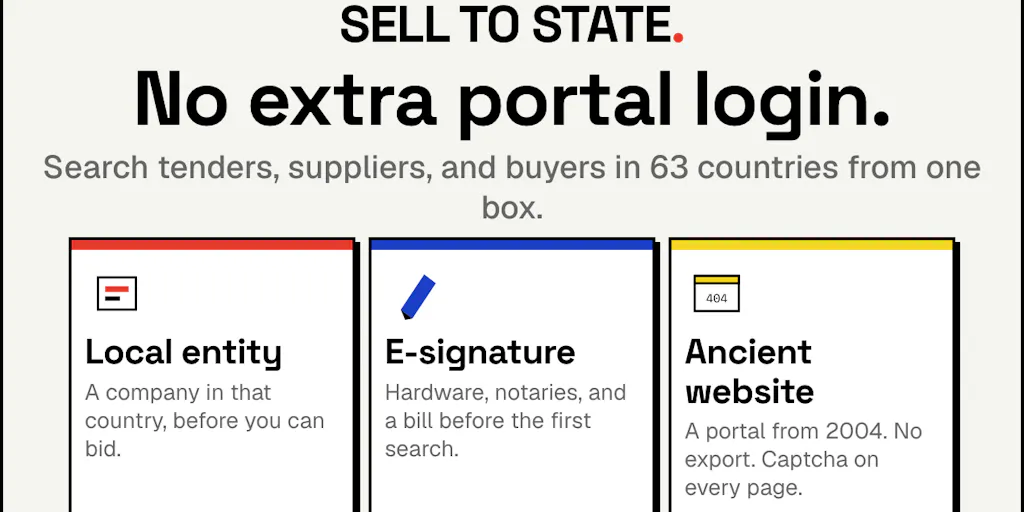
Vlad’s own launch copy is refreshingly blunt about the pain: “If you want to sell to a government that is not yours, the work is ugly. You make a local entity. You buy an e-signature. You learn a portal that last shipped a UI in 2009. A month later you still do not know if there is a contract worth the trip.” That month-long ambiguity is the real tax. Sellers will tolerate paperwork once they know the prize is real. What kills B2G experiments inside small teams is spending four figures on entity formation in Singapore or a notarized power of attorney in the EU before confirming that anyone in that market actually buys your category.
The product’s answer is unglamorous but correct: collapse the discovery step into a single searchable corpus — “2.95 million tenders, 3.02 million award rows, 986 thousand suppliers, 99 thousand buying agencies,” per the maker’s own numbers. That is a pre-qualification tool, not a procurement agent, and Vlad says so explicitly: “It is a search product. It is not an AI procurement agent.” I respect that honesty more than I respect most launch copy. Too many 2024–2025 tools dress up a database as an autonomous closer.
Why this is a bigger deal for Amazon sellers than Shopify ones
Here’s the counterintuitive part. You would assume DTC Shopify brands are the natural buyers — they own their margin, they can pivot SKUs, they don’t need category approval. Wrong. The operators who will get the most out of a tool like this are Amazon FBA brand owners and marketplace sellers already fluent in Amazon Seller Central B2B features, because they already understand bulk-quantity ordering, tiered pricing, and invoice-based fulfillment. A Shopify store optimized for single-unit DTC checkout has to rebuild its entire back office to serve a health ministry that wants 40,000 units on a 90-day net payment term. An FBA seller with a working wholesale arm is maybe two spreadsheets away from being able to quote.
The second reason Amazon sellers should care more: government buyers frequently specify compliance, certification, and origin requirements that map cleanly onto the documentation discipline FBA sellers already maintain for restricted categories. The Shopify operator who has never filed a certificate of origin is going to learn a lot of new vocabulary. The Amazon seller who has already fought through category ungating is halfway there.
How it differs from the tools you already pay for
The obvious comparison set is a mess of legacy and semi-modern players. On the legacy side you have national portals themselves — TED for EU tenders, SAM.gov for US federal, GeBIZ for Singapore, and dozens of country-specific equivalents. These are free and authoritative, but each one is its own island with its own taxonomy, its own authentication, and its own idea of what a “search” is. The whole value proposition of aggregators is that you stop maintaining 63 bookmarks and 63 logins.
Against existing aggregators — Tenders.guru, TenderNed for the Dutch market, BidStats for US state and local, and the enterprise tier of GovWin IQ from Deltek — Sell to State is positioned as the cheap, flat, API-friendly layer. GovWin IQ is the incumbent for serious capture teams, and it prices and packages accordingly; it is a sales-ops platform, not a $49/month search box. That price gap is the entire wedge.
What I find more interesting is the MCP angle. Vlad’s answer to a user asking for cross-country comparison dashboards was telling: “we don’t have a built-in dashboard for this, but I think any AI agent can do those calculations… you plug in Sell to State’s MCP, get raw data (e.g. all solar panel tenders per country) and ask your Claude/Codex/Grok/Qwen/whatever else you use to crunch the numbers.” That is the correct 2025 posture. Ship the corpus, ship the pipe, let the operator’s LLM of choice do the slicing. Compare that to the dashboard-first mindset of Klenty or Helium 10 — great products, but built around the assumption that the vendor decides which views matter. The MCP approach inverts that, and for a long-tail use case like “solar panel tenders per country,” it is the only economically sane design.
Where the math breaks
Two numbers in the source deserve scrutiny. The first is “63 markets,” which Vlad himself immediately qualifies: “Coverage is uneven. Some countries are fat (Singapore is a good demo: search for ‘hospital’ is 123 rows with values). Some countries are thin. We are filling those next. I will not pretend every market is equally deep.” Good on him for saying it. But 123 rows for “hospital” in a wealthy, digitally mature market is a number I’d want to see contextualized against GeBIZ’s actual volume before I’d trust the corpus as a sourcing pipeline. If Singapore — the demo market — returns 123 rows on a broad term, the long tail in thinner markets is going to be thin indeed.
The second number is the price: “US$49/month or US$499/year. For this launch week the annual plan is US$349 with code PRODUCTHUNT.” At $349/year, the tool pays for itself if it saves you a single wasted entity-formation exercise. That is a genuinely low bar, and it is the right bar. Where the math breaks is if you treat it as a lead-gen engine. It is not. It is a qualification engine. The moment you start expecting it to fill a pipeline, you will be disappointed, and you will blame the tool for a job it never claimed to do.
What cross-border sellers can borrow from this launch
Even if you never bid on a government contract, there are three transferable lessons in how this product is framed.
Lesson one: sell the pre-commitment step, not the outcome. Vlad is not promising you’ll win a tender. He is promising you’ll know whether one exists worth chasing. That is a much easier promise to keep, and it is the same discipline you should apply to your own funnel copy. “Find out if this category is viable in your market in 20 minutes” beats “10x your revenue” every time, because the former is falsifiable and the latter is astrology.
Lesson two: flat pricing as a positioning weapon. Against GovWin IQ’s enterprise seat model and the per-country subscription stacks of legacy aggregators, a single $49/month number is a statement. If you are a DTC operator competing against a category incumbent with a byzantine pricing page, consider whether a flat, published, no-sales-call price is itself a differentiator. It usually is.
Lesson three: the MCP-first integration posture. Ship the data, ship the pipe, let the customer’s agent do the work. If you are building any internal tooling this quarter — a repricing engine, a returns classifier, a review-mining pipeline — ask whether you should expose it as an MCP server rather than building yet another dashboard nobody opens. The answer is usually yes.
The renewal-cycle tactic worth stealing regardless
Buried in the comments is the single best operational idea on the entire launch page, courtesy of Konstantin Tikhaev: “real fix is tracking renewal cycles on historical awards, like multi-year LTA and Ministry of Health contracts… sales team gets positioned before formal tender notice is even published.” He then gets specific: “check awards.contractPeriod.endDate in standard schema. filter contracts expiring in 60 to 90 days, instant pipeline.”
That is a pre-tender outreach playbook, and it is not limited to government work. The same logic applies to any B2B channel where incumbents hold multi-year contracts — distributor agreements, retail shelf placements, SaaS renewals. If you can find the contract end date, you can show up 60 to 90 days before the RFP with a warm introduction instead of cold-pitching into a locked account. Vlad admits he “has not built anything for it yet,” which is either a roadmap gap or an opportunity depending on whether you want to build it yourself.
Where my judgment says it falls short
I’ll be direct about the three things that give me pause.
The corpus is only as good as its OCDS coverage. Vlad says he doesn’t “invent a new taxonomy, just allow to search using OCDS/TED/local codes.” That is the right call technically, but it means his coverage ceiling is set by how well each jurisdiction publishes to Open Contracting Data Standard or equivalent. Markets that publish clean OCDS will look fat. Markets that publish PDFs and scanned notices will look anemic no matter how much engineering he throws at them. The “we are filling those next” promise runs into the reality that some markets cannot be filled without manual data entry, which does not scale at $49/month.
No dashboard is a real gap, not just a philosophical choice. When Denis Prodan asked directly whether a comparison dashboard was planned, Vlad’s answer was “at the moment I don’t have it in my backlog. but I don’t see any blocker besides me not quite understanding the use case.” I think he is underestimating the use case. The MCP answer is elegant for power users running Claude or Codex locally. It is useless for the account manager at a 15-person seller who needs a one-page PDF to bring to a Monday meeting. There is a middle layer — canned comparisons, saved searches, shareable views — that would cost him little and unlock a much larger buyer segment. Skipping it is a bet that his customers are all technical. They are not.
Award data is backward-looking by nature. The most valuable signal in procurement is not who won last year — it is who is about to re-tender. Without the contract-end-date feature Konstantin proposed, the tool tells you where money already went, not where it is going. That is a fine first version, but it caps the product’s usefulness at market-mapping rather than pipeline generation.
The entity-formation problem is still yours
One thing the tool does not solve, and cannot solve, is the operational reality that most governments prefer to buy from locally registered entities. Vlad’s own launch copy names this: “You make a local entity. You buy an e-signature.” Sell to State lets you decide whether that investment is worth making. It does not make the investment cheaper. For a seller weighing whether to open a Singapore subsidiary, the tool is a $349 decision-support input against a five-figure commitment. That is a good ratio. But do not confuse it for a shortcut past the paperwork.
What I’d watch / test next
If you sell anything with a plausible government end-use — medical devices, office furniture, solar, IT hardware, PPE, industrial components — I would spend this week doing three things. First, grab the Sell to State annual plan at the launch price before the code expires, and run your top three product categories through one fat market (Singapore is the demo, so start there) and one thin market you actually care about. Second, before you buy anything else, ask Vlad directly whether the contract-end-date filter Konstantin described is on the roadmap — because that single feature is the difference between a market-map and a pipeline. Third, and this is the one most operators skip, take whatever you learn and run the same exercise manually against SAM.gov and TED to calibrate how much the aggregator is actually saving you. If the manual version takes you four hours and the tool takes you twenty minutes, you have your answer on renewal. If it takes you twenty minutes either way, you have learned something more valuable: that your category is not a B2G category, and you can stop wondering.