Why Your Doomscrolling Habit Is Actually a Product Research Problem
For the better part of the last decade, I’ve watched cross-border sellers drown in information. We maintain Slack channels, Telegram groups, YouTube playlists, and a desert of browser tabs labeled “read later.” We tell ourselves that staying current on Amazon policy changes, TikTok Shop algorithm shifts, and Temu pricing tactics is part of the job. And it is. But the way we actually consume that information—in fragmented, reactive bursts between spreadsheet refreshes—looks a lot like the doomscrolling we tell ourselves we’ve outgrown. The product that landed on Product Hunt this week, BrainFeed, isn’t built for sellers. It’s a consumer app that turns articles and videos into short, spaced-repetition flashcards you swipe through like a social feed. But the framing its makers use—*“scrolling isn’t the problem; what you scroll is”*—hits at something deeply relevant for anyone running an e-commerce operation. We don’t have an attention deficit. We have a fragmentation problem. And the tools we use to learn about our markets are the same broken interfaces that waste our time. BrainFeed doesn’t fix that for sellers—it wasn’t designed to—but it exposes a product gap that someone will fill. This essay is about what that gap looks like and what you can steal from the app’s design logic before the inevitable spin-offs arrive.
What Problem BrainFeed Actually Solves (And Why It’s Not Just Another Read-It-Later App)
BrainFeed’s origin story, as told by maker Arnav Lohiya, is familiar: he wanted to learn but kept ending up on YouTube Shorts. The content he meant to read sat in a “saved” folder, untouched. Co-founder Aasrith Mareddy notes that quitting social apps didn’t help—they just migrated to TikTok. Their insight is simple: the urge to scroll is a habit, not a content problem. So they built a feed designed to satisfy that habit while delivering actual learning.
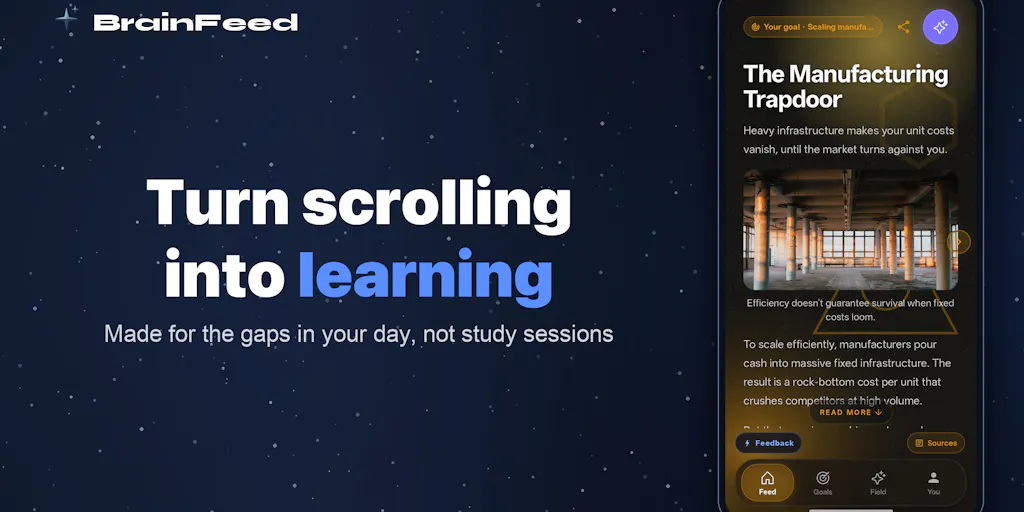
Here’s how it works in practice. You tell BrainFeed a goal (e.g., “understand futures and options”) or paste in a link—an article or YouTube video you’ve been avoiding. The app uses AI to break that material into short, swipeable “cards” that take seconds to consume. It then applies spaced repetition: you double-tap a card to enroll it in what the team calls a “star field,” and the app resurfaces it later for retention. Early users report that it turns a 30-minute video into manageable coffee-break chunks, with source links always visible to prevent the AI black-box feeling.
Compared to existing tools, the differentiation is sharp. Pocket and Readwise are archivers and highlighters—they assume you’ll sit down and read. Blinkist and Headway offer micro-book summaries, but they’re pre-curated; you can’t drop in your own unique content. BrainFeed lets you bring your own raw material and transforms it into the same low-friction format as Instagram or TikTok. That’s a meaningful UX breakthrough. The app currently lives on iOS, with an Android closed test running and a Play Store launch in two weeks. The free tier allows up to 15 active goals and 15 link shares—enough for a heavy learner to evaluate before hitting a paywall.
Why Amazon Sellers Should Care More Than Shopify Ones
Shopify sellers tend to live in a world of curated tooling—Oberlo, Spocket, Klaviyo—where decision-making is supported by dashboards and recommendations. Amazon sellers, by contrast, inhabit an ecosystem of constant, opaque change: algorithm updates, new fee structures, policy shifts that require immediate response. The typical Amazon operator I know has Seller Central open in one tab, Helium 10 in another, and three YouTube videos on PPC strategy queued up. That’s not learning; that’s triage. BrainFeed’s model—convert a policy announcement or a competitor analysis video into 10-second retention checks—is far more relevant to the Amazon seller’s reality than to a Shopify brand manager who can plan ahead with less volatility.
What Cross-Border Sellers Can Borrow From BrainFeed’s Design Logic
You don’t have to download the app (though you should) to extract patterns worth testing in your own workflow. Here are three concrete borrows.
1. Treat your saved content as a scrollable feed, not an archive.
Most of us maintain a “research” bookmark folder that grows faster than our reading speed. BrainFeed’s approach suggests an alternative: use an AI layer to pre-digest that content into bullet-point cards before you ever plan to read it. You could replicate this manually with a tool like Notion AI or Mem.ai: whenever you bookmark a competitor analysis article, instantly paste it into a database that summarizes it into “key takeaways per swipe.” Then schedule a 10-minute block each day where you only swipe that feed, not your Twitter timeline.
2. Apply spaced repetition to product research notes.
Spaced repetition is the backbone of BrainFeed’s retention system. Most sellers I know take detailed notes on product trends, supplier conversations, and price fluctuations—then never revisit them. A simple practice: after any significant research session, write 3–5 one-sentence insights and set calendar reminders to review them 1 day, 3 days, and 7 days later. Tools like RemNote or Anki can automate this, but even a recurring weekly note in Notion with a “review old entries” checkbox makes a difference. The goal is to move from passive collection to active retrieval.
3. Build a “learning goal” for each market you enter.
BrainFeed encourages users to create explicit goals like “I want to understand options trading.” Sellers typically approach new markets—say, selling on Etsy for the first time, or preparing for TikTok Shop expansion—with a shotgun of reading. Instead, define one concrete goal per market (“I want to know the top 5 policy changes affecting cross-border sellers on Etsy in 2025”) and feed only content that directly serves that goal. This narrows the signal-to-noise ratio drastically.
Where the Math Breaks: Three Gaps That Make BrainFeed Unsuitable for Sellers Out of the Box
BrainFeed is a consumer learning tool. I like the concept, but if you’re a seller hoping to install it and suddenly master cross-border logistics, you’ll run into hard limits.
1. No e-commerce-specific vertical curation.
The app’s content transformation is AI-driven, but the AI doesn’t understand the nuance of Amazon FBA inbound placement fees or SHEIN marketplace onboarding. When you drop a seller-focused YouTube video into BrainFeed, it will break it into cards, but those cards may miss the operational context that makes the information actionable. For example, a video on “Amazon PPC targeting strategies” might distill into “match types are broad, phrase, exact” without explaining when to use each for high-ACOS categories. The AI summarization lacks domain judgment.
2. No social feedback loop for operational knowledge.
BrainFeed shows “what other users are learning” and lets you join their goals. That’s valuable for broad topics like psychology. But for cross-border sellers, the highest-value knowledge is often counterintuitive and specific: which 3PLs in Germany are currently experiencing customs delays, or how to handle a Temu return label mismatch. That knowledge lives in private Slack communities and WhatsApp groups, not in public learning goals. BrainFeed can’t tap into that, and it’s not designed to.
3. Gamification might actually harm decision-making.
The spaced-repetition “star field” gamification is clever for retention, but as Aasrith Mareddy explains, you manually double-tap a card to enroll it. That introduces a selection bias: you’ll likely double-tap the most confidence-boosting insights, not the important-but-ambiguous ones. In e-commerce, what you need to remember most are the edge cases (return fraud patterns, tariff changes, supply chain bottlenecks). The app’s incentive structure may lead you to reinforce surface-level knowledge while forgetting the critical details.
Behavioral Design That Incumbents Should Steal
If you’re building or buying tools for seller education—and I know many SaaS providers in this space—the most replicable piece of BrainFeed is its “don’t quit, replace” philosophy. Most training platforms (think SellerApp or Scope) assume a classroom or library model. BrainFeed assumes you will never sit down to study, so it meets you in the scroll. A vendor that could turn weekly marketplace policy email updates—say from Amazon or eBay—into a swipeable, spaced-repetition feed would own the seller onboarding segment. No one has done that yet. Pulse is close but remains email-first.
What I’d Watch / Test Next
I’m not going to tell you to drop everything and install BrainFeed as your primary research tool. But here’s what I’d do this week as a cross-border operator:
- Download BrainFeed on iOS and spend 15 minutes creating three goals: one on “Amazon FBA policy changes 2025,” one on “TikTok Shop targeting for US buyers,” and one on “SHEIN supply chain model.” Even if the AI summaries are mediocre, the exercise forces you to articulate what you actually want to learn in those areas. That act of goal-setting alone has value.
- Take the idea to your team. If you have a virtual assistant or a research intern, ask them to pull your five most-flagged YouTube videos or blog posts from last month. Turn each into a set of five single-sentence cards (manually or via ChatGPT). Then schedule a weekly 10-minute standup where the team swipes through those cards together. It costs nothing and replicates BrainFeed’s core loop.
- Watch for clones. This is a feature that will be baked into existing tools within 12 months. Notion AI or Readwise Reader could add a “scroll view” tomorrow. The players to monitor are any tool already sitting in the seller’s browser: Helium 10 (they own keyword research, why not knowledge retention?), Jungle Scout, or even Shopify’s Commerce Components. When one of them adds a swipe-to-learn feed for policy updates, that’s the moment to integrate it into your stack.
BrainFeed isn’t your next sell-more tool. But it’s a mirror held up to how poorly we currently learn this business. The solution won’t be a single app—it’ll be a design pattern that turns every source of market intelligence into something you can actually finish between packing orders and checking ad spend. Steal the pattern, not the product.