The build-vs-buy math for internal tooling just flipped — and most sellers haven’t noticed
Every cross-border operator I know is running the same invisible tax: a stack of spreadsheets, a Zapier duct-tape layer, and three SaaS subscriptions that each solve 60% of one problem. The reason nobody fixes it is economic, not technical. Hiring a developer to build a returns dashboard or a supplier scorecard costs more than the pain it removes. So the pain stays. What’s changed in the last eighteen months is that the cost side of that equation collapsed — not to zero, but far enough that a solo Amazon FBA owner can now spec, build, and ship a working internal tool in an afternoon. Base44, an AI app builder with a 4.4 rating across 41 reviews, is one of the clearest examples of that shift. And its newest push — Base Code, which lets non-engineers contribute to an existing GitHub repository — is the part cross-border sellers should actually study, because it points at where the whole category is heading.
What Base44 actually is, and the problem it solves for operators
Strip away the launch-page gloss and Base44 is a prompt-to-app platform. You describe what you want — a dashboard, a landing page, an internal tool — and it generates a working application with authentication, a database, hosting, and API integrations already wired in. Reviewers consistently call out the same pros: no-code platform (15 mentions), fast prototyping (13), prompt-based development (7), and API integration (4). The pitch is that a non-technical person can go from idea to deployed tool without touching infrastructure.
For a cross-border seller, that maps onto a very specific pain. Your business runs on data that lives in six places: Amazon Seller Central, your Shopify admin, a TikTok Shop seller dashboard, a 3PL portal, a freight forwarder’s email thread, and a Google Sheet someone built in 2022. None of these talk to each other natively. The classic answer has been middleware — a Klaviyo for email, a Helium 10 for research, a separate tool for inventory forecasting, another for returns. Each one is a subscription, each one has its own login, and each one exports a CSV you then have to reconcile by hand.
Base44’s bet is that for the long tail of “I just need a simple internal tool” problems, you don’t buy another SaaS — you generate the thing yourself. A supplier lead-time tracker. A per-SKU profitability calculator that pulls landed cost, ad spend, and return rate into one number. A lightweight QC checklist app your sourcing agent fills out on a phone in Shenzhen. These are not products anyone will build a company around, which is exactly why no SaaS serves them well.
Where this differs from the incumbents you already pay for
The honest comparison isn’t “Base44 vs. hiring a dev.” It’s Base44 vs. the no-code and AI-builder field, and that field is crowded. Reviewers explicitly name Softr, Replit, Lovable, Reflex, bolt.new, Cursor, and Claude Code as alternatives they tested. One reviewer claims to have tested more than 10 similar tools in six months before settling on Base44, citing “unmatched precision and reliability” and “architectural consistency.”
That’s a single reviewer’s judgment, not a benchmark, and I’d treat it accordingly. But the comparison set itself is informative. Softr is stronger for internal tools bolted onto Airtable or Google Sheets. Replit and Cursor skew toward people who can read code. Lovable and bolt.new optimize for shipping a polished front-end fast. Base44’s differentiation, per the reviews, is the combination of built-in auth, database, and hosting with a genuinely non-technical entry point — the “I described it and it worked” experience that non-technical users keep reporting.
The part that should actually worry you: Base Code and the GitHub bridge
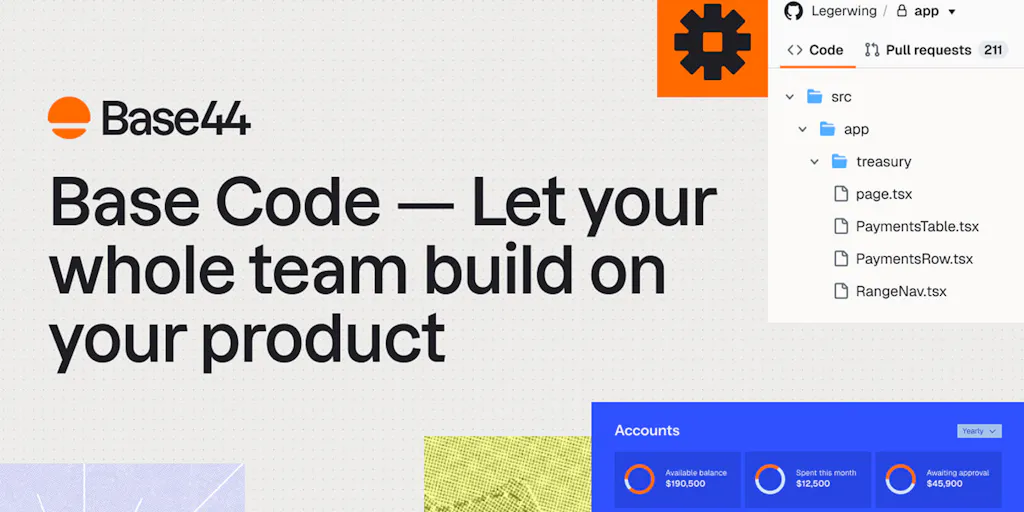
Here’s where the launch page gets interesting for anyone running a real operation. Base Code, announced by hunter Rohan Chaubey, connects an existing GitHub repository to a browser-based workspace. The feature list is specific: connect an existing repo, describe changes in plain language, work on isolated branches, preview changes live, collaborate across branches and sessions, submit changes through GitHub pull requests, and keep existing branch protections, checks, and review processes intact. It’s aimed at product, design, marketing, QA, and engineering teams who want to contribute directly to a codebase.
For a cross-border seller, this matters more than it first appears. Most sellers with any scale end up with some custom code — a Shopify app, a price-monitoring script, a repricing bot, a custom integration between your ERP and your 3PL. That code was written by a freelancer who has since disappeared, and now nobody on your team can touch it without fear. Base Code’s promise is that your ops lead can describe “add a column for return reason to the order export” in plain language and open a pull request, while your engineer still reviews the diff.
Why Amazon sellers should care more than Shopify ones
Shopify merchants live inside an ecosystem with thousands of apps; if you need something, you buy it. Amazon sellers live inside a walled garden where Seller Central exposes what it wants to expose, when it wants to, and third-party tools are perpetually one API deprecation away from breaking. That asymmetry means Amazon-side operators have far more unserved internal-tooling needs — and far more reason to build their own thin layer on top of the data they can pull. A Base44-style tool that lets your VA generate a “flag every SKU whose return rate crossed 8% this week” dashboard is worth more to an FBA brand than a prettier storefront is to a DTC shop.
Where the math breaks
The reviews are not all glowing, and the cons are the ones that kill projects quietly. Lack of documentation (4 mentions), poor customer support (4), no real integrations (3), and limited backend logic (2). One reviewer notes that output can be inconsistent, that memory retention across sessions is imperfect, and that PDFs sometimes fail to download. Another says that as the platform grows, “some features can still feel a little unpredictable, especially when handling more complex projects,” and asks for better error messages and clearer failure explanations.
Read those complaints as an operator and a pattern emerges: Base44 is excellent at the first 80% and unreliable at the last 20%. That’s fine for a throwaway internal dashboard. It is not fine for anything touching money — a repricing engine, a payout reconciliation tool, an inventory sync that writes back to a marketplace. The aggressive credit pricing and vendor lock-in complaints deserve equal weight. If your tool becomes load-bearing for the business and you can’t export it cleanly, you’ve traded one SaaS dependency for a worse one.
The context problem nobody solved yet
The sharpest comment on the thread came from Leo Heo, who asked whether a pull request opened by a non-engineer carries the original plain-language request and the back-and-forth, or just the diff. His point: “the code was rarely the problem. It was the engineer getting a change with zero context on what the person actually wanted.” Gal Dayan pushed further, asking what “preview changes live” actually catches. Branch protections and CI will catch a broken build. They won’t catch a query that’s technically correct but N+1, or a permission check that’s slightly too loose. He asked whether the reviewing engineer gets a diff summary that flags “this touches auth” or “this touches billing” changes specifically.
Neither question has a public answer on the page. That silence is the real risk. AI-generated contributions from non-engineers multiply the volume of changes flowing into a codebase without proportionally multiplying review capacity. If Base Code just produces more diffs for the same one engineer to read, it hasn’t removed the bottleneck — it’s moved it.
What cross-border sellers should actually borrow from this
Three things, in order of how soon I’d act on them.
First, use it for the tools you’d never buy. The correct first Base44 project is not your storefront. It’s the ugly internal thing: a landed-cost calculator that accounts for freight, duty, and returns; a supplier scorecard tracking on-time rate and defect rate; a simple app your sourcing agent uses to log factory visits with photos. Low stakes, high annoyance, no revenue at risk if it breaks. That’s the sweet spot the reviewers describe.
Second, treat every generated tool as disposable until proven otherwise. Given the documentation and support complaints, assume you will not get help when it breaks. That means keeping a plain-English spec of what each tool does and where its data comes from, so you can rebuild it elsewhere. If a tool survives three months and becomes genuinely load-bearing, that’s your signal to have a real developer rewrite it — not to double down on the generated version.
Third, watch the Base Code direction even if you never use it. The interesting signal isn’t the feature; it’s the strategic bet. Base44 is moving from “generate a new app” to “let non-engineers safely modify existing codebases.” That’s the same trajectory every AI tooling category is on, and it’s the one that eventually reaches your Shopify theme, your ERP customizations, and your marketplace integrations. The sellers who understand the review-and-context problem now — who insist that any AI-generated change arrives with its reasoning attached — will be the ones who can safely adopt it later.
What I’d watch / test next
This week, pick the single most annoying recurring manual task in your operation — the one you’ve automated with a spreadsheet and a prayer. Write a one-paragraph spec for it. Then spend one hour in Base44’s free tier building it, and judge the output on three criteria: does it work, can you export the data, and would you trust it with a number that affects a purchasing decision. If the answer to the third is no, you’ve learned something useful for free. If it’s yes, you’ve just found a category of tooling you can stop paying SaaS for.
Then watch two things over the next quarter. One, whether Base44 publishes anything concrete about how Base Code surfaces context and risk in pull requests — the unanswered questions from that thread are the whole ballgame. Two, whether the credit pricing and lock-in complaints get addressed or get worse. The category is real and the direction is right. The question for operators is whether this particular vendor earns the right to sit inside your stack, or whether it’s just the cheapest way to prototype the thing you’ll eventually build properly.