The Multi-Agent Coordination Tax Is Coming for Your Ops Stack — and BAND Is an Early Bet on Paying It Down
Every cross-border operator I know is quietly running the same experiment right now: they’ve bolted an AI agent onto listing optimization, another onto customer-service triage, a third onto supplier email parsing, and maybe a fourth onto ad-copy variation. Individually, each one looks like a small miracle. Collectively, they’ve created a new job — human switchboard operator — where the founder or ops lead spends the afternoon copying context from one tool into another and discovering, an hour too late, that the pricing agent and the compliance agent made opposite assumptions about the same SKU. That’s the real bottleneck in 2026, and it’s why BAND’s “agents coordinate in shared rooms” pitch is worth a serious look even though the launch is framed entirely around developers. The underlying problem — handoffs that route through a human — is exactly the problem a seven-marketplace seller has.
The company, BAND, launched its developer-facing product on April 24th, 2026, with 176 reviews at the time of the scrape. The maker’s framing is crisp: “More agents should mean more work done. Instead, a lot of it turns into more coordination for you.” If you’ve ever tried to chain an Amazon PPC agent to a Shopify inventory agent to a TikTok Shop content agent, you already know that sentence is not a developer problem. It’s an operator problem wearing a developer costume.
What BAND Actually Solves (and What It Doesn’t)
Strip away the launch-day gloss and BAND is doing one thing: it moves the state of a multi-agent workflow out of individual sessions and into a persistent shared room. Agents message each other, delegate, review each other’s output, and unblock one another. Plans and decisions live in the room “rather than inside one session, so they survive when a session ends.” A human — you — steps in only when an agent is blocked and waiting.
That’s a meaningfully different architecture from the current generation of multi-agent dev tools, which the maker fairly characterizes as “a better dispatch board.” You assign tasks, agents run in parallel, you review what comes back. Throughput improves; every handoff still goes through a human. Anyone running Zapier automations or a Make scenario chain knows the feeling — the automation runs, but the moment a decision needs judgment, it lands in your inbox as a task.
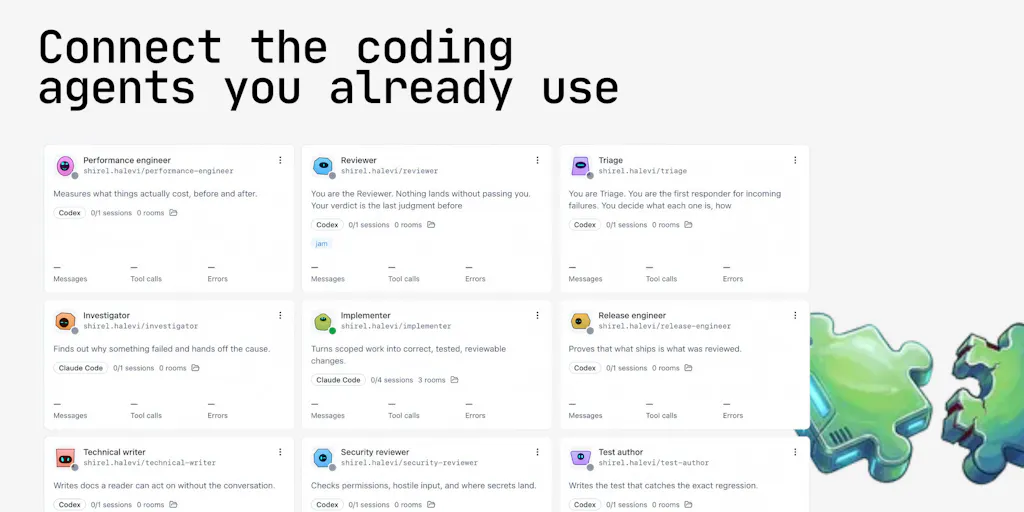
The supported harnesses at launch are Claude Code, Codex, GitHub Copilot, and OpenCode. BAND Desktop is free to download, per the maker’s post, and rooms sync across Desktop, the Web Platform, and a Mobile App (Android today, iOS “coming soon” per the maker’s comment). That mobile sync matters more than it sounds — most cross-border founders I work with are checking state from a phone between supplier calls, not sitting at a terminal.
Why Amazon sellers should care more than Shopify ones
Here’s my contrarian read: the DTC Shopify crowd will nod along and then go back to their Klaviyo flows, because a single-brand store rarely has enough parallel workstreams to justify a coordination layer. The seller who actually feels this pain is the multi-marketplace operator — the one running Amazon Seller Central, a TikTok Shop storefront, a Temu feed, and an eBay store with overlapping SKUs and divergent compliance rules. That’s four surfaces where the same product needs four different titles, four different image specs, and four different return policies. Four agents that don’t talk to each other is worse than one generalist, because now you have four sources of truth.
How It Compares to the Incumbents You’re Probably Already Using
The honest comparison set isn’t other “agent coordination” startups — it’s the stack you already pay for. Helium 10 and Jungle Scout give you research and listing tooling with their own AI assists, but they’re vertical SaaS: each feature is a silo, and the “agent” is really a button. Shopify’s Sidekick and the various Amazon Rufus-adjacent seller tools are the same shape — helpful inside their walled garden, useless the moment your workflow crosses a boundary.
BAND’s differentiator is the boundary-crossing: you keep your existing harnesses and IDEs, and the coordination layer sits above them rather than replacing them. The maker explicitly says you don’t have to “move your whole team onto one vendor’s agents.” That’s a real architectural bet, and it’s the right one for operators who’ve already standardized on a mix of tools.
Where I’d push back: the launch is developer-shaped, and the vocabulary — “dark factories,” “plan to implement to review pipelines” — will read as alien to a seller ops team. The maker’s own comment concedes the broader use cases (B2B workflows, support triage, research pipelines, scheduled ops tasks) but the product surface is still a terminal-and-rooms metaphor. A category manager at a cross-border brand does not think in “rooms.” She thinks in “this SKU is stuck in customs and the listing is still live.” Translating that into a BAND room is a mental model shift nobody has time for during Q4.
Where the math breaks
The free-desktop pricing is generous, but it’s also the tell: this is a land-grab phase, and the monetization model (seats? rooms? agent-minutes?) is not disclosed. For an operator, that means the cost of adoption is low but the cost of dependency is unknown. If you build your returns-triage workflow on BAND and the pricing flips to per-agent-seat, your unit economics move overnight. I’d pilot, not standardize.
The second break: context fidelity. A commenter named Ariel asked the sharpest question on the page — how is context managed between agents, and is there a risk one agent invalidates another’s output for lack of full context? The maker’s answer focused on visibility of the handoff trail (who owns what, what got handed off, where something’s blocked, which questions escalated to you), which is a governance answer, not a reasoning answer. Whether reasoning is shared between agents wasn’t clearly resolved in the visible thread. For a seller, that’s the difference between an agent correctly flagging a restricted-ingredient issue on a supplements listing and an agent confidently overriding it because it never saw the compliance memo.
What Cross-Border Sellers Can Borrow From This Launch
Even if you never install BAND, the architecture is a template worth stealing. Four moves:
1. Make state live in a shared artifact, not in a person’s head. The single most valuable idea here is that “plans, decisions and work state live in the room rather than inside one session.” Most seller ops teams run on Slack threads and tribal memory. If your Q4 promo calendar, your restock decisions, and your ad-bid changes aren’t in a persistent shared doc that any agent or human can read, you’re the switchboard.
2. Design for handoff visibility before you design for autonomy. The maker’s answer to the context question — show who owns what, what got handed off, where it’s blocked, what escalated — is the right order of operations. Autonomy without an audit trail is how you get a listing taken down by an agent that “helpfully” updated a title with a restricted claim.
3. Keep your harnesses, add a coordination layer. The lesson for a seller running ShipStation plus a 3PL portal plus a returns app plus a review-management tool: don’t rip and replace. Add a thin coordination layer — even if that’s a well-structured Notion database and a shared prompt library — before you buy a platform.
4. Use the “step in when it matters” pattern for exception handling. BAND’s model is that the human handles the blocked cases, not the routine ones. That’s exactly how you should staff returns and compliance: agents handle the 80% that’s pattern-matched, humans handle the escalations, and the escalation queue is a first-class product surface, not an afterthought.
Where My Judgment Says It Falls Short
I’ll be blunt: BAND is launching into a market where the buyer and the user are the same person (a developer) and the value is immediately legible. Cross-border e-commerce has neither property. The buyer is often a founder or ops director; the user is a category manager or a VA; the value is buried three layers deep in a workflow that spans Alibaba sourcing, Flexport freight, Stripe payouts, and Etsy or SHEIN marketplace rules. No coordination layer survives contact with that complexity unless someone builds the seller-specific connectors, and BAND hasn’t.
Second, the “176 reviews, no reviews yet” oddity on the page is a reminder that launch-day signals are noisy. The visible comments are mostly enthusiastic and lightly probing; the one genuinely hard question (Ariel’s on context) got a partial answer. I’d want to see a seller actually run a returns-triage or listing-localization workflow in BAND for 30 days before I’d recommend it in a stack review.
Third, the mobile story is Android-only today. For a founder checking state from a Shenzhen factory floor, that’s fine; for a team standardized on iPhones, it’s a “coming soon” that may or may not arrive before your next peak season.
The uncomfortable question: do you even have enough agents?
Most sellers reading this have one or two AI tools, not a fleet. BAND’s value curve is flat until you’re running three or more agents on overlapping work. If you’re still at the “ChatGPT for listing copy” stage, the coordination layer is a solution to a problem you don’t have yet. The operators who should be paying attention are the ones who’ve already hired — or built — a small agent team and are feeling the switchboard tax.
What I’d Watch / Test Next
This week, before you touch a new tool, do the diagnostic: list every AI agent or automation you currently run, and for each one, write down where its output goes and who carries it to the next step. If the answer is “me” more than twice, you have a coordination problem worth solving. Then pick your single highest-friction handoff — my bet is listing localization across marketplaces, or returns triage — and pilot BAND’s free desktop on just that one workflow, keeping your existing harnesses in place. Watch two things: whether the room state actually survives a session ending (the maker’s core claim), and whether the handoff trail is legible to a non-developer on your team. If both hold after 30 days, expand to a second workflow. If the trail requires a developer to interpret, shelve it and steal the architecture instead: build a shared state doc, a visible escalation queue, and a rule that no agent output ships without a named human owner. The coordination tax is real, and the operators who pay it down first — with or without BAND — will be the ones who can actually scale agent headcount without scaling headcount.