Why a Client Portal Builder Is Suddenly Relevant to People Who Sell Widgets
Let me start with a confession: when I first saw Assembly Studio’s Product Hunt launch, my instinct was to scroll past. Another AI app builder? Another tool aimed at accountants, law firms, and consultants? I write for cross-border sellers, DTC operators, and Amazon FBA owners — people whose clients are customers, not engagements. What does a “client portal” have to do with someone shipping polybags from Shenzhen to a warehouse in Ontario?
Then I read the maker’s comment more carefully, and the thesis snapped into focus. The founder, Marlon Misra, says his team kept watching customers build impressive prototypes in tools like Claude Code, but hitting a wall when it came to the boring, brutal logistics of actually getting software into end users’ hands: auth, permissions, hosting, and the question of where to send the link. Replace “clients” with “customers,” and you’ve just described the exact pain every cross-border operator feels when trying to move beyond a generic Shopify theme or an Amazon listing page. The infrastructure of trust — branded login, secure file exchange, permissions that actually mean something — is the same whether you’re an accountant onboarding a bookkeeping client or a DTC brand onboarding a wholesale buyer. The product is different, but the plumbing is identical.
That’s the lens I want to use here. Not “should you buy Assembly?” (probably not, for reasons I’ll get to). But rather: what does this launch tell us about where the e-commerce tooling stack is heading, and what can a seller operating across Amazon, Shopify, and TikTok Shop borrow from a product built for professional services firms?
The Problem Assembly Actually Solves: The Last Mile of Software
The core insight buried in the launch copy is that building software is no longer the bottleneck — shipping it is. The maker’s comment makes this explicit: customers were building “incredible prototypes” in AI coding tools, but couldn’t get them into clients’ hands because of the unglamorous layers of authentication, permissions, and hosting. Assembly’s bet is that the client experience — your domain, your brand, one login — should be a platform primitive, not something you bolt on after the fact.
This is a genuinely different positioning from the incumbents. Compare it to Lovable, which the maker name-checks as a complementary tool: Lovable is great at generating a marketing site or a public-facing app, but it doesn’t come with a built-in notion of who your users are or what they’re allowed to see. Assembly’s argument is that for service businesses, the client relationship is the product. Every app you build on top of Assembly already knows who your clients are, what they’ve purchased, and what their permissions should be. That’s not a feature; it’s the substrate.
For cross-border operators, the translation is straightforward. Think about the tools you use daily: Helium 10 for keyword research, Klaviyo for email flows, ShipBob or Flexport for logistics. Each of these tools has its own login, its own data model, its own notion of who your customer is. None of them share context. The result is that you spend your day copy-pasting customer data between silos, and your customers experience you as a fragmented series of branded emails and portal links rather than as one coherent operation. Assembly’s bet — that the client relationship should be the organizing principle of your software stack — is exactly the bet that a mature DTC brand should be making about its own tech stack.
Why Amazon sellers should care more than Shopify ones
Here’s a counterintuitive take: this product is more relevant to Amazon sellers than to Shopify store owners, even though it’s built for service businesses. On Shopify, you already own the customer relationship — the checkout, the email list, the post-purchase flow. The Shopify admin gives you a unified view of orders, customers, and products. The problem there isn’t fragmentation; it’s depth. On Amazon, the opposite is true. You’re renting customers from Seller Central, and the platform actively discourages you from building direct relationships. Your “client portal” is a branded insert card that may or may not survive Amazon’s review policies.
Assembly’s model — where the client account is a platform primitive and every app knows who the user is and what they’re allowed to see — is a useful mental model for Amazon sellers trying to escape the platform’s gravity. The question isn’t “how do I build a better listing?” It’s “how do I build a direct relationship that survives the marketplace?” That might mean a subscription box portal, a warranty registration page, or a VIP buyer community. The tools are different, but the architecture of trust is the same.
How Assembly Differs From the Incumbents — and What That Teaches Us
The most revealing detail in the launch is the list of products that Assembly’s private beta users claim to have replaced: Airtable, Databox, and others. That’s a bold claim. Airtable is a genuinely flexible database tool that can model almost anything; Databox is a purpose-built analytics dashboard. What could a client portal builder possibly offer that would make a firm abandon either?
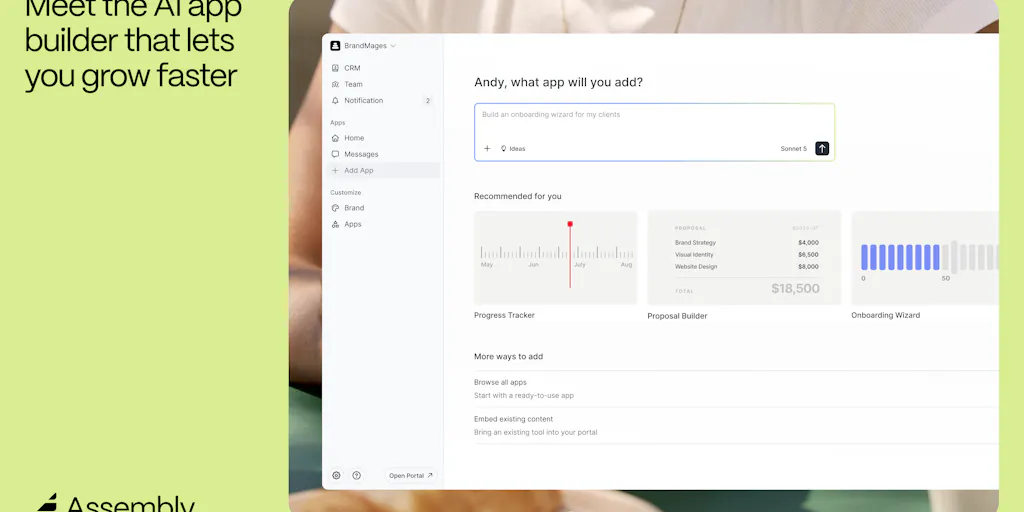
The answer, I think, is the difference between a tool and a system. Airtable is a tool: it lets you build a database, but it doesn’t know what a client is, what a contract is, or what a payment looks like. Assembly is a system: it has opinions about the shape of client work — messaging, payments, file sharing, forms, contracts, billing — and it bakes those opinions into every app you build. That’s why the templates work. The client onboarding wizard, the document collector, the project tracker — these aren’t generic CRUD apps. They encode a specific workflow that professional service firms actually run.
There’s a lesson here for anyone building a DTC tooling stack. The most successful tools aren’t the most flexible ones; they’re the ones that encode a specific workflow and make it feel inevitable. Shopify won over WooCommerce not because it was more flexible, but because it had opinions about how a store should work. Amazon FBA won over self-fulfillment not because it was cheaper in every case, but because it made the decision of “where do I send this inventory” disappear. Assembly’s bet is that the same logic applies to client portals: the tool that removes the decision is the tool that wins.
Where the math breaks
Let me be the skeptic for a moment. The launch copy mentions a “free forever plan” and a private beta where “firms built 200+ apps.” That’s a great sign for product-market fit, but it raises a question the launch doesn’t answer: what’s the pricing after the free tier? The source doesn’t disclose it, which means either it’s still being figured out, or it’s not the point of this launch. For a cross-border operator evaluating this as a potential tool, that’s a red flag — not because the pricing is bad, but because it signals that Assembly is still in the land-and-expand phase. They’re optimizing for adoption, not for revenue. That’s fine for them, but it means the product roadmap is likely to shift as they figure out what to charge.
There’s also the question of lock-in. The launch positions Assembly as a platform where “apps publish directly into that client experience.” That’s powerful, but it’s also a cage. If Assembly changes its pricing, its features, or its direction, you’ve built your client-facing apps on top of their data model. The integrations and webhooks mentioned in the reviews mitigate this — one reviewer specifically praises Calendly and Airtable integrations — but the core relationship data lives in Assembly’s database. For a service firm with a few dozen clients, that’s acceptable risk. For a DTC brand with tens of thousands of customers, that’s a non-starter.
What Cross-Border Sellers Can Actually Borrow From This
Now let’s get practical. I don’t think you should rush out and build your customer portal on Assembly Studio. But I do think there are four concrete lessons from this launch that you can apply to your own operation this week.
First, the template-first approach works. Assembly’s team built 20+ templates for professional service firms. The insight is that nobody wants a blank canvas; they want a starting point that encodes best practices. For cross-border sellers, this translates to your email flows, your ad creatives, and your product listings. Don’t start from scratch. Find the operator in your niche who’s winning, reverse-engineer their templates, and remix them for your brand. The winners aren’t the most creative; they’re the most efficient at adapting proven patterns.
Second, the “client account as primitive” idea is the future of DTC. The most valuable thing Assembly does is treat the client relationship as the foundational data model, not an afterthought. The DTC equivalent is treating your customer database as the product and everything else — ads, email, product pages — as surfaces on top of it. That means investing in a CDP or at least a well-structured Shopify customer object, and making sure every tool you use writes back to that source of truth. If your Klaviyo, your Recharge subscription data, and your Gorgias support tickets don’t share a unified customer view, you’re building on sand.
Third, the “replace Airtable” claim is a reminder to audit your stack. Assembly’s users claim to have replaced Airtable and Databox with a more specialized tool. That’s a useful prompt: what generic tools are you using that a specialized tool could replace? Are you tracking inventory in a Google Sheet when a purpose-built tool like Crafty or SkuVault would do it better? Are you running your post-purchase surveys in a generic form builder when a tool like Delighted would give you better analytics? The most expensive tool in your stack is the one that’s almost right.
Fourth, the AI-assisted building workflow is the new normal. The launch’s most striking detail is that Assembly’s own team built 20+ templates in “the last few months” — a pace that would have been impossible without AI-assisted development. The maker’s comment about customers building prototypes in Claude Code confirms this: the barrier to building custom software has collapsed. For cross-border sellers, this means the tools you use should be getting better faster. If your ERP or your WMS hasn’t shipped an AI feature in the last six months, that’s a signal — not that you should switch, but that you should be evaluating alternatives.
Where Assembly Falls Short — My Honest Judgment
I want to be clear about the limits of this product for the cross-border e-commerce audience. Assembly is built for professional service firms: accountants, law firms, agencies, consultants. The templates reflect that — onboarding wizards, document collection, project tracking, help desks, case status pages. None of these map directly to e-commerce workflows. There’s no template for “wholesale buyer portal,” no template for “warranty registration,” no template for “subscription management.” You’d be building those from scratch, which defeats the purpose of a template-first product.
The integrations also skew toward service-firm tools. The reviews mention Calendly and Airtable; the launch mentions Base44 and Claude Code as complementary AI builders. There’s no mention of Shopify, Klaviyo, or any e-commerce-specific integration. That’s not a criticism — it’s a positioning choice — but it means the “one client experience” pitch doesn’t extend to your existing e-commerce stack. You’d be running Assembly alongside Shopify, not instead of it, and that’s a harder sell.
The bigger concern is the pivot risk. The launch copy describes Assembly as having evolved from a CRM and client portal into “an AI app builder.” That’s a significant repositioning, and it’s worth asking whether the company knows what it wants to be. The earlier launch described “modern client portals for service businesses”; the current one is “branded customer portals & AI-powered CRM”; this launch is “AI app builder.” Three launches, three framings. For a cross-border operator evaluating tooling, that’s a warning sign: you want to bet on a platform that’s found its center of gravity, not one that’s still searching for it.
What I’d Watch / Test Next
If you’re intrigued by the underlying thesis but not ready to commit, here’s what I’d do this week.
First, sign up for Assembly’s free forever plan and spend thirty minutes with the client onboarding wizard template. Don’t think about e-commerce; think about the last time you onboarded a wholesale buyer or a large B2B account. What did that process look like? How many emails did you send? How many documents did you chase? If the template gives you a better mental model for that process, that’s a win — even if you never use the product.
Second, audit your own stack for “almost right” tools. The Airtable replacement claim is the most actionable insight in this launch. Make a list of every generic tool you use — spreadsheets, form builders, project trackers — and ask whether a specialized tool would encode your workflow better. The answer doesn’t have to be “switch”; it just has to be “I’ve thought about it.”
Third, and most importantly, steal the “client account as primitive” idea for your own business. Pick one customer segment — your wholesale buyers, your subscription customers, your VIP email list — and map every touchpoint they have with your brand. Where are the gaps? Where does context get lost? The tool you build to fix that gap doesn’t have to be an AI app builder; it could be a Zapier workflow, a Notion dashboard, or a better Shopify customer tag strategy. The point is to treat the customer relationship as the foundation, not the afterthought.
Assembly Studio is not the product cross-border sellers have been waiting for. But it’s a useful signal about where the industry is heading: toward tools that encode workflows, treat the customer relationship as the platform, and make AI-assisted building the default. If you’re not already thinking about your stack in those terms, this launch is a good reason to start.