Why Every Cross-Border Seller Should Care About the Invisible Failures in Their AI Stack
The most expensive error in your e-commerce operation isn’t a bad ad set or a rejected payment gateway. It’s the AI agent that tells a customer their refund has been processed, when it hasn’t. It’s the chatbot that promises a delivery window your 3PL can’t meet. It’s the voice assistant that confirms a size swap, then sends the original item. These failures cost you in refunds, chargebacks, and reviews — but worse, they’re nearly invisible. A dashboard shows “200 OK” and a successful tool call, while the customer sits there with a fabricated link and a promise that will never be fulfilled. That gap between what the system logs and what the customer actually experienced is where your margin disappears. Agnost AI, launched on Product Hunt by two founders who got tired of being unpaid QA testers for other companies’ AI agents, is trying to close that gap. And for anyone running customer-facing AI at scale, this matters more than yet another analytics dashboard or A/B testing tool.
The Problem: Your Evals Can’t Catch What You Don’t Know
Every serious operator running AI agents has a testing framework. You’ve got evals for the common cases: refund requests, order status, return eligibility. You’ve carefully crafted prompts and golden datasets. And yet, the real world keeps finding ways to break your agent that your test suite never anticipated.
The founders of Agnost AI — Shubham and Parth — describe the exact loop that should sound painfully familiar to anyone running support automation: a product launches with an impressive demo, feels magical for the first ten minutes, then claims it completed something it didn’t, invents a link, or makes the user repeat themselves three times. When they’d message the founders of these tools, the response was always the same: “This is really useful feedback, we had no idea.”
Here’s the kicker — and the reason this isn’t just a tooling problem but a business problem: the observability dashboards showed a successful request. HTTP 200. Tool call succeeded. Response generated. The failure was only visible if someone actually sat down and read the conversation. That’s not scalable. That’s not even feasible once you’re processing thousands of conversations a day across chat and voice channels.
For a cross-border seller, this is existential. You’re already managing timezone gaps, language barriers, and logistics complexity that domestic brands don’t face. Your AI support agent isn’t a nice-to-have; it’s the only way to provide 24⁄7 coverage when your team sleeps. But if that agent is silently failing — hallucinating links, inventing refund confirmations, drifting from its training — you’re not just losing a sale. You’re generating negative reviews that follow your brand across marketplaces and geographies for years.
The core insight here is deceptively simple: evals test problems you already know about. You cannot write an eval for a failure mode you haven’t discovered yet. And in cross-border commerce, where the failure modes multiply with every new marketplace, currency, and carrier integration, that blind spot is enormous.
What Agnost AI Actually Does: Reading the Conversation, Not the Log
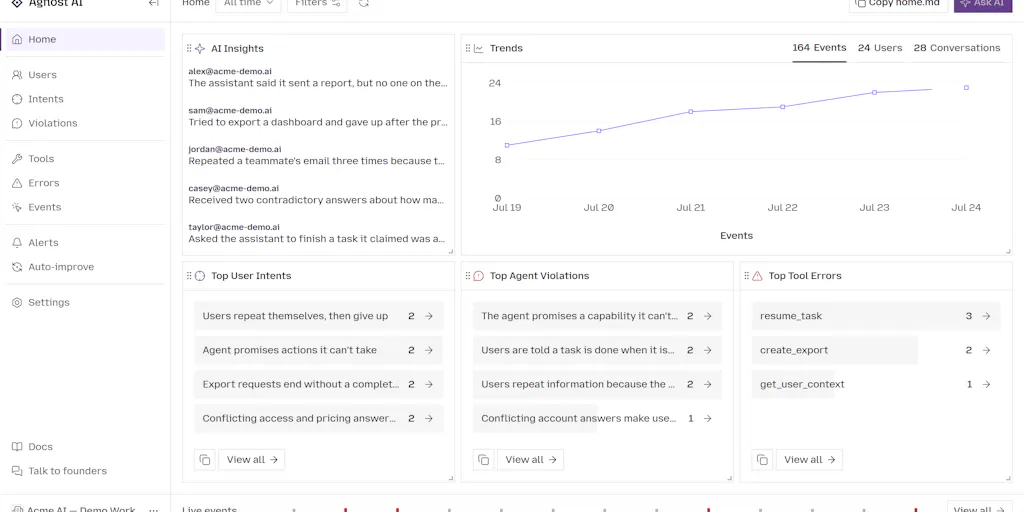
The product itself is straightforward in concept: it reads every production conversation across your chat and voice agents, then groups them into recurring failure patterns — behavioral drift, hallucinated links, user frustration, feature requests, and churn signals. It surfaces the exact users and conversations behind each pattern, and from there you can create an eval or hand the problem to your coding agent to debug and fix.
The technical implementation matters less than the philosophical shift. Most AI observability tools measure performance at the API level: latency, token count, cost per request. They tell you the system is running. They don’t tell you whether the system is lying.
The company claims it connects in three lines of code or through OpenTelemetry, and already analyzes more than one million messages every day. That scale matters because the failure patterns don’t emerge from single conversations — they emerge from clustering thousands of them. A customer who asks the same question three times isn’t a data point; it’s a pattern. A link that gets hallucinated once is a bug; a link that gets hallucinated in 2% of conversations about international shipping is a systemic issue.
This is where the product diverges from incumbents. Most teams use platforms like LangSmith or Langfuse for LLM observability — and those are fine for what they do. They give you traces, latency metrics, and cost breakdowns. But they’re built for developers who want to debug individual requests, not for operators who need to understand customer experience at scale. The difference is subtle but critical: a trace shows you what the system did. Agnost AI claims to show you what the customer experienced.
The synthetic data angle is worth noting too. When asked about exporting discovered failures into evaluation frameworks, the founders confirmed they support integration via MCP (Model Context Protocol) into any framework. That’s the right answer. The product’s value isn’t in being the eval framework — it’s in being the discovery layer that feeds your existing testing infrastructure.
For Cross-Border Sellers, This Is a Logistics Problem as Much as an AI Problem
Why Amazon sellers should care more than Shopify ones
Let me be direct about where this matters most. If you’re a Shopify DTC brand with a small ticket size and a support team that can manually review conversations, Agnost AI is a nice-to-have. You can probably get away with weekly manual trace reviews and a decent eval suite. The failure cost is manageable.
But if you’re an Amazon FBA seller, the calculus changes fundamentally. Your support interactions are partially visible to Amazon itself. A pattern of unresolved customer issues — even if those issues were caused by your AI agent’s hallucinations — feeds into your account health metrics, your return rates, and your listing rankings. A single week of an AI agent confidently promising delivery dates that your Seller Central settings can’t fulfill could tank your Buy Box position or trigger a performance notification.
The compounding effect is what kills you. One hallucinated tracking link might cost you a customer. Ten hallucinated links about international shipping might cost you a marketplace standing. Agnost AI’s approach of clustering failures and surfacing the exact users behind each one is designed for this kind of systemic understanding. The question is whether you have the operational bandwidth to act on what it surfaces.
Where the math breaks
The cost question is the one that will make or break adoption for smaller sellers. The founders mention that they can train a small language model based on where your agent fails with frontier models, claiming it’s “more accurate, faster, and cheaper.” That’s an ambitious claim. My skepticism here is rooted in experience: SLM fine-tuning for specific failure modes works well when the failure patterns are narrow and well-defined. For a cross-border operation with dozens of product categories, multiple languages, and varying marketplace policies, a single SLM is unlikely to cover all the edge cases.
The pricing itself is not disclosed on the Product Hunt page, which is always a yellow flag for enterprise-focused tools. If this is priced for VC-backed AI startups with six-figure annual budgets, it’s not going to be accessible to the mid-market sellers who arguably need it most. The value proposition is real, but the addressable market is constrained unless they’ve built tiered pricing for smaller operations.
What Cross-Border Sellers Can Borrow From This Approach
Even if you don’t adopt Agnost AI this week, the philosophy behind it is transferable to any AI deployment you’re running. Here’s what I’m taking from the launch:
Stop measuring system health; start measuring conversation health. Your LLM observability dashboard showing 99.9% uptime is meaningless if 5% of conversations end in customer frustration. The metrics that matter are behavioral: Did the agent resolve the issue? Did the customer have to repeat themselves? Did the agent invent information? You need to build your own monitoring around these outcomes, not just API status.
Cluster your failures, don’t enumerate them. The most powerful insight in their approach is the grouping of conversations into recurring patterns. A single customer complaint is noise. Fifty complaints about the same return policy misunderstanding is a signal. If you’re running AI support, you should be building your own failure taxonomy — even if it starts as a manual review of a random sample of conversations each week, then grows into something more systematic.
Feed discoveries back into your testing. The loop of “discover failure → create eval → fix agent → verify” is the right way to mature an AI system. Most teams I see are stuck at the first step because they don’t have the discovery layer. Whether you use Agnost AI or build something in-house with OpenTelemetry, the principle stands: you need a mechanism for finding the failures your evals don’t cover.
Where My Judgment Says It Falls Short
The founder’s offer to personally help find “three things happening in your conversations that you probably don’t know about” is a great hook, but it reveals the product’s current maturity. For a tool that’s analyzing a million messages a day, the onboarding still feels consultative rather than self-serve. That’s fine for early adopters, but it doesn’t scale as a business.
The integration with coding agents to “debug the problem and fix it” is ambitious but potentially dangerous in production environments. An AI agent that can modify your support agent’s prompts or logic based on discovered failures is a powerful capability — and a terrifying one if the fix introduces new failure modes. I’d want human review in that loop for at least the first few months, especially for cross-border operations where the stakes of a bad support interaction include marketplace penalties.
The Product Hunt launch page also shows this is a two-person team. That’s fine for a product at this stage, but it raises questions about support, SLAs, and long-term viability for sellers who would be baking this into mission-critical customer support infrastructure. You’re not just buying a tool; you’re betting on the company’s survival.
The voice agent coverage is interesting but unproven at scale. Voice failure modes are different from text — they involve speech recognition errors, latency issues, and the inability to show links or visual confirmations. If Agnost AI is genuinely handling voice conversations well, that’s a differentiator. But the launch page doesn’t provide specifics on how voice transcription errors are handled or whether the clustering accounts for the additional noise that voice introduces.
What I’d Watch and Test Next
If you’re running AI-powered customer support for a cross-border operation, here’s my practical advice for this week:
First, audit your current failure discovery mechanism. Ask yourself honestly: how do you currently find out when your AI agent hallucinates, drifts, or frustrates customers? If the answer is “customer complaints” or “manually reading traces,” you have a discovery gap. That gap is costing you money — in refunds, in lost customers, in marketplace penalties — and you don’t even know the magnitude.
Second, run a small pilot with Agnost AI on a single channel. Connect it to your chat agent first, not your voice agent. Give it a week to cluster your conversations. The founder’s offer to personally identify three issues you didn’t know about is genuinely valuable — take him up on it. Even if you don’t become a paying customer, the audit alone is worth the integration time.
Third, pay attention to the eval export workflow. The fact that it can plug into existing frameworks via MCP means you’re not locked in. If you’re already using DeepEval or Braintrust, you can take the discovered failures and fold them into your existing testing pipeline. That’s the right architecture — the discovery layer should feed your existing tools, not replace them.
Fourth, watch the pricing page. The fact that pricing isn’t disclosed on the launch page means they’re still figuring out their go-to-market. If they land at a price point that makes sense for mid-market sellers, this becomes a no-brainer tool. If they anchor to enterprise pricing, wait for the inevitable downmarket push or look for competitors who will copy the approach.
The broader lesson here is bigger than any single tool. The AI agent gold rush of the last two years has produced a lot of magic demos and very few production-grade systems. The next wave of competitive advantage won’t come from building better agents — it will come from building better visibility into the agents you already run. Agnost AI is an early entry in that wave. Watch it, test it, and more importantly, adopt the mindset: your AI isn’t done when the demos work. It’s done when you can see every failure, understand every pattern, and fix every hallucination — before your customers have to tell you about it.