Why a Hiring Tool Just Became Your Ops Problem
Let’s be honest: when you run a cross-border operation, you don’t think about hiring software until you’re drowning. You think about ad spend, landed costs, and the new TikTok Shop seller fee structure. But the reality is that your entire P&L hinges on the quality of the people you put in seats—especially if you are managing a distributed team across Shenzhen, Los Angeles, and a 3PL warehouse in Kentucky. The biggest bottleneck for scaling a DTC brand isn’t CAC; it’s the cost of a bad hire in a virtual-first world. We’ve all been burned by a “senior” media buyer who was actually ChatGPT with a resume, or a VA who padded their experience with a script. The tool that just launched on Product Hunt isn’t a CRM or an ATS; it’s a litmus test for authenticity in a market flooded with AI-polished candidates. This matters to you because the same AI that writes your product descriptions is now writing your applicants’ answers. If you are still screening candidates based on a keyword match, you are not hiring a person—you are hiring a language model with a pulse.
The Problem: The Resume Is Dead, and the Interview Is Compromised
Let’s cut through the noise. The core issue AgentR is attacking isn’t just “bad hires.” It’s the fundamental breakdown of trust in the remote hiring pipeline. The maker, Prateek Porwal, explicitly states that the problem has shifted: candidates now have AI helping them through every stage of an interview, and most hiring tools have no way to tell.
Think about the last time you hired a customer support lead for your Shopify store. You posted a job, got 500 resumes, and 400 of them were clearly generated by a bot or enhanced by a paraphrasing tool. The ones that survived the screen were “perfect”—too perfect. Then you hopped on a Zoom call, and the candidate froze at the first question that wasn’t in the script. This is the “hallucination gap” in hiring.
The existing incumbents—think traditional ATS platforms like Greenhouse or Lever—are fantastic at tracking candidates but terrible at validating them. They are databases, not detectors. They organize the lies; they don’t catch them. Even newer AI-screening tools like HireVue focus on gamified assessments or video analysis, but they often fail when the candidate is feeding answers through a hidden earpiece or using an AI co-pilot on a second monitor. AgentR’s thesis is that you can’t just monitor for cheating after the fact; you have to design the interview so that cheating is structurally impossible. This is a shift from “policing” to “architecture.”
Why Amazon sellers should care more than Shopify ones
If you are an Amazon FBA operator, you are likely hiring for two distinct roles: the creative (listing optimization, PPC) and the operational (supply chain, reconciliation). The operational roles are where AI cheating is most dangerous. You can’t afford a “logistics coordinator” who claims to know Incoterms but actually just pasted a LinkedIn Learning certificate into their portfolio. A single wrong customs classification on a shipment from Vietnam can cost you more than this software subscription for a decade.
Shopify sellers often run leaner, scrappier teams where the founder does the hiring based on gut instinct. But Amazon forces you to scale faster because the marketplace demands constant attention to Buy Box share and inventory performance. When you scale fast, you delegate, and when you delegate without verification, you bleed cash. AgentR’s focus on “verification runs before evaluation” is specifically designed for high-volume hiring where you don’t have the luxury of a 30-minute pre-screen for every single applicant.
The Product: Rebuilding the Interview as a Verification Engine
So, what actually is AgentR? It’s a phased evolution. The first launch was a basic AI assistant. The second was about workflow connectivity. This Phase 3 launch is about the interview itself. The key features here are not incremental; they are philosophical.
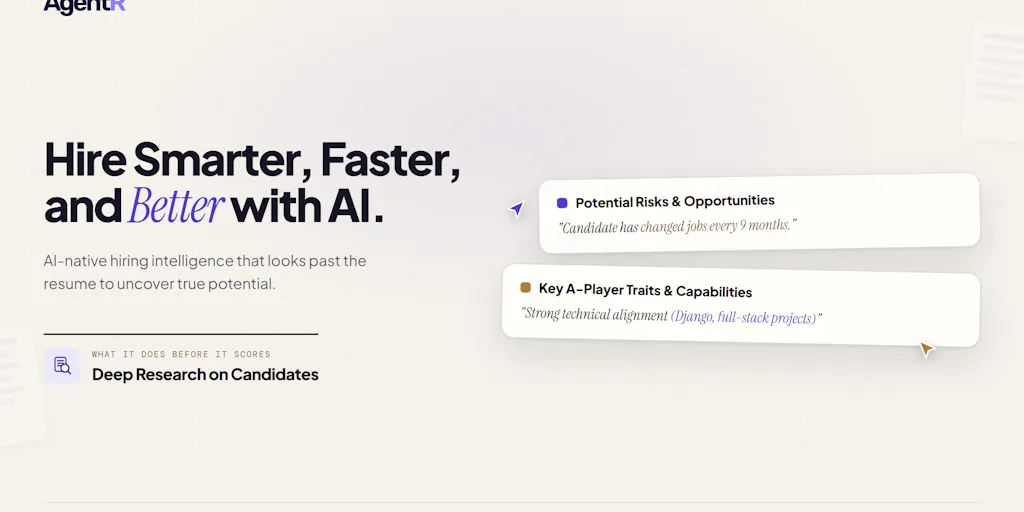
The product now runs a full AI-conducted first interview, voice and video, structured around how someone actually thinks and works. The structure includes a resume walkthrough, real case scenarios, judgment calls, and hands-on problem solving. This is not a “Tell me about yourself” bot. It is a dynamic interrogation engine that adapts to the candidate’s responses.
The crucial differentiator is the “Anti-cheat by design” feature. Most tools try to detect cheaters by flagging eye movements or browser activity—which is invasive and ineffective. AgentR instead builds the interview to be difficult to fake. If you ask a candidate to walk through a specific Excel formula they claimed to use in their last job, and they can’t do it live, it doesn’t matter if they have a second screen open. The format itself exposes the bluff.
The “Context-Aware” Ranking vs. Keyword Overlap
This is where the product gets interesting for operators. Traditional ATS software ranks candidates by keyword density—how many times they mention “Amazon PPC” or “Klaviyo” or “NetSuite.” AgentR claims to rank candidates on how their experience actually fits the role. This is a massive leap.
Imagine you need a buyer for your furniture line. Candidate A has “sourcing” in their title but actually just did data entry. Candidate B has a weird title like “Operations Associate” but actually negotiated freight rates with Maersk directly. A keyword search would favor Candidate A. Context-aware ranking would dig into the nuance of the interview—asking how Candidate B handled a rate increase, what levers they pulled, and whether they actually understand demurrage fees. This is the difference between hiring a label and hiring a capability.
Where the math breaks
Let’s be skeptical for a moment. The promise is that this 25-minute AI interview can verify a candidate’s claims. But can it? The source material notes that the interview adapts to what the candidate says. The risk here is that if the AI is adaptive, it might also be lenient. If a candidate is articulate but wrong, does the AI catch the factual error, or does it just move to the next question?
Furthermore, the “deep research engine” checks resumes for consistency. That’s great for catching date discrepancies, but it won’t catch a candidate who genuinely worked at a company but exaggerated their role. The verification is only as good as the public data available. For niche roles in cross-border logistics, there is often no digital footprint to verify against. The math breaks when the “evidence” is sparse, and the AI is forced to rely on the candidate’s narrative—which brings us back to square one.
What Cross-Border Sellers Can Borrow From This (Even If You Don’t Buy It)
You don’t have to subscribe to AgentR to steal its philosophy. The core lesson here is about “verification before evaluation.” In our industry, we are obsessed with tools that promise to automate the hiring process, but we often forget to build in the verification step.
Adopt the “Resume Walkthrough” technique. In your next interview for a Supply Chain Manager, don’t ask them what they know about Incoterms. Instead, put their actual resume on the screen and ask them to walk you through the timeline of a specific shipment they handled. Ask them to open the actual email they sent to the freight forwarder. If they hesitate or give a generic answer, you have your answer. This is a zero-cost version of AgentR’s core feature.
Also, borrow the “Transparent Rejections” feature. The source mentions that candidates get a clear reason when they don’t move forward. In cross-border hiring, the talent pool is global, and your reputation matters. If you reject a candidate in Manila or Medellin with silence, they post about it on Facebook groups. If you give them a clear, AI-generated reason—”We felt your experience in DDP shipping didn’t align with our need for EXW handling”—you build a better employer brand. It costs you nothing but saves you from a reputation hit.
The Shortfalls: Where My Judgment Says It Falls Short
Here is where I get picky. The tool is aimed at “high-volume hiring,” but the pitch feels very white-collar. The case scenarios and resume walkthroughs are great for marketing managers, but how does this work for warehouse supervisors or pick-pack leads? Those hires are usually based on physical presence and reliability, not cognitive interviews. If you are hiring a warehouse associate in California, you don’t need an AI voice bot to test their judgment calls; you need a background check and a drug test.
Moreover, the pricing is not disclosed in the source. For a cross-border seller running thin margins, the cost of a specialized AI hiring tool can balloon quickly, especially if you are paying per “AI interview.” If it costs $50 per interview and you need to interview 50 candidates for a single role, that’s $2,500 to fill one seat. That might be acceptable for a Director of Operations, but it’s brutal for a Customer Service Rep.
Finally, there is the “AI vs. AI” arms race. The tool is designed to catch AI-assisted candidates. But as AI models get better, the “real case scenarios” might become too easy for a candidate to feed into their own AI for a perfect answer. The tool is built to make it hard to fake, but it doesn’t make it impossible. The cat-and-mouse game will continue, and AgentR will need to constantly update its question bank to stay ahead of the cheaters.
The “Voice and Video” Bottleneck
The product uses voice and video interviews. This is a huge red flag for international hiring. If you are hiring a developer in Lagos or a virtual assistant in Cebu, their internet bandwidth might not support a 25-minute video interview without freezing. This tool assumes a level of digital infrastructure that simply doesn’t exist in many of the regions where cross-border sellers are actively hiring. You might end up filtering out your best candidates simply because their connection dropped during the “hands-on problem solving” phase.
What I’d Watch / Test Next
If you are a DTC operator or an Amazon seller, here is what I would do this week, not next month.
First, take a look at the AgentR Phase 3 launch page and AgentR product hub to see if they have a free tier or a trial. Even if you don’t use it for hiring, use it to audit your own interview process. Run your current job description through their tool and see what kind of questions it generates. This will give you a blueprint for how to interrogate your next candidate manually.
Second, implement the “no resume” rule for your next hire. Take the AgentR approach and skip the resume screening entirely. Instead, send every candidate a practical test immediately. For example, if you are hiring a PPC manager, send them a fake ad account and ask them to write a 200-word critique of the current ad copy. See who actually does the work vs. who submits a prompt-generated response. This is the “verification before evaluation” mindset applied with zero software cost.
Third, watch the broader trend of “AI detection” in hiring tools. If AgentR gains traction, you can bet that LinkedIn and X will start integrating similar features into their recruiter products. Start thinking now about how you will handle the “AI-assisted candidate” in your pipeline. Will you ban them, or will you embrace a world where the baseline is that everyone uses AI, and the interview is purely about judgment and personality?
Finally, check out the AgentR 2.0 launch to see how they handle workflow connectivity. The future of hiring isn’t just about the interview; it’s about how that interview data flows into your onboarding and training tools. If AgentR can plug into your existing stack—say, Shopify for a customer service role or Helium 10 for a product research role—then it becomes a true ops tool, not just an HR gadget.
The bottom line: this launch is a signal. It signals that the market is finally waking up to the fact that virtual hiring is broken. Whether you use AgentR or not, you need to fix your own process. Start treating your interviews like the high-stakes negotiations they are, and start verifying everything. Your P&L will thank you.


