Why a Pitch Deck Analyzer Matters to People Who Sell Widgets, Not Fundraises
You run a seven-figure Amazon brand. You have zero intention of raising venture capital. Your “pitch deck” is a listing optimization spreadsheet and your “investor update” is a bi-weekly P&L. So why should you care that a California GTM-focused VC called 1752vc just launched an AI tool that grades pitch decks? Because the core problem it solves is the same one that eats your margin every single day: you are making decisions about your business based on what you think the other side wants to see, not what they actually tell you. Amazon doesn’t send you a decline reason when your conversion rate drops. Meta doesn’t explain why your ROAS halved. You get a polite “no” in the form of a silent algorithm, and you’re left guessing. The 1752vc Pitch Deck Analyzer is a case study in building a tool that turns silent judgment into scored, actionable feedback. And the way it’s built — calibrated on outcomes, not opinions — is exactly the lens you should be applying to your own ad creative, your product pages, and your supplier communications.
The Problem It Actually Solves: The Silent “No”
The folks at 1752vc are explicit about the pain point. They receive 4,000+ applications every year, and most decks get passed on. The founders rarely learn why. As Taissa Maleh, a maker on the project, puts it, there’s no version of the VC job where you write thousands of pieces of real feedback annually, so the honest reason stays in the room and the founder gets a polite no. That’s the exact dynamic you deal with when a buyer abandons a cart or an Amazon A/B test fails to move the needle. You don’t get a detailed critique; you get a data point that something is wrong.
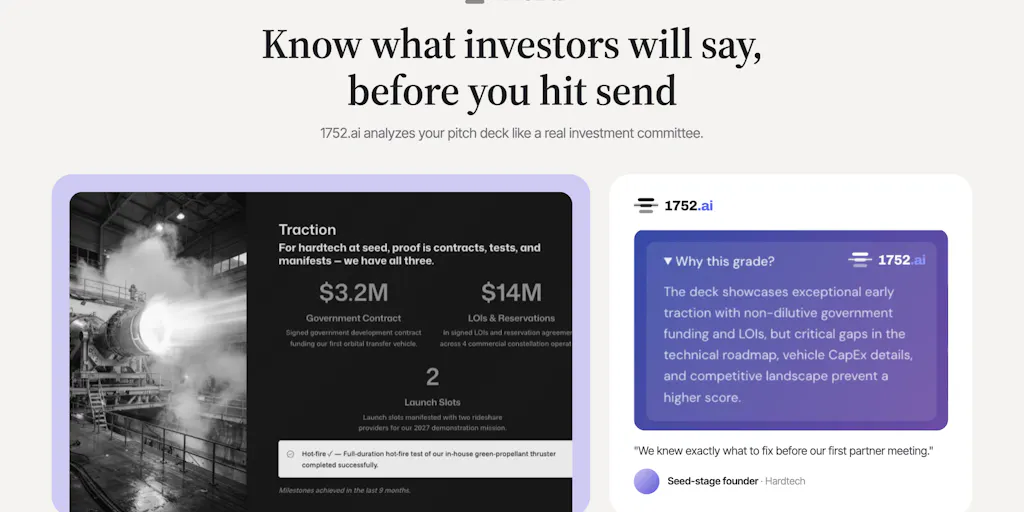
The tool’s answer is to read a deck slide by slide “the way an investor does,” scoring it across 3,000+ investor attributes and training it on 25,000+ real decks and the decisions that followed them. In plain English: they didn’t build a design critic. They built a decision simulator. The claim that only 2% of flags are cosmetic is the most important sentence in the entire launch. It’s a direct rebuttal to every founder who thinks their problem is a bad font or a cluttered cover slide. The tool is telling you that your problem is structural — your market sizing logic doesn’t connect, or your ask doesn’t buy enough runway to hit your milestones.
For a cross-border operator, this is a mirror held up to your own reporting. You can spend hours optimizing the hex code of your “Buy Now” button, but the tool you should be building is one that tells you your offer logic is broken — that your shipping promise contradicts your price point, or that your review velocity doesn’t support your premium positioning. The pitch deck analyzer is a reminder that the most valuable feedback you can get is the feedback that tells you which slide is load-bearing, not which one is ugly.
How It Differs From the Incumbents: Calibration vs. Opinion
There is no shortage of pitch deck feedback tools. You’ve got Pitch for design, DocSend for analytics, and a dozen AI “deck review” services that will happily tell you your deck needs more traction or a clearer ask. What separates this tool from those, at least based on the launch narrative, is the training data. It’s not scraping “100 how-to sites,” as one commenter, Andreas Jablonka, astutely noted. It’s trained on 25,000+ real decks and the decisions that followed them. That’s the difference between a copywriter who has read a book on persuasive writing and a salesperson who has heard “no” ten thousand times.
This is the same distinction you should draw when evaluating your own tooling stack. There’s a world of difference between a tool like Helium 10 that gives you keyword volume and a tool that tells you which keyword will actually convert based on historical outcomes. The former is data; the latter is judgment. The 1752vc tool is attempting to codify judgment. It’s not asking “does this slide look good?” It’s asking “does this slide, in the context of the deck, make a claim that survives the next slide?” That’s a much harder problem, and it’s the one that actually matters.
Why Amazon Sellers Should Care More Than Shopify Ones
If you’re a Shopify DTC operator, you’re used to iteration. You can change your landing page copy in minutes. You can A/B test your value proposition weekly. The feedback loop is tight. But if you’re an Amazon FBA seller, your feedback loop is brutal. You write a listing, you ship inventory months in advance, and you wait to see if the algorithm rewards you. You don’t get to iterate on a “slide” — you’re locked into a “deck” for months at a time. The cost of a broken narrative is not a lost meeting; it’s wasted PPC spend, stranded inventory, and a ranking that takes months to recover. Tools that diagnose structural problems before you commit capital are disproportionately valuable to you. The pitch deck analyzer is a metaphor for the pre-flight checklist you should be running on your listing before you send that container.
What Cross-Border Sellers Can Borrow From It
You’re not going to upload your Amazon listing to 1752vc — that’s not what it’s for. But the design principles of the tool are directly transferable to how you should be building your own feedback loops.
1. Calibrate on outcomes, not opinions. The tool claims it’s calibrated on investor decisions, not design opinion. It’s trained on what actually happened — the yes and the no — not on what a consultant thinks looks good. When you’re reviewing your ad creative, your email flows, or your product photography, you should be doing the same. Stop asking “does this look premium?” and start asking “does this correlate with a higher conversion rate in our historical data?” Aesthetic preference is noise. Outcome data is signal. If you’re not tagging your creative assets with performance data and reviewing them through that lens, you’re running a design opinion shop, not a growth engine.
2. Flag internal contradictions. The most interesting insight from the alpha phase, according to the makers, is that the thing that quietly costs founders the meeting is the deck arguing against itself — a claim in one slide that doesn’t survive the next. This is a massive issue in e-commerce. Your listing says “premium quality” but your price point says “budget.” Your ad promises “free shipping over $50” but your checkout page hides the shipping cost until the last step. Your product page boasts “in stock” but your delivery estimate says “3-4 weeks.” These contradictions kill trust, and trust is the only currency that matters. The tool forces you to see your deck as a single coherent argument. You should be doing a “contradiction audit” of your entire funnel — from ad creative to post-purchase email — at least once a quarter.
3. Separate load-bearing problems from cosmetic ones. The tool separates flags by severity and ties them to the slide that caused them. It’s explicitly designed to stop you from polishing the cover slides while the financials sink you. In your world, this is the difference between obsessing over your product image background color while your inventory management is broken. It’s the difference between rewriting your bullet points for the tenth time while your supply chain has a 30-day lead time that’s killing your cash flow. The tool is a reminder that not all problems are created equal, and that the most dangerous ones are the ones you don’t see because you’re too busy looking at the ones you do.
Where the Math Breaks: The Skeptic’s View
I have to channel the spirit of rick segal, the commenter who played the role of “that guy” on the Product Hunt page. He made a sharp point: “Don’t pay for this stuff… build the MVP instead of obsessing over slides.” His argument is that no investor has ever loved a product and then bailed because of a crappy slide deck. The friction to build is low, and customer validation trumps slide polish every single day.
He’s not wrong. And his critique maps directly to the e-commerce world. You can spend hours perfecting your pitch deck for a supplier partnership, but if your product doesn’t sell, the deck doesn’t matter. You can obsess over your Amazon listing copy, but if your product is a commodity with no differentiation, the copy is just window dressing. The tool can tell you where your argument is weak, but it can’t tell you if your argument is worth making in the first place.
There’s also a structural concern. The tool is trained on 25,000+ decks and “the decisions that followed them.” But VC decisions are not purely rational. They’re influenced by pattern matching, market timing, and gut feel. The tool is attempting to codify a process that is famously idiosyncratic. It might be good at catching structural flaws, but it’s unlikely to capture the “spark” that makes an investor lean in. The same is true for any AI tool in e-commerce — it can tell you what’s broken, but it can’t tell you what’s magical.
The “Free Review” Economics: A Deal Flow Play
Let’s be clear-eyed about the business model here. This is not a standalone tool company. The makers are explicit: “We’re a fund, not a tool company.” The analyzer is a funnel. It gives away “5 free deck reviews” to get founders into the system, and then it sits at the top of a deal flow pipeline for 1752vc. The tool is the bait, and the fund is the hook. This is smart. It’s the same logic as a free Shopify trial or a free Klaviyo audit — you give away a high-value diagnostic to get your foot in the door for the higher-margin relationship.
For you, the cross-border operator, this is a reminder to look at your own “free tools” with a critical eye. Are you using a free Jungle Scout trial to find products, or are you the product? Are you using a free shipping calculator from a logistics provider that’s hoping to win your freight business? There’s nothing wrong with this model — it’s how the industry works — but you should understand the incentive structure. The tool is designed to surface decks that are almost fundable, so the fund can scoop them up. It’s not designed to tell you that your idea is bad and you should go get a job. That’s the bias you need to account for.
The “Ask Slide” Test: A Tactic Worth Stealing
One commenter, Rabnoor Singh, shared a tactic that’s worth its weight in gold, regardless of whether you ever raise money. He said he writes the ask slide first and builds backwards from there, which stops him from over-trimming the vision. This is a brilliant constraint for any narrative-building exercise. Before you write your Amazon listing, write your “ask” — what do you want the customer to do? Buy now? Add to cart? Subscribe? Then build every bullet point, every image, every A+ content block backwards from that single ask. This forces coherence. It stops you from writing a listing that’s a feature dump instead of an argument. It stops you from polishing the “vision slide” (your brand story) while the “financials” (your reviews and price point) sink you.
Where My Judgment Says It Falls Short
For all the smart calibration, the tool has a blind spot that I’d flag for any e-commerce operator watching this space. It’s trained on decks and decisions, but it’s not trained on conversations. The real reason an investor passes on a deck often has nothing to do with the deck itself — it’s a reference call gone sideways, a competing deal that just closed, or a fund’s thesis shifting. The tool can tell you your deck argues against itself, but it can’t tell you that the market has moved on from your category. The same is true for your e-commerce analytics. Your conversion rate might be dropping, but the tool that tells you “your price is too high” is missing the fact that your main competitor just launched a newer version of your product at a lower price. The data is accurate, but the context is missing.
There’s also the question of the grade itself. A “C” grade on a pre-seed deck with “8 critical issues and 4 quick wins” sounds actionable, but it’s still a reductive summary of a complex narrative. The risk is that founders (or operators) optimize for the grade instead of the argument. If the tool flags your market size slide, you might be tempted to pad your TAM with a more generous report — which is exactly the “copy-paste from a report” behavior the tool is designed to catch. The tool can flag the symptom, but it can’t fix the underlying thinking.
What I’d Watch / Test Next
If you’re a founder-operator, here’s what I’d do this week, without spending a dime on a subscription.
First, take the 1752vc Pitch Deck Analyzer for a spin — not because you’re raising, but because it’s a free diagnostic on how you structure an argument. Run your own deck if you have one, or run a hypothetical one for your e-commerce brand. The point isn’t the grade; it’s the specificity of the feedback. Does it tell you your market sizing logic has “no connective tissue”? That’s a signal that your brand story has the same problem.
Second, run a “contradiction audit” on your own funnel. Map out your ad promise, your landing page headline, your product page bullets, your shipping policy, and your post-purchase email. Look for claims that don’t survive the next slide. Your ad says “free shipping” but your product page says “free shipping over $50”? That’s a contradiction that kills conversion. Fix it this week.
Third, steal the “ask slide first” tactic. Write down the single action you want a new visitor to take on your store. Then build your homepage, your product page, and your checkout flow backwards from that ask. Cut anything that doesn’t serve that argument.
Finally, watch how the VC fund uses this tool to source deals. It’s a masterclass in using AI to build a top-of-funnel asset that filters for quality. If you’re a DTC brand thinking about your own “fund” — whether that’s a wholesale channel, a partnership pipeline, or a new marketplace — think about what your equivalent of the free deck review is. What free diagnostic can you offer that gets your foot in the door with the right partners, while filtering out the tire-kickers?
The tool itself might be for founders, but the lesson is for all of us: the most valuable feedback is the feedback that tells you where the argument breaks, not where the font is ugly. Go find that feedback.