The localization lesson hiding inside a $0.99 Japanese slang app
Cross-border sellers talk about localization the way people talk about eating vegetables — everyone agrees it matters, almost nobody does it properly. We ship listings in six languages that were machine-translated out of English, slap “native” flags on them, and wonder why German conversion sits at half the US rate. So when a solo developer launches a deliberately tiny, deliberately honest language product and gets the mechanics right, I pay attention — not because I want to learn Japanese slang, but because the operating principles transfer directly to how we build listings, ad copy, support macros, and creator briefs across markets. That’s the frame for everything below.
What YABAI actually is, and the problem it’s really solving
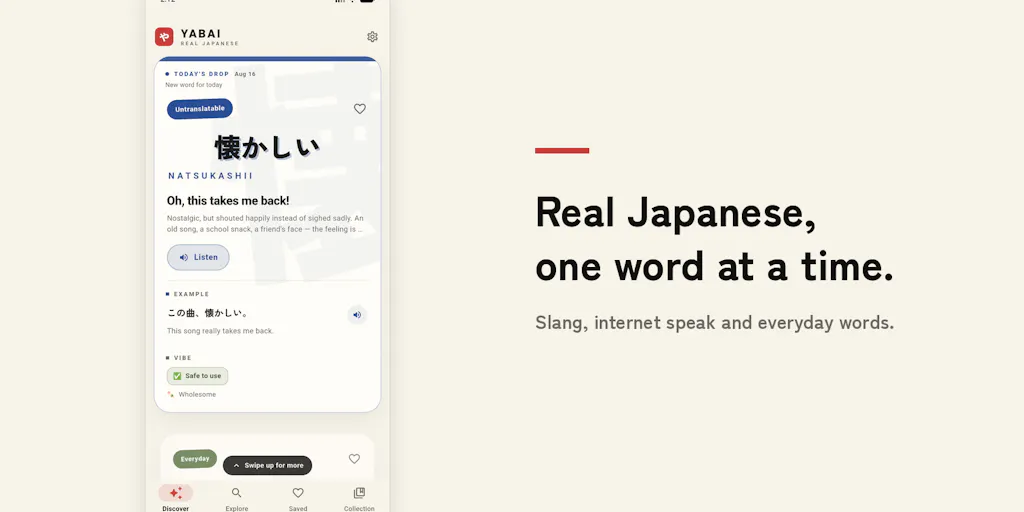
YABAI is an Android app from Yuichi Sato, a solo developer based in Japan. It teaches the layer of Japanese that textbooks skip: slang, internet speak, fandom vocabulary — the words that actually carry a group chat. The pitch, in his own framing, is that he kept meeting people who’d studied Japanese for years and still couldn’t follow a conversation among natives.
The product decisions are where it gets interesting for anyone in commerce:
- 308 words, one per card. Giant typography, swipe to discover, save what you like. No streaks, no tests, no guilt mechanics.
- $0.99, one time. No ads, no tracking, no subscription — explicitly positioned against attention-monetizing apps.
- Offline by default. All 308 entries work without a connection.
- Android only. The iOS side exists in the codebase but hasn’t shipped; he’s said he’ll prioritize it if there’s interest.
- 13 languages, but written in Japanese first. Every entry is researched and written in Japanese, then translated — not machine-translated out of English.
That last point is the whole essay. Hold onto it.
Why the “written in Japanese first” detail matters more than the app
Most localization pipelines in e-commerce run backwards. A merchant writes a listing in English, runs it through a translation layer or a cheap vendor, and ships it. The output is grammatically plausible and culturally inert. It reads like a foreigner doing a competent impression of a native speaker — which is exactly what it is.
Sato inverted the pipeline: source language first, target languages second. That’s a structural choice, not a stylistic one. It means the concept is defined before it’s translated, so the translation has something true to land on.
Now map that onto your own operation. If your German PDP was authored in English and translated, you didn’t localize — you transcribed. If your Japanese Amazon listing was written by someone who started from your US copy, you’re competing against sellers whose copy started in Japanese. You will lose that fight on the margin, every time, and you’ll never see it in a dashboard because the metric that would reveal it — native-reader trust — isn’t in Amazon Seller Central.
How it differs from the incumbents — and why that’s the interesting part
The obvious comparison set is Duolingo, Babbel, and Anki. Duolingo and Babbel are gamified curricula with streaks and retention mechanics baked into the business model — the streak isn’t a feature, it’s the monetization surface. Anki is a power-user spaced-repetition tool with a brutal learning curve and no editorial voice at all.
YABAI sits in a gap none of them occupy: curated, opinionated, tiny, and honest. It’s not a course. It’s not a flashcard engine. It’s closer to a well-edited zine.
Three specific differentiators worth naming:
1. It refuses to invent etymology. Where a word’s origin is genuinely disputed — yabai itself being the example — the app says “nobody agrees” rather than picking a tidy story. Sato’s stated reason: invented etymology is everywhere in slang content and he didn’t want to add to it. That’s an editorial standard, and editorial standards are what separate a brand from a content farm.
2. The word list is rule-governed, not curated by vibe. Every candidate had to be either in current use or evergreen — no dead slang, no words that only exist inside one show. He’s named specific rejections: KY, スパチャ, 最高かよ. The 308 number isn’t a designed cutoff; it’s what survived the rule.
3. The list grows through tester suggestions. Two of the current 308 — ミリしら and ドパガキ — came from testers. New words ship as app updates rather than as paid packs.
Where the math breaks
Here’s the honest counterweight. 308 words is not a fluency threshold, and Sato says so himself — no list of 308 words could be. He’s explicit that YABAI isn’t a course and isn’t a “you can follow native content now” set. It’s the layer textbooks skip.
That’s a narrow promise, and narrow promises are commercially risky. A $0.99 one-time purchase with no subscription, no ads, and no tracking is a business model that only works at volume or as a labor of love. There’s no expansion revenue, no upsell, no LTV curve to speak of. For a solo dev with low overhead, fine. As a template for a venture-backed product, it doesn’t pencil.
But — and this is the point — the monetization model isn’t the lesson. The editorial discipline is.
What cross-border sellers should actually borrow here
I’ve watched a lot of DTC brands burn five-figure budgets on localization vendors and get back copy that reads like a compliance document. The YABAI playbook suggests four things you can steal this quarter.
Source-language-first authoring
Stop treating English as the canonical source of truth for every market. For your top three non-English markets, commission the original copy in the target language from someone who lives in that market and buys in that category. Then back-translate it into English for your own review. You’ll hate the first draft because it won’t match your brand voice doc. That’s the signal it’s working — your brand voice doc was written in English for English readers.
The cost is real: a native-authored German PDP runs multiples of a machine-translated one. But compare it to your CAC. If native copy lifts conversion by even 15% on a market doing $50K/month, the copy pays for itself in weeks.
Rule-governed content, not vibe-governed content
Sato rejected KY and スパチャ not because they’re bad words but because they failed a rule: current use or evergreen, no single-show vocabulary. That’s a content governance framework, and most e-commerce brands have nothing comparable.
Apply it to your UGC and creator pipeline. What’s your rule for which creator clips make it into paid ads? Which customer reviews get surfaced on the PDP? If the answer is “the ones that look good,” you don’t have a rule — you have a taste preference that won’t survive a team change.
Honesty as a differentiator, not a liability
The “nobody agrees” treatment of yabai’s etymology is the single most brand-building decision in the whole product. In a category saturated with confident misinformation, admitting uncertainty reads as authority.
Cross-border sellers have an equivalent move available: say what you don’t know. If your shipping time to Brazil is 12–18 days and you’re not sure which end of that range is typical, don’t print “fast shipping.” Print the range. Buyers who feel misled churn and leave reviews; buyers who feel accurately informed come back. The review-score delta between those two populations is worth more than the conversion lift from a vague promise.
Small, opinionated, maintained
308 words that stay current beats 3,000 words that rot. The tester-suggestion pipeline is what keeps YABAI from going stale — one commenter on the launch thread made exactly this point, noting that most slang apps ship once and decay within a year.
Your equivalent: your help center, your FAQ, your size guide, your returns policy. These are the assets that rot silently. A size guide written for your 2022 product line is actively costing you money in 2025, and nobody owns it because it “shipped.”
Why Amazon sellers should care more than Shopify ones
If you’re on Shopify, you own your storefront and your copy is yours to fix. Painful, but tractable.
If you’re on Amazon, you’re renting shelf space in a marketplace where the listing is the product. Your title, bullets, and A+ content are competing against native sellers who wrote in-market from day one. Amazon’s own translation and localization guidance will get you to grammatical; it won’t get you to native. And the algorithm rewards conversion rate, which means bad localization doesn’t just cost you the sale — it costs you ranking, which costs you the next hundred sales.
Same logic applies on TikTok Shop, where your creator brief is effectively your localization document. If the brief is written in English and the creator is shooting in Indonesian, you’ve already lost the tone. On Etsy, where buyers are explicitly shopping for authenticity, a machine-translated listing is a category error — the whole premise of the marketplace is that a human made this.
Where my judgment says this falls short
I’ll be direct about the limits, because the launch thread was refreshingly honest and the analysis should be too.
Android-only is a real ceiling. Sato confirmed iOS isn’t shipped, though the codebase is set up for it. For a product whose value proposition is casual, snackable discovery, iOS users are a meaningful chunk of the exact demographic that would pay $0.99 for a beautifully designed language toy. Until that ships, the addressable market is roughly half what it could be.
308 words is genuinely thin for the price of attention. Even with the rule-governed framing, a user who finishes the deck in a week has nothing left to do. The update pipeline helps, but it’s dependent on one person’s editorial throughput. There’s no roadmap for what happens at 500 or 1,000 words — does the “one word per card, swipe to discover” interaction still work at that scale, or does it need search and categories? Not disclosed.
The one-time $0.99 model caps the product’s ambition. No subscription means no recurring revenue to fund ongoing research, translation into more languages, or the iOS build. Sato has framed this as a principled choice — no attention monetization — and I respect it. But principled choices have costs, and the cost here is that the app’s growth is bounded by its founder’s available hours.
The 13-language translation claim is the one I’d want to audit. “Researched and written in Japanese first, then translated into 13 languages” is a strong claim. Whether those 13 translations were done by native speakers of each target language, or by Sato with translation tooling, isn’t specified in the thread. For a product whose entire pitch is translation honesty, that’s the detail I’d want surfaced.
The uncomfortable comparison
Compare YABAI’s editorial discipline to what most cross-border brands ship. A $0.99 app with 308 words has a clearer content governance framework than the average eight-figure DTC brand’s localization stack. That’s not a compliment to the app — it’s an indictment of how we’ve been operating.
What I’d watch / test next
Three concrete moves for this week.
Audit your top non-English market’s top-selling PDP. Pull the copy and ask one question: was this authored in the target language, or translated into it? If you can’t answer, that’s your answer. Get a native speaker in-market to read it cold and tell you what feels off. Budget two hours and one freelance invoice.
Write a content rule for one pipeline. Pick your creator UGC or your review-surfacing logic and write down the actual criteria — the equivalent of Sato’s “current use or evergreen, no single-show vocabulary.” If you can’t articulate a rule, you have a taste preference, and taste preferences don’t scale past the person who holds them.
Find one place to say “we’re not sure.” Pick a claim on your PDP or in your ads that you’ve been rounding up. Shipping time, material sourcing, durability. Replace the confident version with the accurate range. Watch your return rate and your review sentiment for 30 days. My prediction: conversion dips slightly, returns drop more, and the net is positive. But test it — don’t take my word for it.
The broader bet I’m making: as AI translation gets cheaper and more ubiquitous, native-authored copy becomes more valuable, not less, because it becomes the only thing that’s scarce. YABAI is a small proof of that thesis. The sellers who internalize it early will have a durable edge in every market where their competitors are still running English through a pipe.


