The AI literacy gap is now a P&L problem for cross-border sellers
Every cross-border operator I know is running the same quiet experiment right now: how much of the daily grind — listing copy, customer replies, ad variants, supplier emails, DSAR responses — can be handed to a model without torching margin or brand voice. The bottleneck was never access. It’s fluency. Most sellers I talk to have ChatGPT open in one tab and a half-finished prompt template in another, and they still can’t explain why one output beats another. That’s why Unscary AI, a free iOS course from Bryce Murray and his team at B43, caught my attention — not because it’s a seller tool, but because it treats AI literacy as a curriculum problem, and most of our industry is still treating it as a vibes problem.
What Unscary AI actually is, and the problem it’s really solving
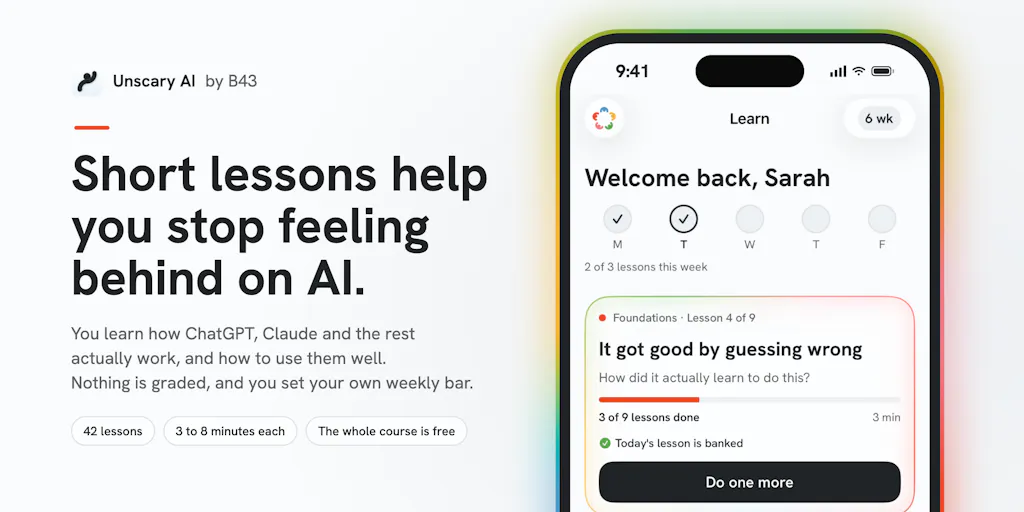
Strip away the launch-page framing and Unscary AI is a mobile course: 42 short, hands-on lessons covering how ChatGPT, Claude, Gemini, Copilot and the rest actually work. Each lesson runs 3 to 8 minutes and shows one thing per screen. It requires iOS 26, and the whole course is free. Murray is the founder of B43 in Columbia, Missouri, where he runs AI training for small businesses across the Midwest and South, and he has a PhD in Explainable AI. The app is the in-person workshop repackaged for anyone who feels behind.
The problem it’s solving isn’t “people don’t know what AI is.” It’s that the people who most need AI fluency — small business owners, ops leads, one-person e-commerce brands — are the least likely to sit through a 6-hour cohort course or a YouTube rabbit hole. Murray’s line at B43, “We take the scary out of AI,” came from a client unprompted, and it’s the whole thesis. The design choice that matters most is the one Louis Durance flagged in the comments: 3-to-8 minute lessons, one concept per screen, doable on a bus or while waiting for tea. That’s a retention mechanic, not a content one. Long courses get abandoned; micro-lessons get finished. Murray’s own reply is telling — “there’s no ‘AI’ in the actual flow. It’s just some reading, clicking, and understanding.” No chat window, no API key, no prompt playground. For a non-technical Amazon seller who’s been told for two years that they need to “learn AI,” that friction removal is the entire value proposition.
Why this lands differently for Amazon sellers than Shopify ones
Here’s the split I keep coming back to. A Shopify DTC operator has more latitude: they own the storefront, they can A/B test a new PDP headline on Tuesday and roll it back on Wednesday, and their brand voice is theirs to define. An Amazon FBA seller is operating inside a stricter box — listing copy has to survive Helium 10 indexing, Seller Central policy, and a marketplace search algorithm that punishes cleverness. The AI tasks are different, too. Amazon sellers need help with keyword-stuffed-but-readable bullets, A+ content modules, negative-review triage, and increasingly, the compliance-heavy stuff like product liability documentation and marketplace-specific returns narratives. A Shopify operator can afford to experiment with an AI-generated email flow in Klaviyo; an Amazon seller who lets a model hallucinate a safety claim on a listing is looking at a suppression. That asymmetry means Amazon-side operators need more foundational understanding, not less — they need to know why the model said what it said, because the cost of a wrong output is higher. A course like Unscary AI, which explicitly teaches how the models work rather than just what to type, is arguably more valuable to the marketplace seller than the DTC one.
Where the math breaks
Free is a great price, but “free iOS course” has a hidden cost structure. First, it’s iOS 26 only — that’s a hard gate that excludes anyone on Android, anyone on an older iPhone, and anyone who does their learning on a laptop between supplier calls. For a cross-border audience specifically, that’s a meaningful slice: a lot of sourcing and ops work happens on Windows machines in Shenzhen, Guangzhou, and Ho Chi Minh City offices, not on a phone. Second, there’s no completion tracking, no certificate, no team dashboard — so if you’re a brand owner trying to roll this out across a 4-person ops team, you have no way to verify anyone actually did it. Third, and this is the one that matters most for operators: the course teaches how AI works, not how AI works for your P&L. There’s no module on “how to audit whether your AI-generated listing copy is cannibalizing your organic rank,” no lesson on “how to build a returns-response prompt that survives a marketplace appeal.” That’s not a criticism of the product — it’s a scope statement. It’s a literacy course, not a playbook.
How it stacks up against the alternatives
The honest comparison set isn’t other AI courses. It’s the three things a busy seller actually reaches for when they want to get better at AI:
YouTube and free newsletters. Infinite, free, and almost entirely unstructured. The failure mode is that you watch a 45-minute “10 ChatGPT prompts for Amazon sellers” video, save none of it, and retain nothing. Unscary AI’s edge is curation and sequencing — 42 lessons in a deliberate order, one concept per screen. That’s a real product decision, not a content dump.
Paid cohort courses and certifications. Typically $500–$2,000, 4–8 weeks, live or semi-live, with a cohort and a Slack. The advantage is accountability and peer pressure. The disadvantage is scheduling — a seller in the middle of Q4 peak cannot block out Tuesday evenings for six weeks. Unscary AI trades accountability for accessibility. Whether that trade is right depends entirely on whether you finish things you start on your phone.
Just using the tools. The default path for most operators. You learn by doing, you build your own prompt library, you develop instincts. This works — until it doesn’t, usually the first time a model confidently invents a shipping timeline or a compliance claim and you don’t have the framework to catch it. That’s the gap a fundamentals course fills.
What Unscary AI does not compete with is the growing layer of seller-specific AI tooling — the listing optimizers, the review-analysis dashboards, the ad-copy generators baked into Helium 10, Jungle Scout, and the various TikTok Shop and Temu seller consoles. Those tools assume you already know what good output looks like. Unscary AI is upstream of them. The two aren’t substitutes; they’re sequential.
The “explainable AI” credential is doing more work than it looks
Murray’s PhD is in Explainable AI, and that’s not a throwaway line on a launch page. The entire failure mode of AI in e-commerce right now is that operators can’t explain why a model produced a given output, so they either over-trust it (and ship a hallucinated spec) or under-trust it (and never use it for anything that matters). Explainability is the discipline of making the model’s reasoning legible. If even 20% of that leaks into the course design — teaching sellers to ask “what would make this output wrong?” rather than “is this output good?” — that’s a more durable skill than any prompt template. Prompt libraries rot. Mental models don’t.
What cross-border sellers should actually borrow from this
Even if you never install the app, there are three transferable lessons for how you run AI inside your own operation.
Lesson one: ship AI training in 5-minute blocks, not half-day workshops. The reason most seller teams never get fluent is that AI training gets scheduled as a special event, and special events get cancelled during peak. Murray’s bet — one thing per screen, 3 to 8 minutes — is the right unit of learning for an ops floor that’s already context-switching between supplier emails and ad dashboards. If you’re a brand owner, stop planning the AI workshop. Start dropping one prompt-technique into the team Slack every morning. Same content, better retention.
Lesson two: teach the why, not the what. A prompt template for “write a 5-bullet Amazon listing” is worthless the moment Amazon changes its character limits or your category shifts. A mental model of how a language model predicts the next token — and where that prediction goes wrong — survives every platform change. This is the explainable AI argument applied to your own team: the goal isn’t a library of prompts, it’s a team that can write a new prompt for a new situation.
Lesson three: remove the “AI” framing from the workflow. Murray’s comment that there’s no “AI” in the actual flow is the most underrated line on the page. The sellers who get the most out of these tools don’t think of themselves as “using AI.” They think of themselves as writing a better product description, faster. The moment AI becomes a separate category of work, it becomes optional. The moment it becomes just part of how you write, it becomes default.
Where I think this falls short for our audience
Two honest gaps. First, the platform gate: iOS 26 only, no Android, no web. For a cross-border audience that skews heavily toward mixed-device teams, that’s a real limitation, and it’s the kind of thing that should be on the roadmap before the course gets recommended inside a 10-person ops team. Second, the content is deliberately generic — it teaches ChatGPT, Claude, Gemini, and Copilot, not Amazon, Shopify, or TikTok Shop. That’s the right call for a literacy product, but it means the seller-specific translation work is on you. Nobody in the app is going to tell you that your AI-generated bullet points need to survive Helium 10 indexing, or that your AI-drafted customer reply needs to comply with Amazon’s buyer-seller messaging policy. That gap is where a paid, seller-specific course could live — and it’s a gap Murray’s team is explicitly not trying to fill right now.
What I’d watch / test next
Three concrete moves for this week. One: if you’re a solo operator or a small brand owner, download the app and actually finish the first three lessons — the first one is 3 minutes and it’s the cheapest possible test of whether this format works for you. Don’t just skim; note where you get bored, because that tells you whether micro-learning is your mode. Two: if you run a team, don’t roll this out as a mandate. Pick one person, have them finish the course, and ask them to teach one lesson back to the group in a 10-minute standup. That’s the real test of whether the content transfers. Three: audit your own AI usage against the explainability question — for your last 10 AI-generated outputs that shipped, could you explain why the model produced them and what would have made them wrong? If the answer is no for more than three, you have a literacy gap, and a free course is a cheap way to close it before it shows up in your returns rate. I’ll be watching whether B43 ships an Android version and whether they ever layer seller-specific modules on top. Until then, treat this as foundational reading, not a growth tactic.