The Real Edge in Cross-Border E-Commerce Isn’t a Cheaper Supplier — It’s a Better Hypothesis
Most sellers I talk to start with the same playbook: scroll best-sellers on Amazon, filter by low competition, order samples from Alibaba, launch with a loss-leader coupon, and pray the PPC math works. That path works until it doesn’t — because by the time a product shows up on a best-seller list, the margin has already been arbitraged away by a dozen copycats in Shenzhen. The real opportunity lies in spotting demand before it registers on the Amazon sales rank or the TikTok trending tab. That’s why I paid close attention when Trend Seeker launched on Product Hunt — a tool built to aggregate weak signals from Reddit, podcasts, job ads, and Google Trends into actionable business ideas. It’s designed for software founders, but the methodology is directly transferable to physical goods. If you can learn to read multiple demand signals instead of relying on a single platform’s sales data, you can enter a category six months before the masses arrive. The trick is knowing which signals actually predict payment — and that’s where Trend Seeker both helps and falls short.
Why a Signal Aggregator Beats a Single-Platform Research Tool
The standard cross-border research stack today is Amazon-centric. Sellers use Helium 10 or Jungle Scout to pull search volume, competition scores, and historical BSR. Those are essential tools, but they only tell you what has already sold on one marketplace. They don’t tell you what people are starting to complain about on Reddit, what podcast hosts are calling the next pain point, or what companies are hiring for — all of which can signal demand that hasn’t yet materialized on Amazon.
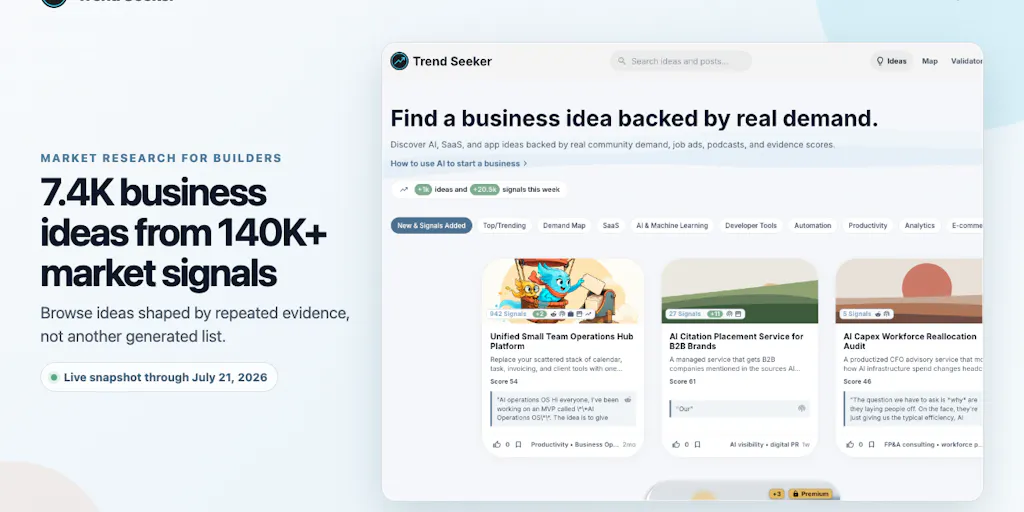
Trend Seeker takes a different approach. It collects signals from Reddit threads, podcasts, job posts, Google searches, and product launch directories. The founder, Tõnis Tiganik, says the tool currently groups 140K+ signals into 7,400 business ideas. For a cross-border seller, that’s a lead-generation engine for product concepts — but only if you know how to filter it for purchasing intent rather than just conversation volume.
I’ve seen sellers miss entire waves because they only watched Amazon’s Movers & Shakers. The fidget-spinner boom, the weighted-blanket surge, the sudden spike in portable air conditioners during heat waves — all of those were preceded by months of chatter in online communities and rising Google searches. A tool that aggregates those signals can compress the time from “I think this might work” to “I know this is worth testing” from months to days. The challenge is that conversation does not equal conversion, and Trend Seeker’s own creator admits “it can’t prove that someone will pay.” That’s the gap the seller must learn to bridge.
How Amazon Sellers Should Use Trend Seeker Differently
Amazon sellers are in a unique position because they can validate demand through keyword search volume and PPC click-through rates before ever ordering inventory. But those Amazon-specific signals are reactive — they show demand that already exists. Trend Seeker’s Reddit and podcast signals can be proactive. For example, if you find a Reddit thread with high karma where people are complaining about the lack of waterproof phone pouches for kayaking, and you cross-reference that with a rising Google Trends curve for “waterproof phone pouch kayak,” and you notice a few job ads for “product designer — outdoor accessories,” you’ve triangulated a real need. At that point, you can run a small Amazon PPC test with a generic listing or even a pre-launch page on Shopify to gauge click-through rates.
The key is not to treat Trend Seeker as a substitute for Amazon-specific tools but as a complement. Use it to generate hypotheses, then validate with Helium 10 keyword data, Jungle Scout opportunity scores, and a cheap PPC experiment. Sellers who rely solely on Amazon data will always be one step behind; sellers who layer on multi-source signal detection can lead the wave.
How Trend Seeker Works — and What E-Commerce Operators Can Borrow
Trend Seeker’s core workflow is simple: you feed it a market category or broad interest area, and it surfaces related signals from multiple channels. The signals are grouped into “business ideas” with links back to the original sources. The Demand Map shows where related signals concentrate geographically or by channel. The free Idea Validator matches your own product description against the signal database and returns related requests and nearby ideas.
For a cross-border seller, the most valuable part is the signal-quality feature. Tõnis explains that they weight signals by podcast reputability and listener count, Reddit poster karma and vote count, and the number of similar products already launched in directories. That’s a rough proxy for “is this real interest or just noise?” But it’s still missing the most important weight: money already moving.
The “Money Already Moving” Litmus Test
One commenter on the Product Hunt page, Clemente Lopez, put it perfectly: “the evidence I trust is not how much people complain, it is whether money is already moving badly: people hiring, stacking tools, paying for workarounds.” He said that in healthcare, everyone complained about clinical notes, but the actual money was in getting reimbursed by insurance. A tool ranking by signal volume would have pointed him at the wrong wedge.
This is the single biggest risk for cross-border sellers using Trend Seeker. A Reddit thread with 2,000 upvotes about how hard it is to clean a reusable water bottle does not mean people will buy a self-cleaning bottle. But a job ad from a major outdoor brand hiring a “hydration product manager” combined with a rising Google Trends curve for “self-cleaning bottle” starts to look like a real market formation. The seller must learn to layer on third-party purchase data. For instance, you can check Keepa to see if any related products have appeared on Amazon with rising sales ranks, or look at TikTok Shop trending products using a tool like TikTok Seller Center. If the signal shows up in Reddit conversations and in actual sales data, you have a much stronger hypothesis.
Why Shopify Store Owners Should Pay Attention to Job Ads
The job-ad component is especially underappreciated. Trend Seeker includes 170K job ads from which it extracts signals. If you see a sudden spike in job ads for “sustainable packaging engineer” or “supply chain manager — direct-to-consumer,” that’s a leading indicator of industry investment. People don’t hire specialists unless they expect demand. For a Shopify store owner, that could mean building a product line around sustainable packaging supplies. For an Amazon seller, it could mean sourcing eco-friendly alternatives to existing best-sellers.
Most product research tools ignore employment data entirely. Trend Seeker doesn’t, and that’s a genuine differentiator. The catch is that job ads are still a lagging indicator of corporate strategy, not a leading indicator of consumer behavior. You need to cross-reference them with consumer-level signals like search trends and social media chatter.
The Free Idea Validator: A Quick Test for Your Next Product
If you’re a seller with a product concept already in mind, the free Idea Validator (accessible via the Trend Seeker product page) is worth a ten-minute test. Paste in a description of your product idea, and it will return related signals from the database. I tested it with “reusable silicone food storage bags” — a saturated category — and it pulled up Reddit comments about freshness seal issues and podcast mentions of zero-waste kitchen habits. That doesn’t tell me whether I should launch, but it tells me which pain points to address in my listing copy and which customer segments to target. For a seller doing product differentiation, that’s actionable research in minutes.
Where the Math Breaks: Talk vs. Transaction
Trend Seeker is a discovery tool, not a validation tool. That’s fine, but sellers need to understand the gap. The founder explicitly states: “It can’t prove that someone will pay.” In cross-border e-commerce, the cost of a wrong bet is inventory — thousands of dollars tied up in a product that moves two units a month. A Reddit thread with 500 upvotes is not a substitute for a Jungle Scout Opportunity Score or a Helium 10 Cerebro search-volume check.
Sellers who treat Trend Seeker as a crystal ball will get burned. The value is in generating hypotheses, not in validating them. The tool can dramatically reduce the number of blind alleys you walk down, but it cannot replace the need to test with real money — whether through a small PPC campaign, a crowdfunding pre-sale, or a limited inventory order.
Why Amazon Sellers Should Care More Than Shopify Ones
Amazon requires inventory commitment. You can’t test a product on Amazon without at least a few hundred units and a PPC budget. That makes every wrong product choice expensive. Shopify store owners, especially those using print-on-demand or dropshipping from suppliers like Spocket, can test a product with zero inventory risk. They can throw up a product page, run a few Facebook ads, and see if the clicks convert. For them, Trend Seeker’s signals are higher-value because the cost of acting on a false positive is lower.
An Amazon seller, by contrast, needs to be more selective. If you see a signal from a podcast about “smart pet feeders with app controls,” you shouldn’t immediately order 1,000 units from a factory. Instead, you should first check Amazon search volume for “smart pet feeder,” look at existing competitors’ reviews for common complaints, and then run a small PPC test with a generic listing (if you have a brand registry) to gauge conversion rates. Trend Seeker can flag the opportunity; the Amazon-specific tools validate the mechanics.
Judgment: Where Trend Seeker Falls Short for Physical Goods
I’ll be blunt: Trend Seeker is currently optimized for SaaS and digital product ideas. The signals it aggregates — Reddit threads, podcast discussions, job ads — are overwhelmingly about software problems. A quick scan of the “business ideas” it generates shows a heavy bias toward AI tools, developer workflows, and productivity apps. Physical goods like kitchen gadgets, pet accessories, or outdoor gear are underrepresented because the signal sources tend to be tech-heavy.
The tool also lacks any integration with e-commerce platforms. It doesn’t pull Amazon Best Sellers, TikTok Shop trending products, or eBay trending categories. For a cross-border seller, those are the most direct sources of demand evidence. Without them, Trend Seeker remains a pre-research tool rather than a core part of the product research stack.
Additionally, the signal-quality scoring is a work in progress. Weighting podcast relevance by listener count is a start, but it doesn’t account for whether the podcast host is talking about a consumer pain point or a corporate solution. A mention on a tech podcast about “API integrations” is useless to a seller of baby car seats. The tool needs better categorization of signals by vertical and by consumer vs. business context.
That said, the concept is sound, and the execution is early. I’d rather see a tool that tries to aggregate broad signals than one that stays narrow. Trend Seeker has a unique angle — the combination of Reddit, podcasts, job ads, and Google Trends — and if the team continues to refine it, it could become a useful addition to a seller’s toolkit.
What I’d Watch for in the Next Update
The most promising direction for cross-border sellers would be if Trend Seeker adds an e-commerce data layer. Imagine being able to see a signal from Reddit about “noise-canceling curtains” and immediately see that Amazon search volume for “noise reduction curtains” has doubled in three months, or that three new products have launched with positive reviews. That kind of integration would make the tool far more actionable.
For now, I’d also like to see better filtering by consumer vs. B2B signals. Many of the job ads and Reddit threads are corporate. A “product manager” job ad does not necessarily point to consumer demand. If the team can add a filter for “consumer pain point vs. enterprise need,” that would help sellers focus.
What I’d Watch / Test Next
If you’re a cross-border seller or DTC operator, here are concrete steps you can take this week using Trend Seeker plus your existing stack:
Create a free account on Trend Seeker and run searches for your niche — “kitchen gadgets,” “pet supplies,” “outdoor gear.” Spend 30 minutes exploring the signals. Note any Reddit threads or podcast episodes that mention a specific pain point you haven’t seen before. Link to the product page here for sign-up.
Cross-reference the top three signals with Google Trends. If the search trend is flat or declining, discard the idea. If it’s rising, move to step three.
Run a keyword assessment using Helium 10 Cerebro or Jungle Scout Keyword Scout. Look for monthly search volume above 10,000 but with low-to-medium competition. If the keywords don’t exist on Amazon, the demand may still be too niche — consider testing on Shopify first.
Check for existing products on Amazon using Keepa. Look at the sales rank history of similar products. If no one is selling it yet, you could be first — but also be wary of a nonexistent market. A few competitors with stable ranks is a good sign.
Run a low-cost ad test on Facebook or TikTok Ads for the product concept. Use a simple landing page or a Shopify storefront. If you get a 3%+ click-through rate or low-cost conversions, that’s a green light to order samples.
Set up a simple Reddit alert for your niche using Brand24 or a free IFTTT applet. Track mentions of pain points you found on Trend Seeker to see if the conversation is growing.
Finally, bookmark Trend Seeker’s updates. The signal-quality feature is still WIP. If they add purchase-intent data from e-commerce platforms, I’d reconsider it as a primary research tool. For now, it’s a useful hypothesis engine — but never bet inventory on a single Reddit thread.
The best cross-border sellers I know aren’t the ones with the cheapest factory or the most aggressive PPC. They’re the ones who spot a demand pattern before the market saturates. Trend Seeker can help you spot the pattern — but you still need to verify that the pattern leads to a purchase. Use it as a spotlight, not a compass, and you’ll find your next winning product before the copycat herd arrives.