Why a Tiny App Store Ranking Tool Matters More to Sellers Than to Developers
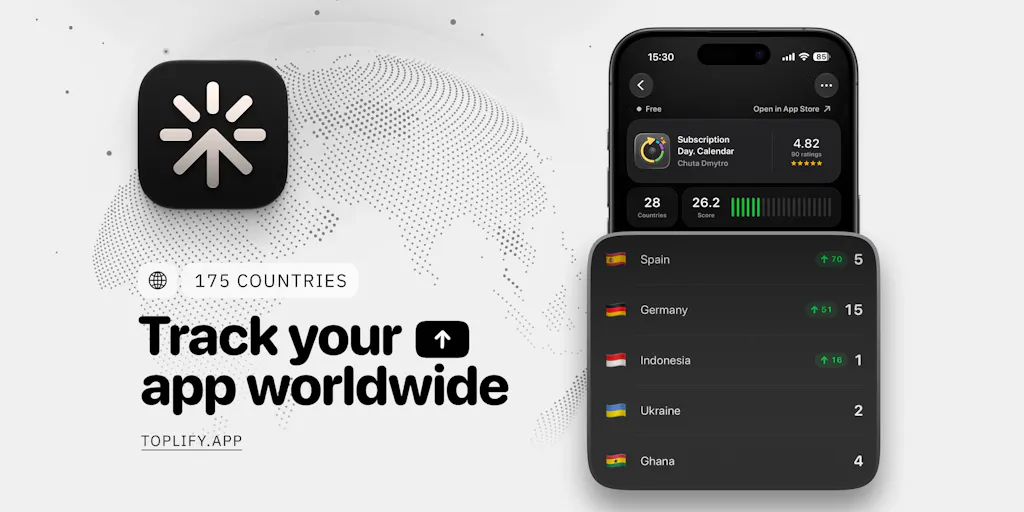
Every cross-border operator I know has the same blind spot: we obsess over our own storefront metrics — conversion rate, ad spend, review velocity — while treating the marketplaces we sell on as static black boxes. We watch our Amazon BSR climb and assume it means something, but we have almost no visibility into where our products are actually winning geographically, or when a ranking shift is a genuine signal versus statistical noise. That blind spot is expensive. It means we discover a breakout market three weeks late, or we pour ad spend into a region where we’ve already plateaued. So when I saw a small indie tool called Toplify launch on Product Hunt this week, I didn’t see another ASO utility for lonely iOS developers. I saw a working example of something cross-border sellers desperately need: real-time, geographically granular ranking intelligence, delivered without enterprise bloat. The specific product is for apps. But the pattern — lightweight monitoring, push-based alerts, AI-filtered noise reduction — is a template for how any seller should be watching their own performance across 175 markets.
The Problem: You’re Flying Blind in 174 of Your Markets
Let me be blunt about the state of ranking intelligence in e-commerce. If you sell on Amazon Seller Central, you get a Best Sellers Rank that updates sporadically, gives you zero historical context, and tells you nothing about why a product moved. If you sell on Shopify, you have to piece together “ranking” from third-party app data that’s often stale by days. And if you’re running a TikTok Shop or an Etsy storefront, you’re lucky to get a category position at all. The platforms treat ranking data as a proprietary asset, not a service they owe you.
The indie developer who built Toplify, Dmytro Chuta, articulated the frustration perfectly in his launch post: “Most indie developers don’t know where their apps are ranking.” He points out that App Store Connect doesn’t show where your app ranks across countries, and that existing ASO tools are “expensive and overloaded with features that many indie developers simply don’t need.” Swap “ASO tools” for “Amazon tracking software” and “app” for “product,” and he’s describing the exact gap every cross-border seller lives with. We have tools like Helium 10 and Jungle Scout that give us keyword volume and estimated sales, but they’re weekly snapshots at best. They don’t tell you the moment your product enters a new country’s top 100, and they certainly don’t push a notification to your phone when it happens.
Toplify’s core pitch is that it monitors App Store rankings across 175 countries, 24⁄7, with no API keys and no App Store Connect access required. You just paste a link and it starts tracking. For a cross-border seller, that “no integration required” philosophy is the real lesson. We’ve all been trapped in setups where the data you want is locked behind a vendor’s API contract or a platform’s permission model. The moment a tool tells you “just paste your product URL and we’ll handle the rest,” it’s removed the single biggest barrier to actually using competitive intelligence.
Why Amazon sellers should care more than Shopify ones
Amazon sellers live and die by ranking in a way that Shopify store owners simply don’t. A Shopify store’s “ranking” is really just your ad position and your SEO domain authority — both of which you control through spend and content. But an Amazon listing’s rank is a proxy for demand itself, a direct function of sales velocity in a given category and region. When your product jumps from rank 4,000 to rank 350 in Germany overnight, that’s not a vanity metric — it’s a signal that either a competitor ran out of stock, a viral social post hit, or a deal site featured you. Missing that signal means missing the chance to raise your price or increase your ad bid while the window is open. Toplify’s approach of alerting on “significant jumps” — a jump of 50+ positions or entering a new country’s charts — is precisely the kind of event-driven monitoring an Amazon seller needs for their BSR across marketplaces.
How Toplify Actually Differs from the Incumbents
The existing ASO landscape is dominated by heavyweight platforms like App Annie (now data.ai) and Sensor Tower. These are enterprise tools with six-figure price tags, designed for marketing teams that need deep-dive analytics, competitive benchmarking, and multi-platform coverage. They’re powerful, but they’re also slow. As Chuta notes in his Product Hunt comments, “Web services… often provide daily or weekly reports, while I wanted to build a tool that shows the results of your work almost immediately.”
That’s the fundamental difference. Toplify is built around the push notification as the primary interface, not the dashboard. The maker’s own example is telling: “You post about your app on Threads and it takes off. You immediately get a notification that your app has entered the Top Charts. Then you generate a Share image to celebrate the result, post it, and potentially get even more downloads.” This is a real-time feedback loop, not a reporting tool. For a cross-border seller, this is the difference between checking your Amazon dashboard every morning and getting a ping the moment your product enters a new country’s top 50.
The second differentiator is the AI-filtered alerting. A commenter on the Product Hunt thread raised the exact concern any seller would have: “Small stores are so thin that an app can jump 40 places on like 6 downloads, so if every wobble pings me I’d have it muted by Tuesday.” Chuta’s response is the smartest thing in the entire launch thread. He explains that the app tracks all “Events” server-side, but AI selects only the single most important one to notify you about, and “it may decide not to send anything at all, even if dozens of Events occurred.” This is noise filtering done right — not a threshold slider you have to fiddle with, but a judgment call about what actually matters.
For sellers, this is a direct critique of how we currently use tools like Keepa or CamelCamelCamel. Those tools give us price drop alerts, but they spam us with every minor fluctuation. We end up ignoring notifications entirely. Toplify’s “AI picks the one thing worth saying” approach is the model we should demand from every e-commerce monitoring tool we use.
Where the math breaks
Here’s where I have to be honest about the limits of the comparison. Toplify’s data model works for apps because an app has a finite set of rankings: up to four per country (two category rankings, overall, and overall games). That’s manageable. But a physical product on Amazon has a BSR for every category it’s eligible in, across every marketplace, and those rankings fluctuate based on inventory, seasonality, and competitor stockouts. The data volume is orders of magnitude larger. The maker himself admits that history is limited to two weeks because of storage costs — “Imagine storing every ranking change in every country for every app on the App Store.” Now imagine doing that for every SKU you sell. The math gets ugly fast. This is why the big enterprise tools charge what they do: the infrastructure cost of real-time, multi-market tracking is genuinely expensive.
What Cross-Border Sellers Can Borrow (Even Without Using the App)
The most valuable part of this launch isn’t the app itself — it’s the design philosophy for how a solo operator should build a monitoring stack. There are three specific lessons I’d extract and apply to any e-commerce operation this week.
Lesson one: No API key means no lock-in. Toplify’s decision to work without App Store Connect access is a product stance, not a technical limitation. It means the tool can track any app, including competitors, without needing their permission. The cross-border equivalent is using publicly available data — like Amazon’s public BSR pages or Shopify’s public storefronts — rather than paying for API access. You can track a competitor’s price changes and stock status without ever logging into Seller Central. The data is public; the tooling just has to be willing to scrape it.
Lesson two: Push notifications beat dashboards for time-sensitive decisions. We’ve all been trained to think of analytics as a place you visit. But the most profitable decisions in cross-border e-commerce are time-sensitive: a competitor’s stockout, a sudden spike in a new market, a viral social post about your product. Those opportunities close within hours, not days. The tool that wins is the one that pushes the signal to you the moment it happens, not the one that has the prettiest charts. Toplify’s entire product is built around push notifications for new rankings and significant jumps, and that’s the right instinct for any seller.
Lesson three: AI-filtered alerts are the only way to avoid alert fatigue. The commenter who worried about being “muted by Tuesday” is describing exactly what happens with every e-commerce alert tool I’ve ever used. The solution isn’t more granular thresholds — it’s smarter filtering. Toplify’s approach of having AI decide whether an event is worth interrupting you is the right model. You don’t want to know about every 10-position wobble. You want to know when something changed. For sellers, this means being willing to pay for tools that filter intelligently rather than free tools that blast everything.
The “quiet log” problem every operator will face
One commenter raised a point that should resonate with anyone who reports to a team or an investor: “During a launch week I report numbers to the team, and ‘the AI didn’t think it mattered’ is a scary answer if someone asks why we missed a dip.” This is the eternal tension between automation and accountability. The maker’s response was that all data is still visible in the app — the AI just chooses what to notify you about. But for a cross-border operator, this is a genuine workflow issue. If your monitoring tool decides not to alert you, and you don’t have a way to audit what it skipped, you’re trusting the algorithm’s judgment with your business decisions. The practical fix is to demand tools that give you both: smart alerts and a full event log you can review on your own schedule.
Where My Judgment Says Toplify Falls Short
I want to be clear that Toplify is a well-executed product for its intended audience. The UI is polished, the pricing is indie-friendly, and the free tier for apps ranking in fewer than 4 countries is a smart acquisition play. But for cross-border e-commerce operators, there are three significant gaps.
First, it’s Apple-only. The maker has said he plans to add Google Play and Steam tracking in the future, but that’s not a roadmap for e-commerce. There’s no mention of Amazon, eBay, Etsy, or TikTok Shop. The underlying infrastructure — monitoring public rankings across many countries — is transferable, but the product as built is irrelevant to anyone selling physical goods. This is a missed opportunity, not a fatal flaw. The pattern is right; the vertical is wrong.
Second, the two-week history limit is a real constraint. The maker explains that storing all ranking data is expensive, and they plan to extend to one month “once we grow a bit more.” But for any serious analysis — identifying weekly seasonality, measuring the impact of a marketing campaign, spotting a declining trend before it’s obvious — two weeks is not enough. You need at least a quarter of data to see patterns. This is the classic indie trade-off: you build the MVP to prove the demand, then you figure out the data infrastructure later. It’s understandable, but it limits the tool’s utility for anything beyond immediate reaction.
Third, the AI notification filter is a black box. The maker’s description of AI deciding “the single most important one to notify you about” is elegant, but it’s also opaque. How does the AI define “important”? Is it a fixed threshold, or does it learn from your behavior? The commenter’s request for a “quiet log” of skipped events is the right instinct — you need to be able to audit the filter’s decisions. Until there’s transparency into what the AI considers noise, trusting it with your attention is a leap of faith.
What I’d Watch / Test Next
If I were running a cross-border operation, here’s what I’d do with this launch — not by downloading Toplify, but by stealing its blueprint.
This week, audit your own alert stack. Look at every monitoring tool you use — Keepa for Amazon price history, Klaviyo for email flows, Google Alerts for brand mentions — and ask which ones are giving you real-time, actionable signals versus daily digests you skim and forget. Replace at least one daily-digest tool with a push-notification alternative. The feedback loop matters more than the data depth.
Next, build your own “no API key” competitor tracker. Pick your top three competitors on your primary marketplace. Set up a manual weekly check of their public storefronts — price, stock status, review count, BSR. Do it for four weeks. You’ll be shocked at how much you learn about their launch cadence and pricing strategy just from public data. Then look for a tool that automates that collection.
Finally, demand transparency from your AI tools. Before you adopt any tool that uses AI to filter alerts or prioritize data, ask the vendor: “Can I see everything you decided not to show me?” If the answer is no, that’s a red flag. You need the quiet log, not just the headline notification.
The real takeaway from this launch isn’t about App Store rankings. It’s about the shift from passive reporting to active alerting. Cross-border sellers who adopt that mindset — and build their tool stacks around it — will spot market opportunities days before their competitors. That’s a gap worth closing.