The UI Layer of AI Agents Is Quietly Becoming a Cross-Border Ops Problem
Cross-border sellers spent the last two years bolting AI agents onto everything — listing generation, review triage, ad copy, supplier email drafting, customer service macros. What almost nobody budgeted for is the interface layer: how a human operator knows whether the agent is thinking, searching, stuck, or quietly compacting its own context window before it answers. That gap matters more for marketplace sellers than for pure SaaS teams, because our agents run against rate-limited APIs (Amazon SP-API, TikTok Shop, Shopify Admin) where a silent stall costs real money. Thinking Orbs, a new React component library from indie maker Yogesh, is a small but telling signal that this layer is maturing into its own product category — and that operators, not just front-end engineers, should have an opinion about it.
What Thinking Orbs Actually Is (and Why It’s Not Just a Design Toy)
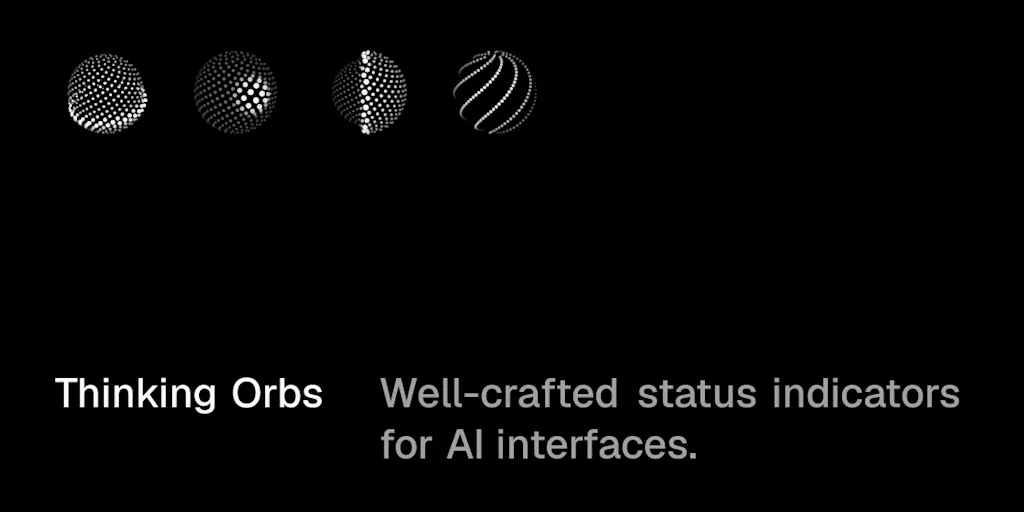
The pitch is deliberately narrow: a React component library of animated status indicator orbs for AI agents. The maker’s own framing is that these are “well-thought-out orbs built with attention to detail on every state and variant” — 8 states, 15 variants, 5 shapes, and 8 render styles, installable via npm i @yogesharc/thinking-orbs. It’s free and open source, which is the detail that should get your attention if you’re running an internal ops dashboard.
The states are the interesting part. They aren’t just “loading” and “done.” They include thinking, searching, and — the one that generated the most discussion in the launch thread — compacting. That last one is a very specific moment familiar to anyone who has watched a long-running agent session summarize its own context to stay under a token limit. As one commenter from Dial put it, compacting is “a very Claude-Code-specific moment… that most status indicator libraries wouldn’t think to name separately from generic ‘thinking.’”
For a cross-border seller, that distinction is not cosmetic. If you’ve ever had an agent mid-way through rewriting 400 Amazon bullet points suddenly lose the thread because it silently compacted the product spec out of context, you already understand why “compacting” deserves its own visual state.
The states are the product, not the animations
A generic spinner tells you something is happening. A state-aware orb tells you what kind of something. That’s the difference between an operator waiting patiently and an operator refreshing a tab, killing a job, and re-running it — which, on a metered API like Amazon Selling Partner API or a paid model endpoint, is a direct cash leak.
How It Compares to the Incumbents You’re Already Using
If you’re building internal tooling, you’ve probably reached for one of three things: a generic UI kit like shadcn/ui or Chakra UI, a chat-specific library like Vercel AI SDK’s UI primitives, or — most commonly — nothing at all, just a <Spinner /> and a prayer. Thinking Orbs sits in a fourth slot: purpose-built for agent state, not chat state.
The comparison that matters most is against Vercel AI SDK. That library gives you streaming hooks, message parts, and tool-call rendering — genuinely excellent plumbing. But it stops short of opinionated visual language for states like “searching the web” versus “reasoning.” Thinking Orbs is the opposite trade: narrow scope, high visual specificity, zero data-fetching opinions. You’d realistically use both.
Against shadcn/ui, the pitch is weaker on flexibility but stronger on defaults. shadcn gives you copy-paste primitives you own forever; Thinking Orbs gives you a black box with 8 states baked in. For a two-person DTC brand running a Shopify admin extension, the black box is fine. For a marketplace aggregator with a design system and 40 engineers, it’s probably a hard sell.
Why Amazon sellers should care more than Shopify ones
This is the part most reviewers will miss. A Shopify merchant’s AI agent typically runs against a forgiving, well-documented API with generous rate limits and idempotent writes. An Amazon seller’s agent runs against Seller Central endpoints where a botched retry can trigger a listing suppression, and where the SP-API’s throttling means a “searching” state that lasts 90 seconds is normal, not broken. The visual difference between “still working” and “hung” is worth actual money in that environment. TikTok Shop and Temu seller tooling is even less mature, which means the state-signaling problem is worse, not better.
What Cross-Border Operators Should Borrow From This
Three transferable ideas, in descending order of how soon you can use them.
1. Name your agent’s states explicitly — in the product spec, not the code. Most internal AI tools at cross-border brands have exactly two states: “running” and “done.” That’s a UX failure disguised as an engineering shortcut. Before you write another prompt, sit down and enumerate the states your agent actually passes through: fetching supplier data, translating, deduping against existing catalog, waiting on a rate-limited call, compacting context, retrying after a 429. Each one deserves a distinct signal, even if it’s just a text label. The Thinking Orbs library is useful precisely because it forces that enumeration.
2. Treat “stuck” as a first-class unknown. One commenter on the launch asked the sharpest question in the thread: is there a state for an agent that’s stuck versus one that’s just taking a long time on something genuinely hard? The maker hasn’t publicly answered, and the honest answer is probably that stuck-ness isn’t knowable from the UI layer — it has to come from the harness. That’s a lesson for operators, not designers. If you’re running agents against Klipfolio-style dashboards or internal ops tools, build the timeout heuristic into the backend, not the front end. The orb can only render what the harness tells it.
3. Steal the “compacting” state for your own observability. Even if you never touch React, the concept is portable. Any agent you run that has a context window — whether it’s summarizing a 200-SKU supplier catalog or a year of Helium 10 keyword data — will eventually compact. Log it. Alert on it. If your listing-rewrite agent compacts mid-batch, you want a Slack ping, not a silent degradation in output quality that you discover three weeks later when conversion drops.
Where the math breaks
Free and open source sounds great until you count the integration cost. Dropping in an npm package is trivial; wiring it to real agent state requires your backend to emit structured events with the same vocabulary the library expects. If your agent runs on OpenAI’s Assistants API or Anthropic’s tool-use loop, you’ll need a translation layer between their event streams and the orb’s 8 states. That’s a day of engineering, minimum, for what is ultimately a visual polish. For a solo operator, the ROI is marginal. For a team shipping an internal tool to 20+ CS reps, it’s probably worth a sprint.
Where My Judgment Says It Falls Short
Three honest criticisms.
It’s React-only. If your ops dashboard is Next.js, fine. If it’s a Retool app, a Metabase dashboard, or — very common in cross-border — a slapped-together Airtable interface, Thinking Orbs does nothing for you. The cross-border tooling stack is famously polyglot, and a React-only library narrows the audience considerably.
The animation performance question is unresolved. The top comment in the launch thread asks whether the animations are CSS-only or JS-driven, and whether they stay smooth on slower phones. As of the scrape, there’s no public answer from the maker. For a warehouse-floor tablet or a low-end Android used by a 3PL partner in Shenzhen, that’s not a theoretical concern. If you’re deploying to those environments, benchmark before you commit.
“Stuck” is genuinely missing, and it’s the state that matters most. The maker’s state list is thoughtful, but the one state every operator actually wants — this agent is not going to recover on its own — isn’t there. That may be a fair scoping decision, but it means the library solves the easy half of the problem. The hard half, distinguishing slow from dead, still lives in your backend.
A note on the launch itself
The thread is small — a handful of comments, mostly from other makers and one from a Dial team member. That’s not a knock; it’s context. This is an early-stage, single-maker project, and you should evaluate it as such. The polish is real, the scope is honest, and the price (free) is right. But it’s a component, not a platform, and treating it as anything more will lead to disappointment.
What I’d Watch / Test Next
This week, two concrete moves.
First, audit your own agent UIs. Open whatever internal tool your team uses to run AI against marketplace data, and count the distinct states it actually displays. If the answer is fewer than four, you have a visibility problem worth fixing before you buy another AI tool — because you can’t optimize what you can’t see. Write the state list down. It’ll take 30 minutes and it will change how you spec your next automation.
Second, if you are building in React, clone the Thinking Orbs repo, wire one orb to a real agent event stream, and watch it for a week. Don’t ship it to customers yet. Use it as a diagnostic: does seeing “compacting” fire in real time teach you something about your agent’s behavior you didn’t know? If yes, you’ve found a monitoring gap. If no, you’ve saved yourself a sprint.
What I’m watching longer-term is whether the maker adds a “stuck” or “unrecoverable” state, and whether the library gets a framework-agnostic or web-component build. Either move would meaningfully expand its usefulness for cross-border ops teams, who — more than almost anyone — need to know the difference between an agent that’s working hard and one that’s quietly given up.