The Boring List-Building Problem Is Eating Your GTM Budget — And Why a “Tinder for Sales” Stunt Deserves Your Attention
Every cross-border seller I know has the same dirty secret: the product is polished, the listing is optimized, the ad creative is sharp, but the outbound motion is a mess. We obsess over ACoS and conversion rates while our B2B or wholesale playbook still runs on manually copying company names from a directory into a spreadsheet, then Googling each one to figure out what they actually do. That’s not a workflow; it’s a tax on your sanity. So when a small team ships a free tool that treats prospect list-building like a swipeable deck of cards, I don’t see a gimmick. I see a critique of every bloated, data-dump SaaS that confuses “more records” with “better targeting.” This matters to you specifically because whether you’re selling on Amazon, running a Shopify DTC brand, or trying to get your product into retail chains, the bottleneck is rarely the product. It’s the qualification of who you talk to first. Let’s dig into what this launch actually teaches us, where it falls short, and what you should steal from it this week.
The Problem: Prospecting Isn’t a Data Problem, It’s a Decision Problem
Open any sales blog and you’ll hear the same mantra: you need a bigger pipeline, more leads, more volume. The tools that dominate this space — think ZoomInfo, Apollo.io, or even the built-in search on LinkedIn Sales Navigator — are all built on the assumption that the bottleneck is access to data. They give you a firehose of contacts, titles, company sizes, and technographics, then expect you to figure out the rest. The result is that a typical operator spends hours filtering, exporting, and cleaning lists, only to send a blast of emails that get ignored because the fit was never actually validated.
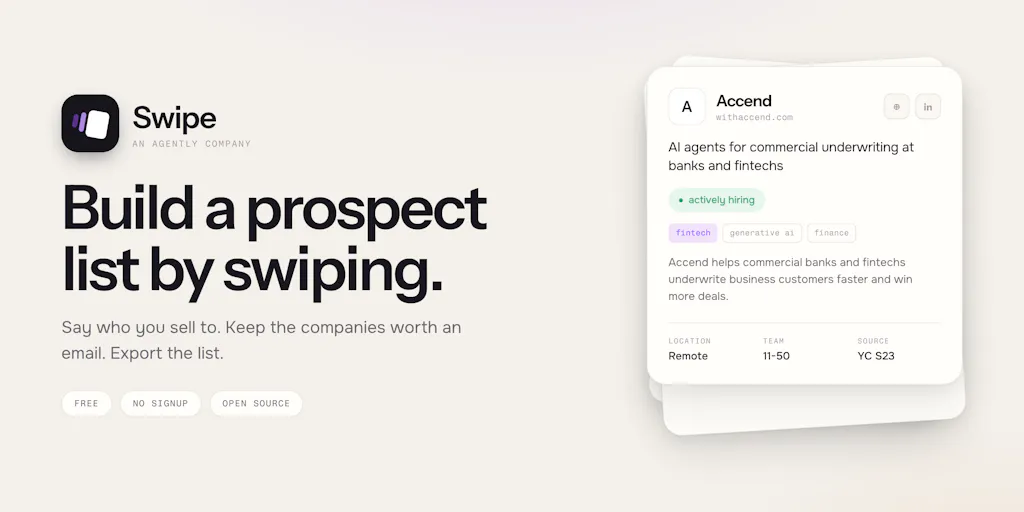
The product that launched here, Swipe, flips that assumption on its head. Instead of asking you to filter a database, it asks you a single question: who do you sell to? You type in your ideal customer profile, and it deals you a deck of real companies. You swipe right on the ones worth an email and swipe left on the noise. The maker, Omar Ghandour, describes it as “the worst part of selling” being the manual grind of opening a directory, copying a name into a sheet, and then going to read what the company actually does — repeat two hundred times. That’s not a data problem; that’s a decision problem. The friction isn’t in finding the names; it’s in the cognitive load of evaluating them one by one in a clunky interface.
For a cross-border operator, this is the exact same pain you feel when you’re trying to find Amazon influencers, TikTok Shop affiliates, or wholesale buyers for your Shopify store. You don’t need a list of 10,000 random TikTok creators; you need the 50 who actually post about your niche and have an engaged audience. The existing tools give you a massive spreadsheet and a prayer. Swipe’s premise is that you should be able to move through that evaluation process at the speed of thought, not the speed of a spreadsheet formula.
Why Amazon sellers should care more than Shopify ones
Shopify DTC brands often think they’re immune to this because they have a direct line to their customers via email and SMS. But that’s a retention channel, not an acquisition one. When you want to scale, you still need to partner with other brands, pitch podcasters, or get into subscription boxes. Amazon sellers, on the other hand, live and die by the Buy Box and the algorithm. You can’t just “build a brand” on Amazon without external traffic. You need to find wholesale distributors, get into physical retail, or run influencer campaigns on TikTok Shop to feed the beast. The problem of qualifying who to approach is even more acute on Amazon because the margin for error is thinner. If you pitch a distributor who doesn’t handle your category, you’ve not only wasted an email, you’ve burned a relationship. A tool that forces you to look at the company and make a quick judgment call is inherently more aligned with the Amazon seller’s need for speed and precision.
How Swipe Differs from the Incumbents (and Why That Matters)
The most refreshing part of this launch is the deliberate constraint: no harvested emails. The maker explicitly states, “There are personal addresses sitting all over the sources we pulled from and we left every one out. You get the company and a link to go find the right person yourself.” In a world where every lead-gen tool brags about the size of its email database, this is a contrarian bet on quality over quantity.
Compare this to the standard workflow with a tool like Apollo.io. You pull a list, you get the emails, you upload it to Instantly.ai or Smartlead, and you blast. The deliverability is terrible, the response rates are sub-1%, and your domain reputation gets shredded. Swipe is saying: we’ll give you the target, but you have to earn the introduction. That’s a harder sell for lazy marketers, but it’s a much better strategy for anyone who cares about long-term sender reputation and actually getting replies.
The interface itself is the other differentiator. The team behind it, Agently, openly admits this was a “stunt” to showcase their AI-powered company brain. But the UX is the product. By limiting the deck to 60 prospects per session (with unlimited sessions, as confirmed in the comments), they force you to focus. You can’t just mindlessly swipe through 2,000 leads. You have to be deliberate. This is a psychological hack that the incumbents don’t have. ZoomInfo doesn’t care if you look at 10,000 records; in fact, it encourages it because it makes you feel productive. Swipe makes you feel like you’re actually closing something.
Where the math breaks
Let’s be brutal about the numbers here. The tool gives you a deck of 60 companies. If you’re a serious operator, you need 500 qualified prospects to book 10 meetings. That means you’re going to be running this session 9 times just to get a week’s worth of outreach. The comment from user Kate Ramakaieva highlights another friction point: she kept 11 but couldn’t find the export button until she reached the end of the deck. That’s a UX flow that punishes efficiency. If I’m a power user, I don’t want to swipe through 60 cards just to get the 11 I liked; I want to export on the fly.
The bigger issue is the lack of intent data. When you use a tool like Clearbit or 6sense, you’re seeing who is visiting your site and showing buying signals. Swipe is purely static — it’s showing you a snapshot of a company based on its public profile. It doesn’t know if that company is hiring, if they just raised a round, or if they’re about to launch a product that needs your component. That means the qualification is still on you. The tool helps you sort, but it doesn’t help you prioritize based on timing.
What Cross-Border Sellers Can Borrow From This (Beyond the Tool Itself)
You don’t need to go sign up for Swipe to get value from this launch. The principles behind it are transferable to your entire GTM strategy.
First, the “Deck” mindset. Stop thinking about your prospect list as a database. Think of it as a curated deck of opportunities. For every campaign you run — whether it’s a TikTok Shop influencer push or an Amazon B2B wholesale pitch — create a “deck” of no more than 50 targets. Force yourself to evaluate each one on a binary yes/no basis. If it’s a “maybe,” it’s a “no.” This will increase the quality of your outreach because you’re only spending time on the ones you actually want.
Second, the “no harvested emails” rule. If you’re doing outbound on Amazon or Shopify, stop buying lists. It’s 2024; the spam filters are too smart, and the buyers are too jaded. Instead, use the “link to go find the right person” approach. Go to LinkedIn, find the buyer, and engage with their content for a week before you send a message. It’s slower, but the reply rate is 10x higher.
Third, the “stunt” as marketing. The Agently team built a useful free tool to demo their core product. This is a masterclass in content marketing. Instead of writing another blog post about “How AI will change sales,” they built a working example that people could feel. You can do this for your brand. Don’t just sell a water bottle; build a free “hydration calculator” that shows you how much water you should drink based on your city’s climate. That tool will get more backlinks and shares than a product page ever will.
The “Company Brain” angle
The underlying product, Agently, is described as “a company brain that does the busywork.” This is the bigger trend to watch. We’re moving past the era of “AI writes my emails” and into the era of “AI knows my business.” For a cross-border operator, this means the tooling stack is shifting. Instead of having a separate tool for inventory forecasting, customer service, and competitor analysis, you’re going to have one “brain” that holds all the context and can perform actions across those domains.
Imagine asking your “company brain” to “find me 10 Amazon sellers in the pet niche who are using TikTok Shop and have a rating above 4.5, then draft a personalized pitch for each.” That’s what Agently is aiming for. Swipe is just the demo — a controlled, simple use case. The fact that they’re starting with prospecting makes sense because it’s the most painful, high-volume task. But if they can apply that same logic to inventory management or supplier communication, they’ll be onto something big.
Where My Judgment Says It Falls Short
I’m a skeptic by nature, and there are three areas where this launch doesn’t hold up to scrutiny for a serious operator.
1. The “Free, No Signup” Model is a Trap for the User. If it’s free and open source, it’s not a product; it’s a lead magnet. The comment from Ahmad Hajj confirms this: “getting a lot of good feedback, we might expand on this, was initially just a stunt to showcase how powerful Agently is.” That means you’re the product. The data you provide by typing in your ICP and swiping is being used to train their “company brain.” For a cross-border seller dealing with proprietary product ideas or specific market angles, this is a data leak risk. You’re giving away your targeting strategy for free.
2. The Lack of Integration is a Dealbreaker for Scale. The export function is clunky, and there’s no native integration with HubSpot, Salesforce, or even a simple CSV-to-Klaviyo pipeline. When I’m doing outreach for a DTC brand, I need to get those leads into my CRM immediately, enrich them, and start a sequence. If I have to manually export and re-upload, I might as well just use a spreadsheet. The makers say “import my own list” is “coming up next,” but for a tool that is supposed to save time, the lack of a robust export API is a glaring omission.
3. It Solves the “Who” but Not the “Why” or the “When.” The tool shows you a company and tells you they might be a fit. But it doesn’t tell you why they’re a fit beyond the basic keywords, and it doesn’t tell you if there’s a trigger event. In cross-border, timing is everything. If you’re selling a seasonal product like summer pool gear, finding a buyer in November is useless. You need to know if they’re currently sourcing. Swipe doesn’t give you that. It’s a static snapshot in a dynamic world.
What I’d Watch / Test Next
Despite my skepticism, I think there’s enough signal here to warrant a test. Here’s what I’d do this week:
Go play with the tool. Spend 15 minutes on Swipe and type in the ICP for your next product launch, not your current one. See if the first ten cards are actually relevant. If they are, the underlying data model is better than I think. If they’re generic, you’ve just confirmed my bias.
Reverse-engineer the “Deck” concept for your manual workflow. Take your existing list of 1,000 potential wholesale buyers or influencers. Use a randomizer to pick 50. Put them in a spreadsheet with just three columns: Company Name, What They Do, and “Do I care?” (Yes/No). Delete the “Maybe” column. You’ll be shocked at how much faster you move.
Steal the “Stunt” marketing idea. Look at your own product roadmap. Is there a small, useful tool you can build in a weekend that solves a tiny problem for your customers? A size chart generator for your apparel brand? A shipping cost calculator for your Amazon FBA business? Build it, give it away free, and see if it generates more buzz than a paid ad campaign. The Agently team proved that a functional demo beats a landing page every single time.
Watch the Agently product closely. If they ever release a paid tier that integrates with your CRM and offers intent data, that’s when I’d take them seriously as a replacement for your current stack. For now, treat them as a source of UX inspiration, not a core tool.
The takeaway isn’t “go use Swipe.” It’s “go fix your prospecting workflow.” The tool is a mirror held up to the industry’s worst habit: confusing activity with action. If you walk away from this launch with a new swipe deck, you’ve gained a few leads. If you walk away with a new philosophy on how to qualify and approach partners, you’ve gained an edge.


