The interview-footage bottleneck is quietly becoming a cross-border content problem
Every cross-border operator I know has, at some point in the last eighteen months, been told the same thing: video is the new product detail page. TikTok Shop wants it, Amazon wants it in the A+ module, Shopify wants it above the fold, and your ad account wants forty variants by Friday. The bottleneck is rarely the camera. It’s what happens after the shoot — the pile of raw footage nobody has time to watch, transcribe, and structure into something a buyer will actually sit through. That’s the gap Supacut is poking at, and even though its makers are aiming at documentary editors, the workflow problem it describes is one every seller running UGC, founder-story, or review-mining content should be paying attention to.
What Supacut is actually solving — and why it isn’t just another transcription tool
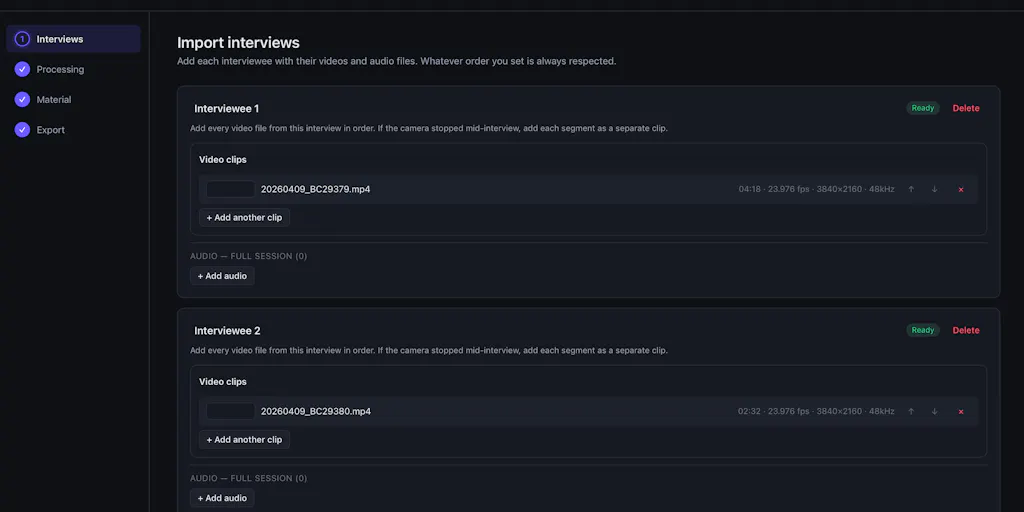
The maker, jonathan muia, frames the problem precisely: the hard part isn’t cutting, it’s “figuring out what to do with hours of material before the edit even begins.” That’s a meaningfully different pitch from the wave of AI video tools that assume you already know what you’re making and just want faster assembly. Supacut splits the work into two modes — “Find the Story,” where you explore interviews by theme, compare answers across speakers, and build a shortlist of selects, and “Create the Story,” where the tool analyzes interviews, proposes narrative directions, and generates an editable rough cut.
For a cross-border seller, translate those two modes into your own reality. “Find the Story” is what you wish you could do with 60 customer testimonial clips, 12 creator unboxings, and a founder interview shot in three languages. “Create the Story” is what your agency charges you a retainer to do badly. The fact that Supacut treats them as two distinct jobs rather than one magic button is, to me, the most interesting design decision on the page.
Why Amazon sellers should care more than Shopify ones
Shopify merchants can get away with a hero video and a couple of lifestyle loops. Amazon sellers can’t. Between the video slots on the listing, the Brand Story module, Sponsored Brands video, and now the video-first placements Amazon keeps bolting onto Amazon Seller Central, you’re producing episodic content whether you like it or not — and every one of those assets needs a different 15-second cut of the same source material. That’s exactly the “compare answers across speakers” problem Supacut is built around. If you’re running a review-mining operation where you’ve collected 200 video reviews and want to know which objection comes up most often, the theme-pillar feature the maker describes in the comments is the closest thing to a shortcut I’ve seen pitched.
How it differs from the incumbents you’re probably already paying for
The honest comparison set isn’t other “AI editors.” It’s the stack you’ve already duct-taped together. Descript owns the transcript-first editing space and is the obvious incumbent for anyone who’s ever deleted a filler word by editing text. Opus Clip and similar tools own the “chop this long video into shorts” job. CapCut owns the last-mile assembly. And if you’re running serious ad volume, HeyGen and Runway sit in the generative layer. None of those tools, as far as I can tell, are built around the specific act of deciding what the story is before you start cutting.
That’s the wedge. Descript assumes you know the story and want to edit it faster. Opus assumes you have a finished piece and want to atomize it. Supacut is betting that the actual time sink is upstream of both — the part where a producer watches 14 hours of interviews and comes out with a paper edit. If that bet is right, it’s a bigger market than “AI video editor” because it’s a market of judgment, not keystrokes.
Where the math breaks
Here’s my skepticism. Rough-cut generation is only valuable if the rough cut is good enough to edit. A bad rough cut isn’t a time-saver, it’s a second job — you now have to watch the AI’s version, diagnose why it chose what it chose, and rebuild from scratch. The maker’s answer to this, in response to a question from Thomas Bennett, is that editors can see why particular clips were chosen and can also check “which parts of the transcript were not selected.” That’s the right instinct — explainability is the difference between a tool and a slot machine — but it’s also the hardest thing to get right, and Supacut is, by the maker’s own admission, only about a month old.
There’s a second math problem specific to cross-border sellers: language. The Product Hunt thread doesn’t mention multilingual support, transcription language coverage, or how speaker separation handles accented English, code-switching, or non-English source footage. For a seller sourcing testimonials from Southeast Asia, LatAm, or Southern Europe, that’s not a nice-to-have, it’s the whole ballgame. Not disclosed on the page — worth asking before you build a workflow on it.
What cross-border sellers can actually borrow from this
Even if you never open Supacut, the launch thread is a decent blueprint for how to think about your own content ops.
Separate “find” from “make.” The single most useful idea here is that exploration and assembly are different jobs and deserve different tooling and different people. Most sellers I audit have one overworked content person doing both badly. Split the roles — even if the “exploration” role is a VA with a spreadsheet and a transcript tool.
Theme pillars before analysis. In the comments, the maker notes you can “define your own topic pillars before the analysis” so the tool returns results aligned to your needs. Steal this regardless of tool. Before you ingest 50 customer videos, write down the five objections or five benefits you’re trying to prove. Otherwise every AI summary you get back will be generically correct and operationally useless.
Show your work. The “here’s what wasn’t selected” feature is a governance idea, not just a UX idea. If you’re using AI to triage customer footage — especially anything that touches claims compliance — you want an audit trail of what the model saw and skipped. That’s the same principle behind keeping your Helium 10 keyword research logs when Amazon asks how you sourced a claim.
Compare across speakers, not just within one. Salmni Gorey flags cross-interview comparison as the biggest time-saver, and Justin Rockmore pushes further, asking whether a theme can carry into the next project. That’s the real dream for a brand running continuous UGC: a persistent taxonomy of customer language that compounds across campaigns instead of resetting every shoot.
Where the tooling stack actually fits
If you’re on Shopify and running paid social, the natural home for output like this is your creative testing pipeline — feed the selects into Meta Ads Manager variants, then let Klaviyo or your ESP recycle the winning hooks into email. If you’re on TikTok Shop, the shorts you’d generate from the same source footage are the native ad unit. The point isn’t that Supacut replaces any of those — it doesn’t — it’s that the “what’s the story” layer is currently missing from the stack, and it’s the layer that determines whether the rest of your spend is efficient.
Where my judgment says it falls short
Three concerns, in order of how much they’d cost you.
One: it’s early, and “early” for a video AI tool means unpredictable output. The maker says Supacut “only launched about a month ago.” That’s not a knock — it’s a scheduling fact. Don’t route a Black Friday campaign through a beta.
Two: the documentary framing may not survive contact with commerce. Documentary editors care about narrative arc, emotional beats, and truth. E-commerce content teams care about hooks in the first two seconds, objection handling, and CTA clarity. Those are related but not identical problems. The “propose narrative directions” feature is genuinely interesting — Gal Dayan calls it out as the differentiator versus tools that stop at “here are your best soundbites” — but I’d want to see how it performs on a 90-second product testimonial versus a 90-minute interview.
Three: the pricing and export story is not disclosed. The page offers “private beta access” to the Product Hunt community but doesn’t say what it costs after, whether outputs export to Premiere, Final Cut, or DaVinci Resolve, or how it handles project handoff to an external agency. For a seller working with a freelance editor in a different timezone, export format is the whole integration.
A note on the category
I’ve watched a lot of “AI video” launches in the last two years, and the ones that stick tend to share one trait: they automate a decision, not a task. Transcription automated a task and got commoditized in about eighteen months. Deciding what belongs in the story is a decision, and decisions are stickier. If Supacut holds that line — and resists the temptation to become a general-purpose editor — it’s positioned better than most of what’s launched this quarter. If it drifts into “we also do captions and b-roll,” it’ll get eaten by Descript.
What I’d watch / test next
This week, if you run any volume of video content, do three things. First, pick your ten longest raw footage files — customer interviews, creator briefs, founder shoots — and time how long it takes a human to produce a paper edit. That number is your budget for any tool in this category. Second, join the Supacut private beta and run one non-critical project through it — ideally something multilingual, because that’s where I expect it to break first. Third, watch the forum threads over the next month; the maker is actively asking editors how they handle first passes through large projects, and the answers will tell you more about the roadmap than any launch copy. If the theme-pillar feature persists across projects and the export story lands in a real NLE, it becomes a line item. Until then, it’s a signal about where the stack is heading — and a reminder that the expensive part of content was never the camera.