The real lesson from a €4.99 project planner: cross-border operators are drowning in coordination debt, not channels
Every cross-border seller I know runs the same quiet second business: the business of keeping plans synchronized. A Gantt chart lives in one tool, capacity planning in a spreadsheet, and the “what happens if our best VA quits in March” question lives entirely in someone’s head. That’s coordination debt, and it compounds faster than ad spend ever will. So when I saw shadow-planner launch on Product Hunt — a desktop planning app built by Martin Midori, a project manager who got tired of exactly that fragmentation — I didn’t read it as a project management story. I read it as a mirror held up to how most Amazon FBA, Shopify DTC, and TikTok Shop operators actually run their operations: baseline in one place, contingency nowhere, and a Q4 plan that was never stress-tested against a supplier delay, a warehouse handoff, or a creator dropping out.
The product itself is small. The thesis behind it is not. Here’s what I think cross-border operators should take from it, where it genuinely differs from the incumbents, and where my own judgment says it falls short for our use case.
What shadow-planner actually solves — and why it maps to e-commerce ops
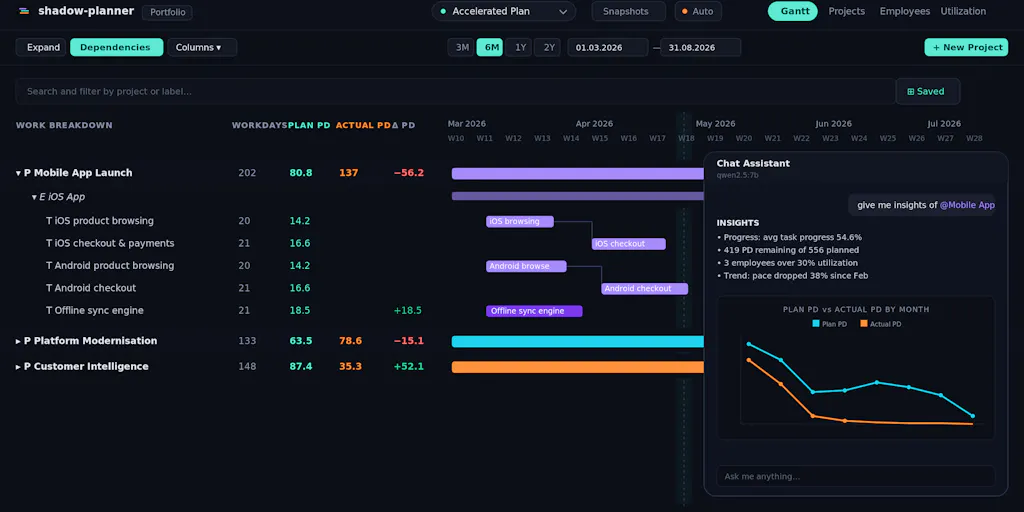
Strip away the desktop-app packaging and shadow-planner is three things in one file: a Gantt chart with finish-to-start dependencies, resource utilization tracking (weekly capacity vs. allocation per person, with over-capacity highlighting and cost roll-up from daily rates), and scenario planning — copy your baseline, test a re-org or a slipped deadline, compare, discard. On top of that sits an AI assistant that reads your actual plan and answers questions like “who’s over capacity next month?” or “push the beta a week and show me what moves.” Destructive changes wait for explicit approval. There’s also a planning agent that takes a Markdown brief and returns epics, tasks, dates, and assignments as a reviewable draft.
If you run a lean cross-border team, you already recognize this shape. Your “Gantt” is a launch calendar for a new SKU on Amazon Seller Central: sourcing, inspection, freight, FBA inbound, listing build, review seeding, ad ramp. Your “resource plan” is two ops people, one designer, a freelance media buyer, and a 3PL contact. Your “scenario” is the question you ask every October: what breaks if the sea freight slips two weeks?
The interesting design choice is the dependency preview — drag a task, see every downstream shift before saving. In e-commerce terms, that’s the difference between knowing a factory delay pushes your FBA inbound date and seeing that it also collides with your Black Friday ad ramp and your influencer seeding window. Most sellers discover that collision in real time, on the wrong week.
Why Amazon sellers should care more than Shopify ones
Here’s a distinction I’d draw sharply. A pure Shopify DTC brand with one hero product and a print-on-demand supplier has a shallow dependency graph — few nodes, short chains, low coordination debt. An Amazon FBA brand with three SKUs, seasonal demand, a freight forwarder, a 3PL, and a review-velocity target has a deep graph. Every node can cascade.
That’s why I think the scenario-copy mechanic matters more for marketplace sellers than for classic SaaS teams. Amazon operators live inside hard external deadlines — Prime Day, BFCM, category-specific deal submission windows — that you don’t control and can’t move. When your internal plan has to bend around an immovable external date, the ability to fork a baseline, simulate the slip, and throw the fork away is worth more than any dashboard. It’s the planning equivalent of a what-if stress test on your supply chain.
How it differs from the incumbents you’re probably already paying for
Let’s place it against the tools cross-border teams actually use. Asana and Monday.com are collaboration-first: great for cross-functional visibility, weak on true capacity math and genuinely weak on scenario forking. ClickUp tries to be everything and, in my experience, becomes a configuration project of its own. Notion is where most DTC brands document their launch process and where almost none of them simulate it. Dedicated capacity tools like Float do resource utilization well but don’t give you the dependency cascade. And Excel or Google Sheets — let’s be honest, the real incumbent for most sellers — does everything badly except being free and familiar.
The three axes where shadow-planner actually diverges:
Local-first data. The whole thing is a local SQLite file. No account, no sync, no telemetry. The AI runs on a local Ollama model by default, with Claude, OpenAI, or OpenRouter as opt-in bring-your-own-key options called directly from your machine. For a cross-border operator juggling supplier contracts, landed-cost sheets, and margin data, that’s not a privacy nicety — it’s a real risk reduction. Most SaaS planning tools want your cost structure in their cloud.
One-time pricing. The free tier has every feature, capped at 1 scenario / 3 projects / 3 people. Unlimited is €4.99 once, forever. Midori notes he launched with a monthly plan, got told off, and switched — existing subscribers became lifetime for free. That’s a pricing posture, not just a price.
AI that reads the plan, not the internet. The assistant is scoped to your actual schedule, and destructive changes require approval. That’s the correct guardrail design, and it’s the opposite of the “agent does whatever it wants” pattern flooding the market right now.
Where the math breaks
I want to be fair about the pricing, because €4.99 forever is a business model that either signals a side project or a very deliberate niche play. For a solo operator or a three-person brand, it’s trivially cheap. For a 30-person cross-border company with a China sourcing office, a US 3PL, and a UK entity, the caps and the single-file local model become the constraint, not the price. The question isn’t whether €4.99 is good value — it obviously is. The question is whether a one-time-payment desktop app will still be maintained in three years when your Q4 plan depends on it. That’s the real risk, and no launch page answers it.
What cross-border sellers can borrow from this, regardless of whether you install it
This is the part I actually care about. Even if you never open shadow-planner, three operating habits from its design are worth stealing this quarter.
1. Fork your baseline before peak season, not during it
Copy your current launch or peak plan. Change exactly one variable — freight lead time, ad budget, headcount — and see what cascades. Discard the fork. Do this monthly. The value isn’t the simulation; it’s discovering which single variable has the longest downstream tail. In most cross-border ops, it’s freight, and most teams don’t know that until it’s too late.
2. Track capacity in weekly allocation, not headcount
“Two ops people” is not a capacity plan. Weekly hours vs. allocated hours per person, with over-capacity flagged, is. If your media buyer is at 140% during BFCM week, your ad account is the thing that quietly degrades — and you won’t see it in revenue until January.
3. Keep the AI scoped to your own data
The most useful pattern here is the guardrail: the assistant knows your plan, proposes changes, and waits for approval before touching anything. If you’re wiring AI into your Klaviyo flows, your Helium 10 workflows, or your replenishment logic, adopt the same rule. Read-only by default, human approval for anything destructive. The sellers getting burned by AI automation right now are the ones who skipped that step.
Where my judgment says it falls short for cross-border use
I’ll be blunt about the gaps, because that’s more useful than a feature list.
No multi-entity or multi-currency view. Cross-border operators think in at least two currencies and often two legal entities. Cost roll-up from daily rates is useful, but if those rates are in CNY and your revenue is in USD, the roll-up is a partial answer. Not disclosed whether multi-currency is on the roadmap.
Local-only means no team sync. The privacy posture is a genuine strength, but it’s also a hard ceiling. The moment your sourcing agent in Shenzhen and your ops lead in Austin need the same live plan, a local SQLite file stops working. For solo sellers and micro-teams, this is fine. For anyone with a distributed supply chain, it’s the dealbreaker.
Planning agent quality is unproven. Pasting a Markdown brief and getting epics, tasks, and assignments back is a great demo. Whether the output is actually usable for a real SKU launch — with realistic freight durations and inspection buffers — is something only hands-on testing will tell you. I’d treat the first few outputs as drafts to heavily edit, not drafts to approve.
The category is crowded and the moat is thin. Gantt, capacity, and scenarios are all solved problems individually. The differentiation here is the combination plus local-first plus one-time pricing. That’s a real position, but it’s a position, not a moat. If ClickUp or Monday.com shipped a credible local mode tomorrow, the differentiation narrows fast.
What I’d watch / test next
Concrete moves for this week, in priority order. First, if you run any kind of launch calendar, spend one hour building a dependency chain for your next SKU — sourcing to FBA inbound to listing live to ad ramp — and identify the single longest-tail node. That node is your real bottleneck, and it’s almost never the one you’d guess. Second, if you’re evaluating shadow-planner specifically, download the free tier and run it against one live project rather than a test project; the 3-project cap is generous enough to be useful. Third, pressure-test the local AI against a real question about your own schedule and see whether the answers are grounded or generic — that’s the fastest way to judge whether the assistant is a gimmick or a tool. Fourth, and most importantly, watch whether Midori keeps shipping after launch week. A one-time-payment app lives or dies on post-launch maintenance, and that’s the single variable I’d track before letting it anywhere near a peak-season plan. The planning habits are worth adopting today. The tool itself is worth a cautious trial, not a migration.