The WhatsApp inbox is where cross-border deals now die or close — and most stacks still treat it as a side channel
Cross-border sellers have spent a decade optimizing the wrong surface area. We tuned Amazon listings, A/B-tested Shopify themes, and bought Klaviyo flows until the marginal email dollar stopped working. Meanwhile, the actual purchase conversation migrated to WhatsApp, Instagram DMs, and TikTok Shop chat — channels where a pre-sales question about sizing, shipping, or customs duties either converts in minutes or becomes a refund. Most operators I know still run those conversations out of a phone held by one ops person, disconnected from the CRM, the helpdesk, and the order system. That gap is why a launch like SalesRep.com is worth more attention than its Product Hunt upvote count suggests.
What SalesRep actually is, and the problem it’s chasing
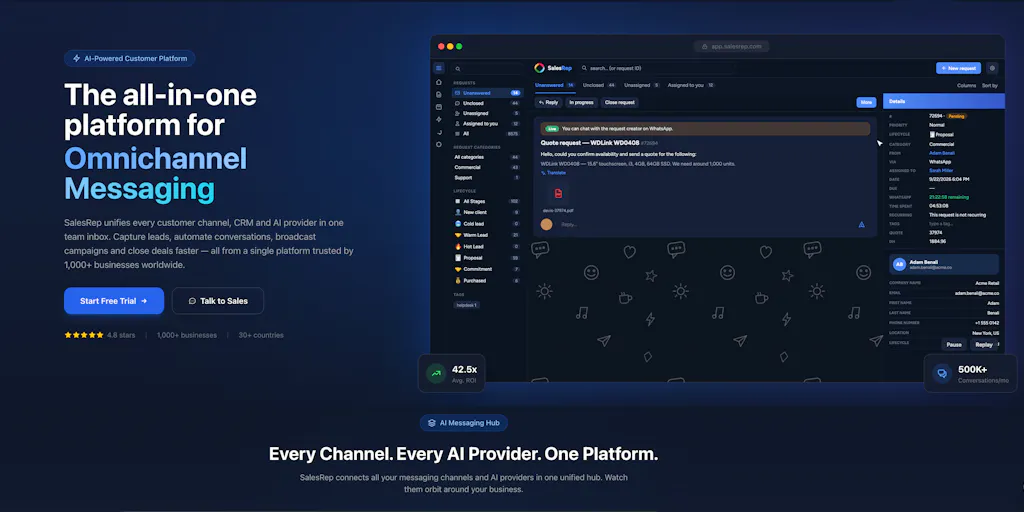
SalesRep.com is a shared omnichannel inbox — WhatsApp, live chat, email, SMS, and social — with AI agents, workflow automation, team collaboration, and reporting layered on top. The maker’s own framing is that customer conversations are “increasingly spread across WhatsApp, live chat, email, SMS and social channels, while sales and support teams still need one place to manage everything.” That’s not a novel pitch. It’s the same thesis behind Gorgias, Reamaze, and Zendesk’s messaging tier. What makes the positioning interesting for cross-border operators is the explicit bet on WhatsApp as a first-class sales surface rather than a bolted-on notification channel.
The feature that drew the sharpest community pushback is the AI agent’s promise to “follow up until the deal closes.” One commenter, Eldar Miensutov, flagged the obvious risk: on WhatsApp, the third unanswered follow-up is where you get blocked. The maker’s response — that you can cap how many messages the AI sends before handing the lead back to a human in the AI center — is the right answer, but it also reveals the real product: not an autonomous closer, but a configurable escalation ladder. That distinction matters enormously for anyone selling physical goods into markets where spam reports can get a business number banned.
Why Amazon and TikTok Shop sellers should care more than Shopify ones
Shopify merchants already live inside an ecosystem where Gorgias, Reamaze, and Zendesk have deep integrations with order data, refunds, and subscription logic. The marginal gain from switching is real but incremental. Amazon FBA brand owners and TikTok Shop operators are in a worse spot. Amazon’s Buyer-Seller Messaging is throttled, templated, and policed — you can’t run a conversational sales motion there. TikTok Shop chat is closer to WhatsApp in spirit but locked inside ByteDance’s walled garden. So the cross-border seller’s actual high-intent conversation happens off-platform, on WhatsApp, where you have no order context and no shared inbox unless you build one. That’s the vacuum SalesRep is pointing at, and it’s a bigger vacuum than the Shopify-native crowd admits.
The onboarding critique is a real signal, not a nitpick
A second commenter, Roger Kaleba, came for the AI sales rep and landed on a team inbox dashboard — the AI demo was “like 2 scroll down.” The maker’s reply pointed to the WhatsApp AI selling demo further down the homepage, where the agent sends product cards and quotes. This is a positioning problem, but it’s also an operator lesson: if your own homepage buries the differentiator, your prospects will too. For sellers evaluating any conversational AI tool, the first question should be “what does the demo actually show me closing?” — not “what does the feature list claim?”
What cross-border sellers can borrow from this launch
Three transferable ideas, regardless of whether you ever sign up:
1. Treat WhatsApp as a sales channel with a funnel, not a support queue. The maker’s framing — making WhatsApp “a real part of the sales and support workflow, rather than treating it as a separate messaging tool” — is the correct mental model. If you’re selling into LATAM, MENA, Southeast Asia, or Southern Europe, WhatsApp is where the deal is. Build the follow-up cadence, the product card templates, and the quote flow there before you build another email sequence.
2. Cap your AI’s persistence explicitly. The comment thread’s most useful exchange was about setting a hard limit on AI follow-ups before human handoff. Write that number down for every channel. My default for cold WhatsApp outreach is two; for inbound product questions, three with a value-add each time. Anything past that is deliverability arson.
3. Audit where your launch traffic actually lands. Kaleba’s complaint is a free conversion audit for anyone running paid traffic. If your ad promises an AI sales rep and your landing page opens on a generic inbox screenshot, you’re paying for clicks you’ll never convert. The same applies to your Amazon storefront, your TikTok Shop bio link, and your Shopify collection pages.
Where my judgment says this falls short
The product is early, and the launch page shows it. Pricing isn’t disclosed on the page, which for a tool competing against Gorgias and Zendesk’s published tiers is a friction point — cross-border operators need to model per-seat and per-conversation costs before they migrate a support team. The AI agent’s “follow up until the deal closes” language is marketing, not spec; the actual behavior depends on the cap configuration the maker mentioned, and there’s no published benchmark on how the AI handles multi-language WhatsApp threads, which is the whole ballgame for cross-border.
More importantly, the category is crowded and the moat is integration depth, not features. Gorgias owns the Shopify-native conversation. Zendesk owns enterprise ticketing. What SalesRep would need to win is a defensible wedge — and “WhatsApp-first for cross-border SMBs” is a plausible wedge, but only if the WhatsApp Business API compliance layer, template approval workflow, and number warming are genuinely better than what’s already out there. The launch page doesn’t prove that. It proves the team understands the problem.
Where the math breaks
If you’re running a lean DTC brand doing $50k–$500k/month, the ROI case for a new omnichannel inbox is straightforward: one recovered abandoned WhatsApp conversation per day at a $60 AOV pays for most SMB tiers. But if your support volume is under 200 conversations a month, you don’t have a tooling problem — you have a volume problem, and a shared inbox will just add a subscription line. Be honest about which one you have.
What I’d watch / test next
This week, before you evaluate any tool in this category: export your last 90 days of WhatsApp, Instagram DM, and TikTok Shop chat into a spreadsheet and tag each thread as pre-sale, post-sale, or refund. If pre-sale threads exceed 20% of volume, you have a conversational sales channel masquerading as support, and it’s worth trialing SalesRep.com against your current setup — specifically testing the AI follow-up cap and the handoff-to-human behavior in a non-English thread. If pre-sale is under 10%, skip the tool and fix your product page. Second, watch whether the team publishes WhatsApp Business API compliance details and pricing within the next 30 days; silence there tells you they’re still building the hard part. Third, benchmark your current first-response time on WhatsApp against a 5-minute target — most cross-border sellers are running 4 to 12 hours and don’t know it. Fix that before you buy software.