The Real Lesson From a Job-Research App: Evidence Beats Vibes in Cross-Border Ops
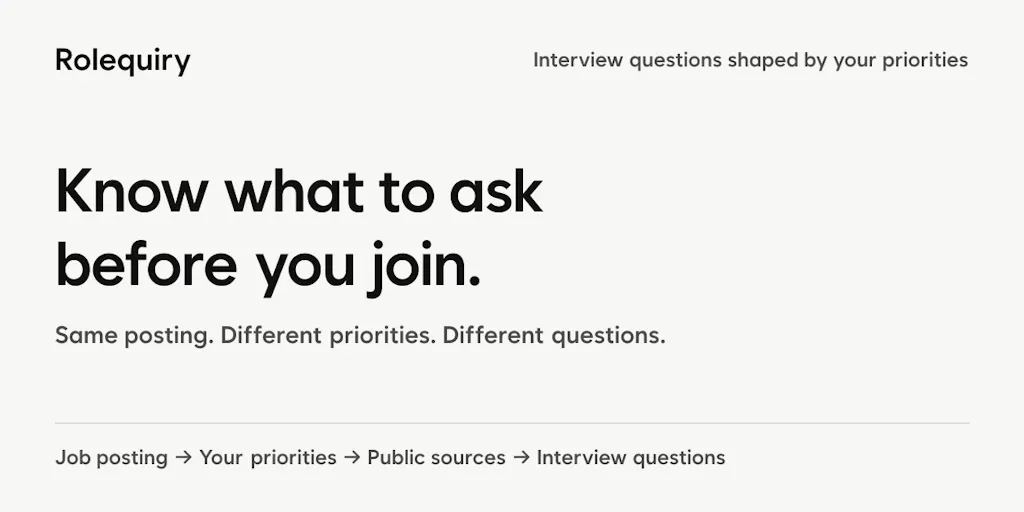
Most Product Hunt launches are irrelevant to people who move physical goods across borders. This one is different, and not because of the product category. Rolequiry is a job-seeker tool, built by Kim Hyoyeol and submitted to the GPT-6 Astra Challenge on OpenAI’s product page. It helps candidates generate role-specific questions from their own career priorities, then verifies the supporting evidence against original public sources. If you sell on Amazon or run a Shopify store, your instinct is to scroll past. Don’t. The architecture underneath — search, fetch, quote-check against the source, and leave uncertainty visible instead of papering over it — is exactly the discipline most cross-border operators claim to want from AI and almost never actually implement.
What Rolequiry Actually Does, Stripped of the Launch-Day Framing
Read the maker’s own description carefully and the mechanics are unusually specific for a Product Hunt submission. Rolequiry separates two things that most AI tools deliberately blur: what public evidence says about a posting, and how that evidence relates to your priorities. The maker states this directly — supporting evidence doesn’t automatically mean a role is right for you.
The workflow, as described in the launch post:
- The app searches public sources and fetches pages relevant to a specific posting.
- It checks quotations against the original source text rather than trusting a model’s paraphrase.
- When the initial evidence review is inconclusive, GPT-6 Astra re-examines the original public source to assess whether it applies to the specific company, role, team, location, and time period.
- Unresolved conditions get converted into interview questions rather than resolved into a confident-sounding answer.
The production example the maker cites is telling: a run against an Automattic engineering posting produced four source-verified quotations, and the sources still didn’t establish the role-specific travel policy. Rolequiry kept the question open. No fit score. No unsupported claim of certainty.
That last sentence is the whole essay. Everything else is application.
Why “kept the question open” is the most important phrase on the page
Every AI vendor selling into e-commerce promises you answers. Almost none of them promise you a well-labeled non-answer. The failure mode of LLM-powered tooling isn’t hallucination in the abstract — it’s hallucination that arrives formatted as a confident recommendation, which a busy operator then acts on because the interface told them to. Rolequiry’s design choice to surface an unresolved condition as a question for a human to ask is a product decision, not a model capability. That distinction matters enormously when you’re deciding what to buy.
How This Differs From the Tools You Already Pay For
The honest comparison set for a cross-border seller isn’t job-search apps. It’s the research and content layer you already run: Helium 10, Jungle Scout, Klaviyo, and whatever general-purpose LLM you’ve bolted on top.
Those tools are excellent at aggregation. Helium 10 will give you search volume, competition scores, and revenue estimates. Jungle Scout will estimate demand. Klaviyo will tell you which segment is likely to convert. What none of them do, by default, is trace a specific claim back to a specific source and tell you when the source doesn’t support it. They give you a number and a confidence-adjacent interface. Rolequiry’s stated method — check quotations against the original pages, keep uncertainty visible — is the opposite posture.
Why Amazon sellers should care more than Shopify ones
If you run a DTC store on Shopify, your research inputs are mostly your own first-party data: session recordings, email flows, cohort retention. You can afford to be sloppy about external claims because you can test them cheaply on your own traffic.
Amazon sellers can’t. Your product research depends on external, third-party estimates of demand, competition, and margin — estimates that are frequently stale, sometimes scraped from partial data, and almost never traceable to a primary source. When you decide to commit $8,000 of inventory to a SKU based on a keyword tool’s volume estimate, you are making a bet on a number you cannot audit. The Rolequiry pattern — fetch the source, verify the quote, flag what the source doesn’t establish — is a direct fix for that. It’s not that the tool does this for Amazon. It’s that the workflow is the right one, and you should be demanding it from your existing stack.
What Cross-Border Sellers Should Borrow From This
Three transferable practices, in order of how fast you can implement them.
1. Separate evidence from fit
The maker’s framing is the cleanest articulation of a problem that plagues supplier and market selection: “Supporting evidence doesn’t automatically mean a role is right for you.” Swap “role” for “supplier,” “market,” or “SKU” and the sentence still holds. A supplier with verifiable certifications, real factory photos, and a clean trade record is evidenced. It is not automatically a good fit for your margin structure, your fulfillment timeline, or your TikTok Shop content cadence. Those are two separate evaluations and most sellers collapse them into one gut call.
2. Turn unresolved conditions into questions, not assumptions
When Rolequiry couldn’t establish the travel policy, it converted the gap into an interview question. In sourcing, the equivalent is a supplier audit checklist where every unknown becomes a written question with a required answer — not a box you leave blank and hope about. If your factory can’t confirm a lead time in writing, that’s an open condition. Track it like one.
3. Quote-check against the primary source
This is the highest-leverage habit and the one most operators skip. When a supplier sends you a compliance certificate, verify it against the issuing body’s registry. When a freight forwarder quotes you a rate, get the surcharge breakdown in writing and check it against the carrier’s published tariff. When a Temu or SHEIN competitive listing shows a price, verify the actual landed cost, not the headline number. The Rolequiry method is just this habit, automated. You can run it manually this week.
Where My Judgment Says This Falls Short
I’ll be direct about the limits, because the launch page won’t be.
The demo uses fictional data. The maker is transparent about this — the featured demo runs on fictional data so you can explore the interaction immediately, and you can try your own posting with one career priority, resume optional. That’s a reasonable choice for a launch. It also means the production example (the Automattic posting with four verified quotations) is the only real-world evidence point disclosed, and a single example is not a track record. If you’re evaluating this as a model for your own tooling, treat it as a design pattern, not a validated system.
The scope is narrow by design. Rolequiry handles job postings. It does not handle supplier contracts, customs documentation, marketplace policy changes, or the dozen other document types a cross-border operator actually needs verified. The pattern generalizes; the product doesn’t, yet.
“Four source-verified quotations” is a small number. For a job posting, that may be sufficient. For a supplier due-diligence file or a market-entry assessment, four verified quotes would be laughably thin. The verification depth that works for a single hiring decision won’t scale to an $80,000 inventory commitment without significant expansion.
The re-examination trigger is underspecified. The maker says GPT-6 Astra re-examines the original source “when an initial evidence review is inconclusive.” What counts as inconclusive? Who sets that threshold? If the model decides when to dig deeper, you’ve moved the judgment call from a human to a model — which is precisely the failure mode the product claims to avoid. I’d want to see that threshold exposed and tunable before I’d trust it in a high-stakes workflow.
Where the math breaks
If you tried to port this pattern to supplier verification at scale, the cost structure gets uncomfortable fast. Each verified claim requires a fetch, a parse, and a comparison against source text. A single supplier file might contain thirty claims worth verifying. Multiply by the number of suppliers you’re evaluating per quarter, and the token and compute cost per due-diligence cycle starts to rival what you’d pay a junior ops person to do it manually — except the human also catches the things the model wasn’t asked to look for. The pattern is right. The unit economics at scale are not yet proven.
What I’d Watch / Test Next
This week, before you buy anything: pick one SKU decision you’re currently sitting on and run the Rolequiry method manually. Write down the three claims your decision depends on — demand estimate, margin assumption, lead time. For each one, find the primary source. If you can’t find one, that’s your answer: it’s an open condition, not a fact. Convert it into a written question for your supplier or your tool vendor.
Then watch two things. First, whether OpenAI or the broader GPT-6 Astra Challenge cohort produces more entrants using this evidence-verification pattern in non-recruiting domains — that’s the signal that it’s becoming a standard, not a one-off. Second, whether the incumbents you already pay for (Helium 10, Jungle Scout, and the rest) ship any version of “here’s what we couldn’t verify” in their next release cycle. When they do, you’ll know the pattern won. Until then, run it by hand and see how much of your current decision-making survives contact with a primary source.