The Repo Road Less Traveled: What a Tiny Product Hunt Prototype Reveals About Building for Cross-Border Operators
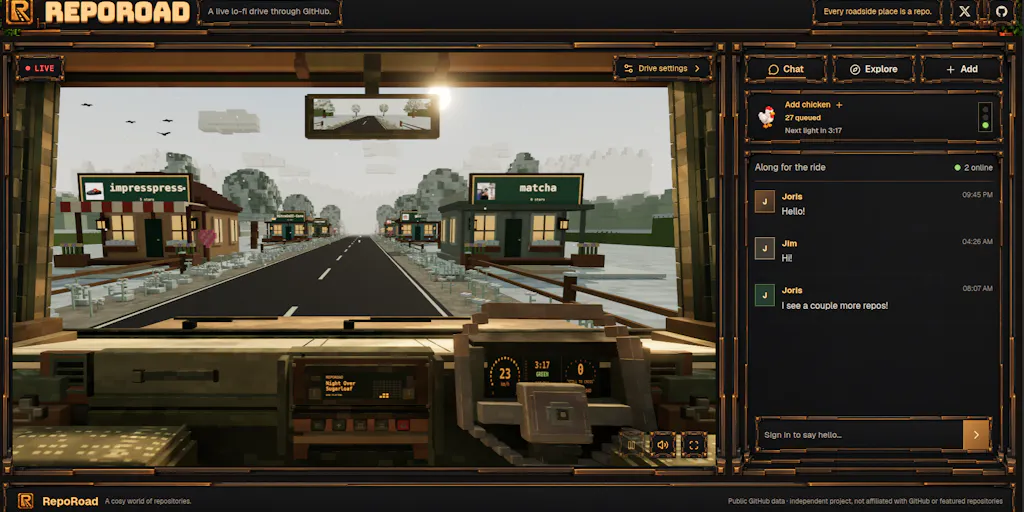
Every few months a Product Hunt launch shows up that isn’t really about the product at all — it’s about a builder pattern that cross-border sellers should be studying. The pitch for RepoRoad is deceptively small: a shared “road” where developers park their GitHub repos, see who else is online, and hang out while they work. But the maker’s framing — “less leaderboard, more neighbourhood” — is the exact opposite of how most e-commerce SaaS gets sold to us. We’re trained to buy dashboards, leaderboards, ranking tools, and competitive-intelligence feeds. RepoRoad is betting that ambient presence, not analytics, is what keeps people coming back. That bet is worth unpacking, because the same instinct is quietly reshaping how DTC teams, Amazon FBA brand owners, and marketplace account managers pick their stacks in 2025.
What RepoRoad Actually Is, and the Problem It’s Poking At
The maker, Joris Suppers, describes RepoRoad as a reaction to how GitHub projects die in obscurity: years of nights and weekends compressed into “a row in a list. A name, a small description and a star count.” His counter-proposal is a live, shared space — chat, music, and animation all running in real time — where you can “wander past what other people made” instead of scrolling a static feed. It’s an early prototype, he says, and rough in places.
Strip away the indie-hacker aesthetic and the underlying problem is one every cross-border operator knows intimately: discovery and retention are broken on every platform we sell on, and the fix isn’t more data — it’s more presence. Think about your own funnel. You list on Amazon Seller Central, you push SKUs to a Shopify storefront, you spin up a TikTok Shop affiliate program, you dabble in Temu and SHEIN to chase volume, you keep an Etsy shop for the handmade SKUs, and you list liquidation lots on eBay. Each of those surfaces has its own version of the “row in a list” problem. Your listing is one of ten million. Your ad is one of forty in a feed. Your email is one of two hundred in an inbox.
RepoRoad’s answer — make the space itself feel inhabited — is a useful provocation. It’s the same instinct behind live shopping on TikTok, behind Discord-run drops for streetwear brands, behind the “who’s online now” mechanic that made early Twitch feel different from YouTube. Presence is a retention feature. Most cross-border sellers treat it as a marketing gimmick.
Why Amazon sellers should care more than Shopify ones
Shopify merchants can, at least in theory, build a community around their brand — a subreddit, a newsletter, a loyalty program via Klaviyo or Yotpo. Amazon sellers mostly can’t. You don’t own the customer relationship, you don’t own the email list, and Amazon’s own attempts at community (posts, brand stores, live) have been tepid. So for FBA brand owners, the RepoRoad lesson isn’t “build a community” — it’s “borrow the mechanic.” The mechanic is visible activity. When a listing shows “12 people viewing right now” or a brand store shows a live drop countdown, conversion lifts. Amazon has experimented with this on Prime Day; most third-party sellers never touch it. That’s a gap worth exploiting with tools like Helium 10’s listing tools or third-party social-proof widgets that plug into your Shopify storefront and sync back to your Amazon funnel.
How It Differs From the Incumbents You’re Probably Already Paying For
The obvious comparison set for RepoRoad is developer-community tools: Product Hunt itself, Indie Hackers, Hacker News, and Discord servers. Each of those solves discovery through ranking or feed. RepoRoad explicitly rejects the leaderboard framing. That’s the differentiator, and it’s also the risk.
For cross-border sellers, the more instructive comparison is to the tools you actually use to find products and competitors. Jungle Scout and Helium 10 rank products by estimated revenue and search volume. TrendHunter and Exploding Topics rank trends by velocity. SimilarWeb ranks traffic sources. All of them are leaderboards. All of them assume the operator wants to find the winner and copy it. None of them help you understand who else is in the room — which suppliers are already working with your competitor, which creators are already promoting adjacent SKUs, which 3PLs are already handling your category.
RepoRoad’s neighbourhood model, if transplanted, would look like a supplier-and-creator graph rather than a product ranking. That’s closer to what ImportYeti does for US customs data — it lets you see which factories are shipping to which brands, not just which brands are winning. It’s also what Sourcify and Alibaba’s own supplier discovery tools half-attempt. The gap is that none of them feel alive. They feel like databases. RepoRoad’s bet is that aliveness is the product.
Where the math breaks
Here’s my honest read: RepoRoad’s model works for indie developers because the cost of a bad connection is near zero. You wander past a repo, you don’t like it, you move on. In cross-border e-commerce, the cost of a bad supplier or a bad creator connection is thousands of dollars and weeks of lead time. That asymmetry means operators will always default to vetted, ranked, review-driven discovery — the leaderboard RepoRoad is rejecting. The neighbourhood model can work as a top of funnel, but it can’t replace the ranking layer. Anyone building a “RepoRoad for sellers” needs to solve verification, not just vibes.
What Cross-Border Sellers Can Actually Borrow From This
Three transferable ideas, in order of how fast you can implement them.
1. Presence beats polish on your owned surfaces. RepoRoad’s chat, music, and animation are all live. Your Shopify storefront, your email flows, your TikTok live schedule — none of them need to be beautiful to feel inhabited. A “last ordered 4 minutes ago” ticker, a live inventory count on a drop, a Discord channel that actually has a human in it during your launch window. These are cheap. Most brands skip them because they feel gimmicky. They’re not gimmicky; they’re the difference between a store and a vending machine.
2. Build the “map of the road” for your category. Suppers floats a future feature: “A map of the whole road, with neighbourhoods — so you can go looking, not just drive and hope.” That’s a product-research thesis. If you sell in a category — say, pet supplements — your version of the map is a spreadsheet or Notion doc that tracks every supplier, every creator, every competitor, every 3PL, every relevant subreddit, and how they connect. Most sellers have fragments of this across Helium 10 exports and Slack DMs. Almost nobody has the map. The operator who builds it has an unfair advantage that no SaaS subscription can replicate, because the map is proprietary to your category.
3. Treat “sending something more than chickens” as a roadmap principle. Suppers lists that as a future idea — a nod to the low-effort engagement mechanics that plague social platforms. The cross-border translation: stop optimizing for clicks and start optimizing for reciprocity. Send a sample to a creator before asking for a post. Send a thank-you note in the box. Send a restock alert to your best customers before the public drop. The brands winning on TikTok Shop right now aren’t winning on ad spend — they’re winning on reciprocal gestures that compound.
The tooling stack implication
If you buy into any of the above, your stack changes. You need a community layer (Discord, Circle, or a subreddit you actually moderate), a presence layer on your storefront (social-proof widgets, live inventory, drop countdowns), and a map layer (a Notion or Airtable database you maintain yourself). None of those are expensive. The expensive mistake is buying another ranking tool and expecting it to solve a presence problem.
Where My Judgment Says This Falls Short
RepoRoad is an early prototype, and Suppers says so plainly. The two questions he asks the Product Hunt audience — “does seeing it make you want to put your own repo out there, and what would bring you back to the road a second time?” — are the right questions, but they also reveal the fragility. Novelty drives the first visit. Habit drives the second. Habit requires either utility (I get something done here) or relationship (I know people here). RepoRoad’s current pitch leans on relationship, which is the harder of the two to bootstrap.
For cross-border operators evaluating anything in this space, the same critique applies to almost every “community-first” commerce tool that’s launched in the last two years. Discord servers for brands die when the community manager leaves. Facebook Groups for DTC brands become spam farms. Reddit communities get hijacked by affiliate marketers. The pattern is consistent: presence without utility decays. The tools that survive — Klaviyo, Gorgias, Recharge — are boring utilities that happen to have a community wrapper. RepoRoad is currently the inverse: a community wrapper hoping utility shows up. That’s a much harder build.
There’s also a cross-border-specific blind spot. Nothing in the launch addresses localization, time zones, or language. A “road” that only works for English-speaking developers in overlapping time zones is a small road. The operators who’d benefit most from a supplier-and-creator graph are exactly the ones spread across Shenzhen, Ho Chi Minh City, Istanbul, and Los Angeles. A neighbourhood model that doesn’t solve asynchronous, multilingual presence isn’t a neighbourhood — it’s a dorm.
What I’d Watch / Test Next
Three concrete moves for this week.
First, audit your own presence layer. Open your Shopify storefront, your Amazon listing, and your TikTok Shop in three tabs. Ask: does any of them show signs of life right now? If not, add one live element — a viewer count, a recent-order ticker, a drop countdown — and measure conversion for seven days. You don’t need a new SaaS subscription; most of these are one-line widgets.
Second, start your category map. Spend two hours building a single Notion page with columns for suppliers, creators, competitors, 3PLs, and communities in your niche. Link everything. This is the “map of the road” Suppers is describing, and it’s the highest-ROI artifact a cross-border operator can own.
Third, watch RepoRoad’s second-week retention, not its launch-day upvotes. If Suppers ships the “lights on in the windows” feature and people come back, the presence thesis has legs — and it’s worth asking whether a vertical version for e-commerce suppliers is buildable. If the road empties out by Friday, the lesson is narrower: presence is a feature, not a product. Either way, the experiment is cheap to run and the insight is expensive to ignore.