The self-hosted media stack is a tell for how cross-border operators should be thinking about their own infrastructure
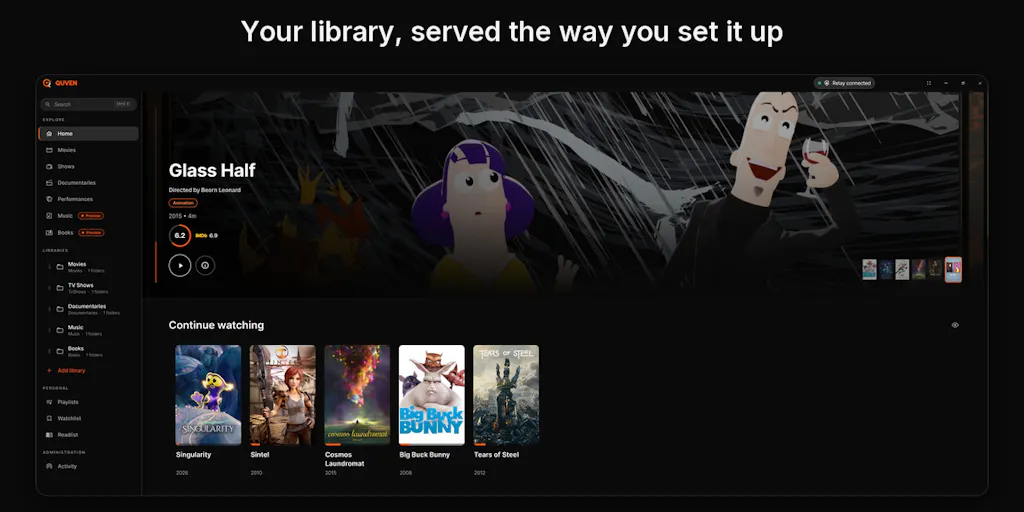
Every few months a Product Hunt launch lands in my feed that has nothing to do with e-commerce on its face, and yet it maps onto the exact decision every cross-border seller is quietly making right now: what do I own, what do I rent, and where does the marginal cost curve bend against me? Quven, from Quven Technologies S.R.L., is a self-hosted media server for films, series, and documentaries — your library on your own hardware, played through native apps on Windows, macOS, iPhone, iPad, Android, Android TV, and Fire TV, with a Linux server and a Docker image. Personal use is free, with hardware transcoding and no ads; Pro adds a managed relay and a hosted web client. If you run a DTC brand or an FBA account, you should care, because the architecture question underneath it — own the box or rent the relay — is the same one you’re answering every time you pick between a SaaS subscription and a self-hosted tool, between a 3PL and your own warehouse, between Shopify’s checkout and a headless build.
What Quven actually solves, and why the framing matters more than the feature list
Strip away the media-server specifics and Quven is a two-tier ownership model. The free tier is genuinely free for personal use, including hardware transcoding, and the maker states plainly that Quven puts no limitation of its own on free hardware transcoding — stream count and quality depend only on what your server can encode, via NVIDIA, Intel Quick Sync, AMD, or Apple encoders, with CPU fallback when no hardware encoder is present. Pro adds the managed relay and the hosted web client. That’s it. The pitch is not “better than Netflix.” The pitch is “your files never leave your hardware unless you decide they should.”
For a cross-border operator, the analog is obvious the moment you look at your own stack. You already run a version of this decision every quarter. Your product images live in Shopify’s CDN or in an S3 bucket you control. Your customer data lives in Klaviyo or in a Postgres instance you pay a contractor to babysit. Your fulfillment logic lives inside Amazon Seller Central’s black box or inside a warehouse management system you licensed. Every one of those choices is a Quven-style fork: managed relay versus your own box.
The interesting part is that Quven’s maker is asking the right question in public — “what would keep you from trying it, and what should I improve first?” — and the top reply is a hardware-cost probe. Dennis Porter asks whether there are limitations tied to server hardware spend, and the maker’s answer is essentially “no artificial caps, your silicon is the ceiling.” That is the cleanest possible articulation of the self-hosted value proposition, and it’s the same sentence I’d want a 3PL, a CDN vendor, or an email platform to say to me. Most won’t. Most cap something — API calls, contacts, bandwidth, seats — because the cap is the business model.
Why Amazon sellers should care more than Shopify ones
Shopify merchants already live in a world where the platform abstracts almost everything: hosting, checkout, payments, tax, and increasingly fulfillment through Shopify Fulfillment Network. The ownership question is mostly about apps and data portability. Amazon sellers live in the opposite world. You don’t own the listing, you don’t own the customer relationship, you don’t own the buy box, and you definitely don’t own the fulfillment pipeline. Your “server hardware” is Amazon’s, and the encoder is whatever Amazon decides to run this quarter.
That asymmetry is why self-hosted thinking matters more on the Amazon side. Every dollar you spend on a tool that sits between you and Seller Central — a repricer, a review automation layer, a PPC management platform — is a dollar spent renting a relay. Some of those relays are worth it. Helium 10, for instance, earns its keep because it does things Seller Central simply won’t do, like keyword tracking and competitor reverse-ASIN workflows. But the moment a tool’s core value is “we store your data and show it back to you,” you should be asking the Quven question: could I run this on a $40/month VPS and a Docker container?
Where the math breaks
Here’s the honest counterargument, and it’s the one I’d make to any seller who reads this and starts pricing out bare-metal boxes. Self-hosting has a labor cost that never shows up in the sticker price. Quven’s free tier is free in dollars, but it isn’t free in attention. You have to provision the Linux server, manage the Docker image, handle updates, deal with certificate renewals, and troubleshoot the night the transcoder decides to stop talking to the GPU. The maker’s framing — “which part of your setup would you never want to repeat: metadata matching, remote access, or playback on one device?” — is a confession that each of those is a real pain point. Metadata matching in particular is the kind of thing that eats a weekend and then eats another weekend six months later when the scraper breaks.
For a solo operator doing $30K/month on Amazon, the math usually says rent. For a brand doing $300K/month with an in-house ops person, the math often says own. The crossover point is not revenue; it’s whether you have someone on payroll whose job includes “keep the infrastructure alive.” If you don’t, you’re not self-hosting — you’re deferring a contractor bill.
What cross-border sellers can actually borrow from this launch
Three things, in descending order of usefulness.
First, the two-tier pricing shape. Quven gives away the thing that costs the maker almost nothing to give away — local playback and hardware transcoding — and charges for the thing that has real marginal cost: the managed relay and hosted web client. That’s the correct way to structure a freemium offer, and it’s the opposite of what most e-commerce SaaS does. Look at how many tools in our space gate the genuinely useful feature behind the paywall and give away a crippled demo. If you’re building anything — a Shopify app, an internal tool you eventually sell, a service — copy Quven’s split. Free should be the part that scales at zero marginal cost to you. Paid should be the part where you’re paying AWS or Twilio or a human.
Second, the platform coverage list. Windows, macOS, iPhone, iPad, Android, Android TV, Fire TV, plus a Linux server and Docker image. That’s not a product decision; that’s a distribution decision. Quven is choosing to be everywhere the user already is rather than forcing the user into a new client. Cross-border sellers should read that as a nudge about channel strategy. If you’re selling on Amazon and Shopify and TikTok Shop and Temu, you’re already doing this. If you’re selling only on Amazon and telling yourself you’ll “do TikTok later,” you’re the media server that only runs on Windows. The relay exists so the user doesn’t have to change their habits.
Third, the public question-asking. The maker’s entire engagement strategy in this thread is “tell me what would stop you.” That’s a product research motion, and it’s cheaper than any survey tool. If you run a DTC brand, you have the same asset sitting in your post-purchase emails and your return reasons. Most sellers treat returns as a cost center. The good ones treat the return reason field as a free focus group. Quven’s maker is doing manually what you could automate with a Klaviyo flow and a tagging taxonomy.
The tooling-stack parallel nobody wants to hear
There’s a version of this essay that’s really about vendor lock-in across the whole cross-border stack, and Quven is just the entry point. Think about how many layers of your business sit on someone else’s relay. Payments: Stripe or PayPal or both, and good luck migrating mid-quarter. Email: Klaviyo, and your flows are the moat, not the data. Customer support: Gorgias or Zendesk, and your macros are the switching cost. Analytics: Triple Whale or a BI tool, and the attribution logic is the lock. Logistics: a 3PL whose WMS you’ve never seen the schema of.
None of those are bad choices. Most are the right choices. But the Quven launch is a useful reminder that the “own it” option exists and is often cheaper than people assume, especially at the long tail. The sellers who get hurt in a platform shock — an API deprecation, a fee change, an account suspension — are the ones who never priced the self-hosted alternative, so they have no fallback and no leverage.
Where my judgment says Quven falls short
I’ll be direct: the launch page is thin on the things that matter for a real buying decision, and I’d hold the same standard to any tool I recommend to sellers.
The pricing for Pro is not disclosed. “Pro adds the managed relay and the hosted web client” tells me what I get but not what I pay. For a consumer media server that’s tolerable; for a business tool it’s a dealbreaker. If you’re evaluating any SaaS this quarter, treat undisclosed pricing as a yellow flag and ask for the number before you build a workflow on top of it.
The relay’s actual performance characteristics are not disclosed — no latency numbers, no bandwidth caps, no regional availability. For a cross-border seller, regional availability is the whole ballgame. A relay that’s fast in Frankfurt and slow in São Paulo is a different product than one that’s fast everywhere, and the launch copy doesn’t say. If Quven is targeting global users, that’s the next thing the maker should publish.
The hardware requirements are implied rather than specified. The maker says stream count and quality depend on your server’s encoders, which is honest, but it means the buyer has to do their own capacity planning. That’s fine for a homelab audience. It’s a friction point for anyone who wants a number.
And the biggest gap: there’s no mention of what happens to your library metadata if you stop using Quven. For a self-hosted product, portability is the entire promise. If the metadata lives in a proprietary database and the export is lossy, you’ve rented a relay with extra steps. I’d want the maker to say, in plain language, “your metadata is in an open format and here’s the export command.”
What I’d watch / test next
This week, do three things.
Audit your own stack for one relay you could own. Pick the tool where you’re paying the most for the least differentiated value — probably a reporting layer, a repricer, or an email automation add-on — and price out the self-hosted or scripted alternative. You don’t have to switch. You just need to know the number, because knowing it changes every renewal negotiation you have.
Then run Quven’s playbook on your own customers. Ask one question publicly — in a post-purchase email, in a Reddit thread, in your TikTok comments — the way the maker asked “what would keep you from trying it.” The answers will be more useful than any survey you’ve paid for.
Finally, watch whether Quven publishes Pro pricing and relay regional coverage. If it does, the product becomes a legitimate reference case for two-tier freemium in a self-hosted category, and I’ll cite it the next time a seller asks me whether to build or buy. If it doesn’t, it stays a nice homelab tool and a useful metaphor — which, honestly, is already worth the read.