The Internal Tooling Bottleneck Is Now a Competitive Weapon — If You Let Ops Build
Every cross-border seller I know runs the same silent race: the market moves faster than your ability to ship internal fixes. Your Amazon repricing logic is held together in a Google Sheet that only one person understands. Your Shopify returns workflow requires a manual CSV export that arrives three days late. Your TikTok Shop reconciliation is a midnight ritual involving screenshots and prayer. Meanwhile, the engineering team — if you have one — is buried in customer-facing feature requests and hasn’t touched an internal dashboard in six months. This is the real tax on modern e-commerce operations: not the platform fees, not the ad costs, but the opportunity cost of waiting on engineering for tools that would save your team hours every single day. The AI coding boom promised to fix this, but it created a new problem — non-technical operators pointing Claude Code or Cursor at sensitive company data with zero permissions or audit trail. That’s not a solution; that’s a data breach waiting to happen. What operators need is a way to build these tools safely, with guardrails enforced at the infrastructure level, not at the mercy of whoever wrote the prompt.
That’s the gap Prized is aiming at, and it’s worth your attention whether you run a three-person DTC brand or a thirty-person Amazon aggregation play.
The Problem: Shadow AI Tools Are the New Shadow IT
Let me paint the picture I’ve seen in a dozen seller operations rooms over the past year. Your customer support lead is drowning in repetitive refund requests. They’ve heard about AI agents. They open Cursor, paste in a prompt that pulls from your Shopify admin API, and within an afternoon they have a working tool that automates the first-pass triage. It works. It saves them two hours a day. And it’s a complete governance nightmare.
The tool has access to every customer record in your store. It can read order histories, payment details, shipping addresses. There’s no audit log. There’s no permission scoping. If the tool breaks or, worse, gets prompt-injected to exfiltrate data, nobody would know until it’s too late. Your ops lead didn’t mean to create a security hole — they were just trying to do their job. But now you’re facing a choice between blocking the behavior (and losing the efficiency gain) or accepting the risk (and hoping nothing goes wrong).
This is the shadow IT problem, reborn for the AI era. Ten years ago, it was a marketing manager spinning up a Mailchimp account without telling IT. Today, it’s an ops manager building a full-stack app with direct database access. The stakes are higher because the tools touch live production data, not just a mailing list.
The founders of Prized — Marinos Eliades and Hudson Griffith — describe the dynamic precisely in their Product Hunt launch: AI made building easy, so the people who understand workflows best (ops, support, finance) stopped waiting on engineering. They point Claude Code or Cursor straight at company data and ship a working tool in an afternoon with no permissions or audit trail. Companies end up choosing between blocking the behavior and accepting the risk.
Sound familiar? If you’re a cross-border seller, you’ve probably been in this exact situation — either on the side of the frustrated ops person or the anxious founder who just discovered what’s been running quietly for weeks.
What Prized Actually Does Differently
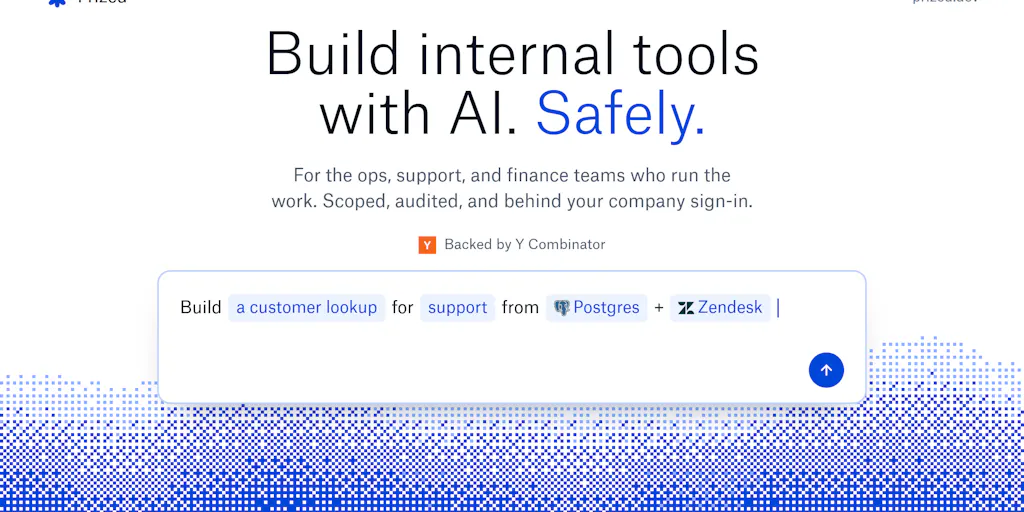
Prized’s approach is to let you describe the tool you need — a customer lookup, an admin panel, an approval flow — and get a real full-stack app, built in a sandbox where company data comes pre-connected and scoped to what you’re allowed to see. Shipping is one click, and the finished tool lives behind your company’s sign-in.
The key differentiator, and the part that caught the attention of commenters like Nick Kalm, is that security is enforced in the infrastructure, not in the generated code. The sandbox never holds a credential. Secrets live in a broker and get injected outside the generated code. Every tool gets its own database role, every data access is audited, and destructive changes wait for a human.
This is a fundamentally different architecture from the typical “let the AI write a script that connects to your database” approach. Most AI coding tools treat security as an afterthought — you get whatever permissions the API key you pasted into the prompt happens to have. Prized inverts that. The sandbox is firewalled from the internet except for the data connectors you approve. When you publish, the tool deploys into your workspace behind your SSO, restricted to your org, with each tool getting its own backing Postgres database automatically.
For a cross-border operation, this matters in ways that might not be obvious at first glance.
Why Amazon sellers should care more than Shopify ones
If you’re running a Shopify DTC brand, your data sprawl is real but relatively contained. Your customer data lives in Shopify, your email data lives in Klaviyo, your ad data lives in Meta and Google. A well-scoped internal tool that pulls from one or two of those systems is useful but not existential.
Amazon sellers operate differently. Your entire business runs on Seller Central, but the data that matters — PPC performance, inventory levels, repricer logic, FBA reimbursements — is scattered across a dozen tools and exports. Your ops team is constantly stitching together data from Amazon Seller Central, Helium 10, your repricer, and your 3PL’s shipping portal. The tools they need to build are not simple lookups; they’re multi-system reconciliation workflows that touch your most sensitive commercial data — cost of goods, margin calculations, supplier pricing.
If one of those tools has a permissions flaw, you’re not just leaking a customer email address. You’re exposing your entire margin structure to anyone who can figure out how to query the database. The audit trail and per-tool database roles that Prized enforces are not a nice-to-have for Amazon operators; they’re the difference between being able to let your ops team build and having to shut the whole thing down.
Where the math breaks
Let’s be honest about the limitations. Prized is YC-backed, which is a strong signal, and has a free tier with no card required. But the product is early. The founders themselves acknowledge in the comments that granular approval policies are still being built out — Hudson Griffith confirms that today only the workspace admin can approve destructive changes, though more granular policies are on the roadmap.
For a cross-border seller, that’s a real constraint. Your ops lead in Shenzhen and your finance person in Austin might both need to build tools, but you probably don’t want every destructive change — a bulk delete, a schema migration, a mass update — to require a single admin’s approval. The human-in-the-loop is the right instinct, but the configurability needs to catch up with the reality of distributed teams.
There’s also the question of how Prized handles the “describe the tool you need” part. The launch page shows a video that impressed commenter Germán Merlo, but the actual quality of the generated tools — how well they handle edge cases, how much hand-tuning is required — is not disclosed in detail. For a non-technical operator, the gap between “I described a customer lookup tool” and “I got a tool that handles every weird edge case in my data” could be significant.
What Cross-Border Sellers Can Steal From This Approach
Even if you’re not ready to adopt Prized tomorrow, the philosophy behind it is directly applicable to how you run your e-commerce operations. Here are three principles worth stealing.
1. Scope data access by role, not by tool
The founders’ answer to a commenter’s question about permissions is instructive: admins scope data access per user or team, down to specific tables, and everything — including the agent and any published tool — inherits the signed-in user’s permissions. This is exactly how you should be thinking about your own data access, whether or not you use Prized.
If your customer support team can access your full margin report, that’s a problem. If your finance team can edit product listings, that’s a problem. The principle of least privilege isn’t just a security best practice; it’s an operational discipline that prevents mistakes as much as it prevents malicious access. Apply this to every tool you use, from your Shopify admin to your ad accounts.
2. Audit everything, even the mundane stuff
The fact that every data access is audited in Prized is a feature that pays for itself the first time something goes wrong. When a shipment goes missing or a refund gets processed incorrectly, the ability to trace exactly who accessed what data, and when, is invaluable.
In my experience, most cross-border sellers don’t have this level of visibility even in their core systems. They rely on platform-native audit logs that are often incomplete or hard to query. If you’re building internal tools — even simple ones — build in your own audit trail from day one. It’s tedious, but it’s the difference between being able to diagnose a problem in minutes versus days.
3. Separate the internal stream from the production stream
When asked about integrating with a company’s existing codebase, Marinos’s answer was deliberate: they intentionally kept production separate to maintain a clear boundary between user-facing and internal development streams. This is a smart default that most sellers should adopt.
Your internal tools should not be tangled up with your customer-facing codebase. They should have their own deployment pipeline, their own database instances, their own access controls. This isn’t just about security; it’s about velocity. When your internal tools are decoupled from your production code, your ops team can iterate on them without fear of breaking the storefront.
Where I’m Skeptical
I want to push back on a few things. The first is the assumption that non-technical operators will actually describe what they need well enough to get a working tool. In my experience, the people who understand workflows best often struggle to articulate them in the structured way that AI tools require. The gap between “I need a tool that shows me which SKUs are underperforming” and a working query against your database is larger than it looks.
The second concern is the data connector ecosystem. The launch page mentions connecting to your VPC or allowlisting an IP for data access, and pulling context from GitHub. But for cross-border sellers, the data sources that matter are often proprietary APIs — Amazon SP-API, TikTok Shop’s seller API, Etsy’s API. If Prized doesn’t have first-class connectors for these, your ops team is back to writing custom code or waiting for engineering.
Finally, there’s the question of cost at scale. The free tier is great for experimentation, but if you’re running a serious operation with multiple teams building tools, the pricing is not disclosed. The per-tool Postgres database approach is elegant, but it could get expensive if you’re spinning up dozens of tools.
The human-in-the-loop question
The destructive-change approval flow is a good idea, but the current implementation — workspace admin only — is too coarse for real-world operations. In a cross-border business, your ops lead in one timezone shouldn’t have to wait for an admin in another timezone to approve a routine database cleanup. The roadmap promise of more granular policies is promising, but it’s not here yet.
I’d also note that the “human” in the human-in-the-loop is a single point of failure. If your admin is on vacation or, more likely, buried in their own work, the approval queue becomes a bottleneck. The system needs to support delegation and conditional approvals — e.g., “any two of these three people can approve” — before it’s truly production-ready for a distributed team.
What I’d Watch / Test Next
If you’re a cross-border seller intrigued by this approach, here’s what I’d do this week:
Spin up the free tier and build a toy tool. Pick a low-stakes workflow — a customer lookup from your Shopify admin, a SKU-level margin calculator from a CSV export — and see how well the “describe the tool” flow works. Don’t connect real production data yet. The goal is to test the builder experience, not the security model.
Map your current shadow AI tools. Go talk to your ops, support, and finance teams. Find out what AI-generated scripts or tools they’ve built in the past six months. You’ll likely be surprised. Catalog what data they access and whether there’s any audit trail. This is your risk inventory.
Test the permission scoping with your actual roles. Create a test workspace and invite a team member with a limited role. Try to scope their access to a specific table or dataset. See how granular the controls actually are in practice, not just in the demo.
Evaluate the data connector story for your stack. If you’re primarily an Amazon seller, check whether the SP-API integration works or whether you’d need to build a custom connector. If you’re on TikTok Shop or Etsy, the answer is probably “not yet,” and that’s a dealbreaker for now.
Watch the roadmap for granular policies. The current admin-only approval flow is a known limitation. If the team ships more granular policies quickly, that’s a strong signal they understand real-world operations. If it languishes, treat Prized as a promising prototype, not a production tool.
The internal tooling gap is real, and Prized’s infrastructure-first approach is the right instinct. But as with any early-stage product, the proof is in the execution — and in whether it can handle the messy, multi-system reality of cross-border e-commerce. Start small, test the edges, and keep your shadow AI inventory current. The tools are coming; the question is whether you’ll be the one building them safely or the one cleaning up the mess.


