The AirPods-as-controller trick is a supply-chain story hiding in a pickleball game
Most Product Hunt launches are irrelevant to anyone running a storefront, a marketplace account, or a DTC brand. This one is worth ten minutes of your attention anyway, because the underlying mechanic — Poddle turning a pair of AirPods into a motion controller and a laptop webcam into a position tracker — is a preview of where accessory demand, motion-sensor sourcing, and zero-hardware game distribution are heading. The maker, Daniel, shipped it as a hackathon side project and kept going. For cross-border operators, the interesting part isn’t pickleball. It’s the fact that a free browser game can now create hardware pull for a device your customers already own.
What Poddle actually solves — and why the “no controller” framing matters
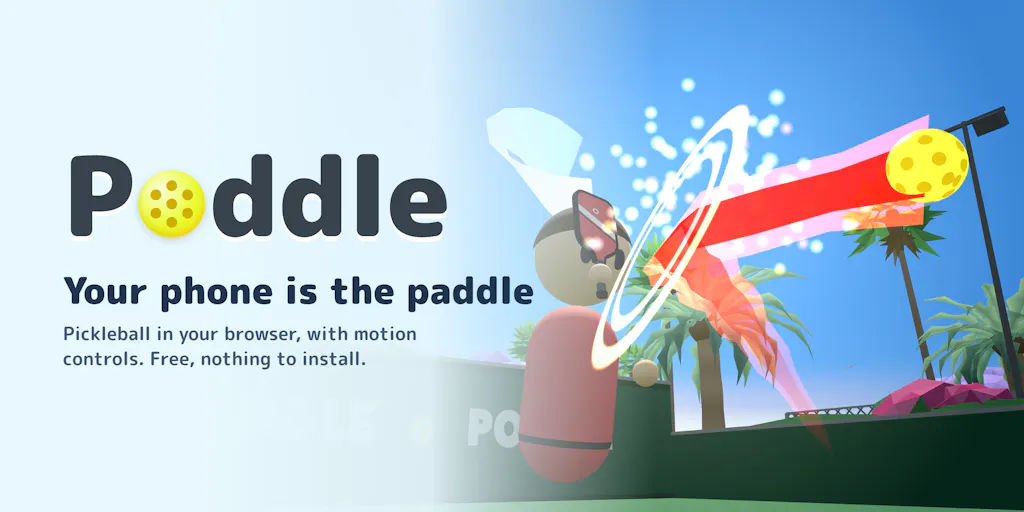
Read the launch copy carefully and the engineering constraint is the whole product. AirPods contain motion sensors, so Daniel’s original experiment was whether one could function as a pickleball paddle “in Wii Sports fashion.” It worked better than expected. But the hard part wasn’t the sensor — it was the mapping. As he puts it, a motion sensor knows how your hand turns, not where it is, so the game reads the swing itself: speed and reach set power, direction aims the shot, a scoop produces a lob, and a wrist cut adds spin. Position on the court comes from your webcam, and the video never leaves your computer.
That’s a genuinely different design philosophy from the last twenty years of consumer gaming. Nintendo built an entire hardware dynasty on the Wii Remote and its infrared sensor bar. Meta is spending billions to get people into Quest headsets. Apple itself sells the Vision Pro as the spatial computing future. Poddle’s bet is the opposite: the sensor hardware is already in your pocket, your ears, and your laptop lid. You don’t buy anything.
The fallback design tells you how seriously the team takes friction. No camera? The game runs you to the ball automatically, like Wii Sports tennis, so you just swing. Early in development Daniel added phone support for easier testing, and it stuck — not because phones are better sensors, but because everyone already has one and time-to-play was faster than pairing AirPods. That’s a product decision made entirely on activation cost, and it’s the same logic you should be applying to your own checkout and onboarding flows.
Why Amazon sellers should care more than Shopify ones
If you sell on Amazon under Amazon Seller Central, your customers are already inside a hardware ecosystem — Echo, Fire TV, Ring, and increasingly AirPods paired to iPhones. Accessory categories around motion, audio, and wearables are some of the most competitive and most review-sensitive on the marketplace. A free game that makes AirPods useful for something new doesn’t just create a novelty moment; it creates a reason for someone to check whether their current earbuds are good enough. That’s a demand signal you can ride with the right listing copy and A+ content, not a product you can build.
Shopify operators, by contrast, live or die on owned traffic. A browser game with no account requirement and no app store gatekeeper is a distribution channel they can actually use — embed it, gate a discount behind it, capture an email. The Shopify App Store is full of gamification widgets, but almost none of them are built around hardware the customer already owns.
How it differs from the incumbents you’d actually compare it to
The obvious comparison is Wii Sports itself, and Daniel leans into it — he calls the auto-run mode “like Wii Sports tennis” and name-drops the swordplay duels as his favorite mini-game. But the more useful comparison for an operator is the stack of tools that try to turn physical motion into digital engagement without dedicated hardware.
Kahoot does this for classrooms with phones. Just Dance Now does it with a phone in your hand. Nike Training Club and Peloton do it with wearables and connected equipment. What none of them do is let you play a racket sport against a bot or a friend with nothing but the earbuds in your ears and the webcam you already have. That’s a narrow but real gap, and it’s the kind of gap that gets cloned fast once someone proves the swing feels right.
The multiplayer and progression layer is where Poddle starts to look less like a toy and more like a platform. You can play Matt the bot at various difficulties, play friends online, earn trophies, run a knockout tournament, or watch live matches. It’s free, and you don’t need an account unless you want progression and stat tracking. That last sentence is the most commercially interesting one on the page — it means the funnel is wide open at the top and monetization, if it ever comes, sits behind identity.
Where the math breaks
Here’s my honest read: a free browser game with no account requirement is a terrible direct business. There’s no disclosed pricing, no disclosed user numbers, no disclosed retention. The maker is a solo developer who didn’t win the hackathon and kept building “out of love for the idea.” That’s admirable and it’s also the profile of a project that either becomes a viral wedge for something else or quietly fades.
The unit economics only work if Poddle is a top-of-funnel asset for hardware, accessories, or a paid tournament/league layer that doesn’t exist yet. If you’re a seller looking at this as a template, don’t copy the “free and accountless” part without a plan for what it feeds. Copy the friction-reduction instinct; ignore the monetization vacuum.
What cross-border sellers can borrow from this
Three things, and none of them require you to build a game.
First, the sensor you already own is the cheapest hardware you’ll ever ship. Every AirPods owner is a potential Poddle player. Every iPhone owner is a potential customer for anything that makes the phone do something new. When you’re doing product research on Helium 10 or Jungle Scout, the question “does this require the customer to buy a new device?” should be a hard filter. The answer “no, it uses what they have” is a moat.
Second, activation cost is a conversion lever, not a UX detail. Daniel kept phone support because “the time to play was so much faster than AirPods.” That’s the same reason one-click checkout, saved payment methods via Stripe or Shopify Payments, and guest checkout matter more than most brands admit. Every additional step between intent and action is a tax on conversion. Audit yours this week.
Third, free plus accountless is a distribution strategy, not a business model. If you run a TikTok Shop storefront or a Temu listing, you already know the platform owns the customer relationship. Poddle’s approach — let anyone play, only require identity for progression — is the same trade. You give up direct monetization at the top to maximize reach, then monetize the slice that self-selects into depth. It works when the top of funnel is cheap. It fails when it isn’t.
A sidebar on the “watch live matches” feature
Buried in the feature list is “watch live matches.” That’s a spectator layer, and it’s the most underrated line in the launch. If Poddle ever gets a critical mass of players, live match viewing is a Twitch-shaped surface — and Twitch itself has proven that watching other people play is a bigger business than playing. For a cross-border seller, the lesson is that community features you’d normally dismiss as “nice to have” are often the retention engine that makes the acquisition spend work. If you’re running Klaviyo flows or a Discord community around your brand, you already believe this. Poddle is just applying it to a sport.
Where my judgment says it falls short
I want to be direct, because the launch copy is charming and that can paper over real gaps.
The webcam tracking is a privacy-adjacent dependency the copy addresses only partially. “The video never leaves your computer” is the right claim to make, but it’s a claim, not a proof. For a game, fine. For anything commerce-adjacent, you’d need third-party verification before you built a customer-facing flow on it.
The phone-versus-AirPods tradeoff is unresolved. Daniel says phone support stayed because time-to-play was faster, which is a testing convenience that became a product feature. That’s a warning sign, not a strength. The AirPods experience is the differentiated one; the phone experience is the convenient one. If the differentiated experience isn’t the default, the product’s identity is muddy.
There’s no disclosed roadmap beyond Daniel’s comment that he’s thinking about boxing with two AirPods, a beat-saber rhythm game, and Wii-style swordplay. That’s a maker having fun, not a product strategy. Nothing wrong with that at this stage — but don’t mistake enthusiasm for traction.
And the competitive moat is thin. The swing mapping took most of the development time, which means it’s the hard part — but it’s also the part a well-funded competitor could replicate. The defensible asset here is the feel, and feel is hard to copy but easy to lose.
What I’d watch / test next
This week, three concrete moves.
One: if you sell anything in the audio, wearable, or gaming accessory space, pull your top twenty listings and ask which ones get more valuable to the customer if a free browser experience makes their existing device do something new. That’s your content angle, not a new SKU.
Two: audit your own activation funnel for the Poddle lesson — count the steps between a customer seeing your ad and completing a first action. If it’s more than three on mobile, you’re losing money you can measure. Run a guest-checkout test against your logged-in flow and compare conversion in Google Analytics 4 or your Triple Whale dashboard.
Three: watch whether Poddle ships the boxing or rhythm-game mode Daniel hinted at. If it does, and if it keeps the accountless entry point, it becomes a genuine case study in hardware-free engagement — and a template worth stealing for your own brand’s retention layer. If it doesn’t ship anything for six months, treat it as a fun hackathon story and move on. Either way, the friction-reduction instinct is the takeaway, and it’s free to apply today.


