Why the Quiet Shift in AI Agent Economics Matters More Than Any “Launch”
If you run a cross-border e-commerce operation — whether as a Shopify DTC brand, an Amazon FBA aggregator, or a multi-marketplace account manager — your single biggest bottleneck isn’t listing optimization or ad spend. It’s multi-step, conditional decision-making at scale: repricing against competitors across six marketplaces, routing low-stock alerts between suppliers and fulfillment centers, triaging customer messages in three languages, and reconciling return requests with carrier claims. Each of these workflows is a chain of small decisions that, today, you either pay a VA to perform or hard-code into brittle Zapier flows. The real story out of this week’s Product Hunt noise isn’t the featured product that made the front page. It’s the quiet math shift that makes agentic AI — not just chatbots, but systems that can act autonomously across multiple tools — finally practical for independent sellers. A comment from maker Sam Odio buried deep in the thread nails it: “GPT-5.6 delivers near-frontier intelligence at roughly half the cost and time of previous models, letting OpenClaw agents run longer multi-step tasks more reliably.” That half-cost, half-latency improvement is the unlock that moves AI-powered e-commerce operations from “cool demo” to “worth the monthly subscription.”
The Real Problem Plow Actually Solves (And Why It’s Not the Tool—It’s the Pattern)
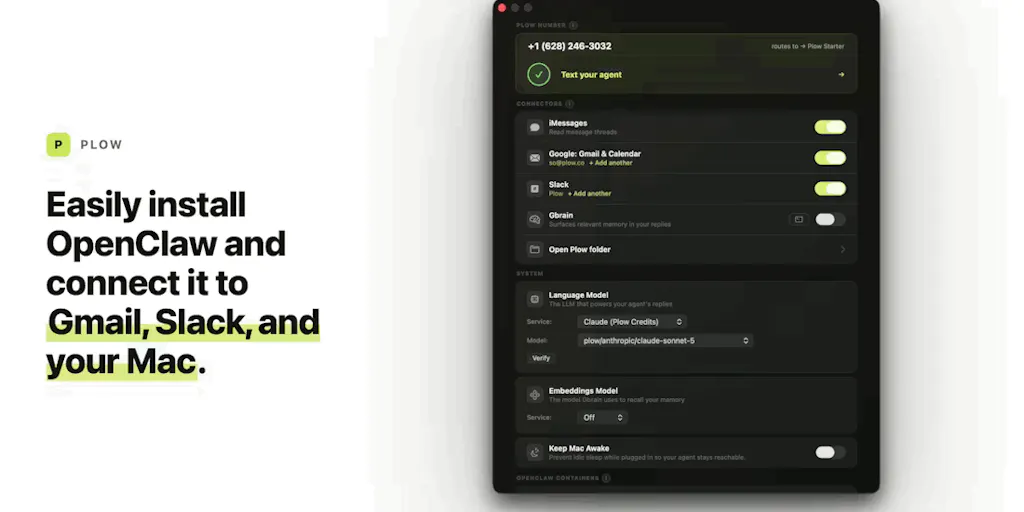
For anyone who has tried to run an open-source agent framework like OpenClaw, the pain point is immediate: installation is still a developer gatekeeping mechanism. Sam Odio built Plow (captured in the launch as “Plow”) to solve exactly that — an out-of-the-box version of OpenClaw that “just works” on a Mac, connects to iMessage, and is secure. On the surface, that sounds trivial. But for a cross-border seller operating without a dedicated engineering team, the ability to spin up a local AI agent that can read your iMessage conversations with suppliers, parse PDF invoices, and then trigger a Shopify inventory update — all without sending sensitive data to a third-party cloud — is a step-change.
The broad problem is less about the specific product and more about the installation and trust tax that current AI automation tools impose. Services like Zapier or Make handle the workflow part but route your data through their servers. Cloud-based AI agents (e.g., Anthropic’s Claude API or OpenAI’s assistants) are powerful but expensive for high-frequency tasks — the kind of repricing checks that run every 30 minutes across 500 SKUs. Local agents, running on your own hardware with a cost-efficient model like GPT-5.6, change that math. The comment from Pueblo Aguilar — “This is a real problem! A lot of my non-programmer friends struggle to install Hermes/OpenClaw!” — underscores the untapped demand from operators who know what they want the agent to do but can’t get past the terminal prompt.
Why Amazon Sellers Should Care More Than Shopify Ones
The differentiation matters. Shopify sellers have a relatively clean API surface and a built-in automation ecosystem (flows, apps like Klaviyo, Gorgias). Amazon Seller Central, by contrast, is a labyrinth of throttled reports, flat-file uploads, and SP-API endpoints that change quarterly. Multi-step tasks on Amazon — for example, “if buy box price drops below margin threshold, pull the SKU from active inventory and email supplier for renegotiation” — require chaining four or five tools. A local agent with long-horizon task reliability (the “longer multi-step tasks” that GPT-5.6 enables) can run that loop without hitting cloud API costs for every intermediate reasoning step. That’s not a hypothetical; it’s the difference between paying $0.20 per call (cloud) versus $0.03 per call (local with GPT-5.6 pricing as hinted in the source). For a seller running 10,000 such decisions a day, the monthly swing is thousands of dollars.
How This Differs From the Incumbent Automation Stacks
The existing tooling landscape for cross-border automation breaks into three camps:
- Low-code workflow platforms (Zapier, Make, n8n) — excellent for linear triggers but terrible at conditional branching that requires semantic understanding. They can move a CSV, but they can’t decide which CSV to move based on a supplier’s email tone.
- Cloud AI agents (OpenAI GPT-4o assistants, Anthropic Claude agents) — powerful but expensive per token, especially when you need them to re-read context for every step. Latency also kills real-time use cases like price monitoring during flash sales.
- Custom scripts (Python + LangChain or AutoGen) — flexible but brittle. Every API change breaks the chain, and maintenance requires a dev on payroll.
Plow + OpenClaw + GPT-5.6, as described in the launch, occupies a fourth quadrant: local, cost-efficient, secure, and opinionated about installation. The “roughly half the cost and time” claim is the killer metric. If you’ve run a Helium 10 repricing rule that only looks at price (not margin, not competitor stockout signals, not seasonal demand), you know the blind spot. An agent that can consider all three at each step, without incurring a $0.10 API call, is the upgrade. The product itself is early — Mac-only, iMessage-centric — but the pattern of low-cost, on-device agency is what sellers should watch.
What Cross-Border Sellers Can Borrow From This (Even If They Never Install It)
You don’t need to buy a Mac or run OpenClaw to extract value from the concept. Three borrowable ideas:
Local-first data processing for compliance. When you sell in the EU, supplier invoices, customer service logs, and return reason codes contain GDPR-relevant data. Sending that to OpenAI’s cloud for analysis creates liability. A local agent (like OpenClaw on your machine) can parse it, extract the key fields, and only push anonymized summaries to your accounting software. Plow’s security-first architecture (“secure” as noted in the launch) is the right design principle.
Multi-step task decomposition. The GPT-5.6 model improvements mean you can break an Amazon FBA restock decision into: (a) check current stock levels via SP-API, (b) read supplier’s latest email confirmation for lead time, © calculate reorder quantity based on sales velocity (pulled from a SellerSprite or Jungle Scout export), (d) place the order via purchase order form. That’s four steps, each requiring a tool access and a decision. Current automation tools handle step a→b→c→d as separate triggers. An agent handles them as a single intelligent thread.
Reduced experimentation cost. Because GPT-5.6 costs half as much per task, you can afford to run experiments that would otherwise be too expensive to test. Want to see if an agent that drafts return-dispute emails outperforms your current template? Run it on 200 real cases for a few dollars. If it lifts win rate by 5%, scale it. The low cost of failure is a competitive advantage.
Where the Math Breaks
There’s a danger in over-romanticizing local agents. The “half cost” comparison assumes you’re comparing GPT-5.6 to GPT-4.0-level models, not to the free tier of Claude Haiku or Gemini Flash. For simple single-step tasks — “translate this review to English” — cloud models are already cheap enough that the overhead of managing a local agent isn’t worth it. The math only flips when your tasks are multi-step, require state retention, or involve sensitive data.
Also, Plow is explicitly Mac-only. The vast majority of cross-border sellers I know run Windows or use cloud VMs. iMessage integration is a feature that appeals to DTC brand owners who text with suppliers, but Amazon sellers rarely use iMessage for vendor communications. The product solves installation friction for OpenClaw, not the broader ecosystem. If you’re a Shopify seller using Slack for team communication, the iMessage hook is irrelevant.
My Judgment: Where It Falls Short (And Where It Points)
The launch itself is modest — a tool that installs another tool. But the embedded claim about GPT-5.6 cost and reliability is the real signal. I’d rate the product as a useful but narrow proof of concept for the cross-border community. It falls short in three dimensions:
- Ecosystem lock-in. You’re tied to Mac hardware and Apple’s messaging system. That’s not a universal e-commerce workflow. A more useful product would integrate with WhatsApp Business API (dominant in China and Southeast Asia supplier communication) or email via IMAP.
- Scalability. Running agents locally means your machine must be on 24⁄7, or you need a remote desktop. For an operator managing 20,000 SKUs, a single Mac isn’t enough. The pattern needs to move to serverless or edge deployment.
- Monitoring and failure recovery. When a cloud Zapier step fails, you get an email. When a local agent hangs because your Mac went to sleep or the iMessage database locked, you lose the task silently. The launch mentions reliability improvements in GPT-5.6, but it doesn’t address the infrastructure reliability of the agent runner itself.
Despite these gaps, the direction is right. The coming year will see a wave of vertical-specific local agent wrappers — tools that combine a pre-configured OpenClaw-like runtime with document parsers for invoices, spreadsheets for inventory, and API connectors for marketplaces. Plow is the canary; the real gold will come when someone builds “Plow for Amazon Sellers” or “Plow for DTC Returns.”
What I’d Watch / Test Next
If you run a cross-border operation and want to stay ahead of the automation curve, here’s a concrete three-step plan for this week:
Download and test Plow on a spare Mac. Even if you don’t use iMessage for business, go through the installation flow. The experience will tell you how far we are from “click to deploy” for local AI agents. If it takes less than 15 minutes, that’s a signal that the barrier is dropping.
Map one of your most painful multi-step workflows — something that currently requires you to toggle between Seller Central, a supplier spreadsheet, and a logistics portal. Write out the steps and the decision rules. Then ask yourself: “If an agent could run this for $0.03 per execution, how many times per day would I use it?” That number is your ROI baseline.
Set up a test using n8n + a local LLM (like Ollama running a GPT-5.6-equivalent model if available) to replicate the pattern without macOS dependency. Run it on a cheap VPS. Connect it to one marketplace API (e.g., Shopify’s admin graphQL or Amazon’s SP-API reports). Let it run for a day. The cost and error rate will tell you whether the “half-cost” claim holds in your use case.
The next 12 months will separate sellers who treat AI agents as a futuristic curiosity from those who start running low-cost, local decision engines today. The Product Hunt thread — with a tool that makes installation easy and a model that makes cost bearable — is a better early warning than any industry report. Don’t wait for the polished SaaS version. Start sandboxing now.