The deliverability bill every cross-border seller is quietly paying
If you sell on Shopify, Amazon, TikTok Shop, Temu, or your own DTC storefront, you send more email than you probably realize. Order confirmations, shipping updates, refund notices, win-back flows, supplier and 3PL coordination, cold outreach to wholesalers — it all routes through some third-party platform that meters you per send and owns the reputation of the domain your customers see in their inbox. That last part is the part nobody thinks about until a shared sender pool burns a bad list and your transactional mail starts landing in spam. So when a maker launches an email platform you can self-host and run through your own AWS account, that’s not a developer-tool curiosity. It’s a supply-chain question for anyone whose revenue depends on deliverability.
What opensend.cc actually solves
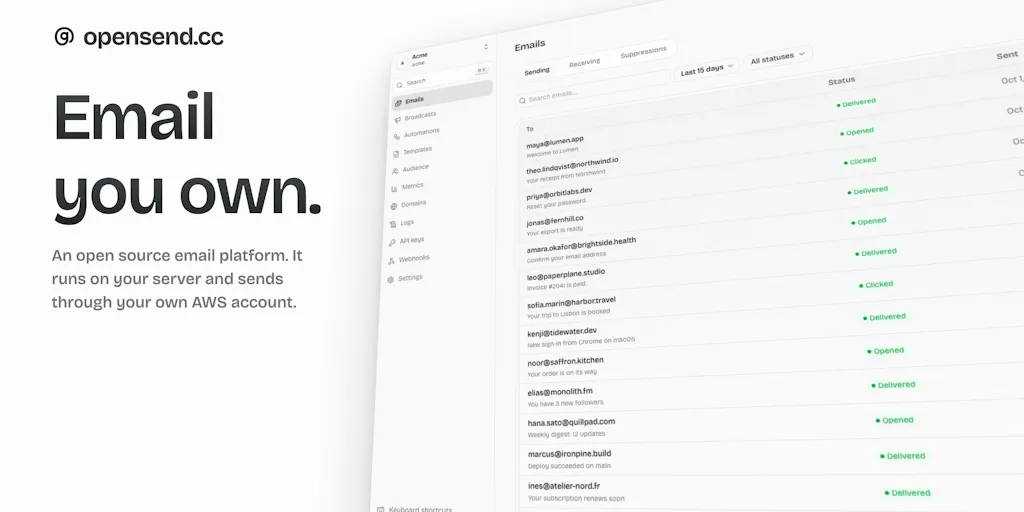
The pitch from maker Kamal Panara is blunt: “Every product sends email, but almost none of them own it. Your mail goes through someone else’s platform. You pay for every email, some features cost extra, and your domain’s reputation is in someone else’s hands.” opensend.cc is the inversion of that. It’s a full email platform — REST API, SDK, SMTP, domains with guided DKIM/SPF/DMARC setup, tracking, broadcasts, templates, automations, audiences, webhooks, logs, and an MCP server so AI agents can send — that you install on your own server with Docker and that sends through your own AWS SES account.
The cost structure is the headline: it’s Apache-2.0 and free to self-host, and you pay AWS for sending at $0.10 per 1,000 emails on SES, plus whatever your server costs. No per-seat, no per-contact, no “contact us for pricing.” If you’re already on Resend, the API is compatible — change the import and the key and your sends keep working.
Why this is a cross-border problem more than a dev-tool problem
Cross-border operators live in a permanent state of being one vendor’s bad day away from a revenue outage. Your Shopify confirmation emails, your Amazon buyer-seller messages, your TikTok Shop order updates, your post-purchase flows in Klaviyo — every one of those is a dependency. When a shared sender pool degrades, you don’t get a Slack alert from your ESP saying “someone else on this IP just torched it.” You get a slow bleed of opens that you misattribute to creative fatigue.
The other cross-border wrinkle is data residency and compliance. If you’re selling into the EU, you’re already juggling GDPR obligations on customer data. Every platform that touches your customer list is a processor you have to vet. A self-hosted email layer doesn’t magically solve compliance — you still own the obligations — but it does collapse one vendor out of your data-flow diagram. For sellers running multiple storefronts across regions, that’s a real simplification.
How it stacks up against the incumbents
Let me be specific, because “cheaper email” is a claim every ESP makes.
Against Klaviyo, Mailchimp, and the DTC marketing stack
Klaviyo and Mailchimp are marketing platforms first and delivery infrastructure second. You’re paying for segmentation, flows, predictive analytics, and a UI your marketing hire can operate without engineering help. opensend.cc is not competing there — it has broadcasts, templates, automations, and audiences, but it’s not going to replace your Klaviyo flows for a DTC brand doing serious lifecycle marketing. What it can replace is the transactional layer underneath: order confirmations, shipping updates, password resets, internal notifications, and any volume where you’re currently paying Klaviyo’s per-send rate for something that isn’t actually a marketing message.
That’s a real arbitrage. Plenty of Shopify brands are pushing 40–60% of their email volume through Klaviyo as transactional sends that carry no segmentation logic. Moving that layer to a self-hosted SES pipe cuts the bill substantially and leaves Klaviyo doing what it’s actually good at.
Against Resend, Postmark, and SendGrid
Resend, Postmark, and SendGrid are the developer-facing transactional ESPs. They’re good. They’re also metered, and their pricing scales with your success. opensend.cc’s API compatibility with Resend is a deliberate wedge — it means migration is a config change, not a rewrite. That’s the smartest thing in the launch post.
Against rolling your own SES integration
You could always have wired SES directly. The reason most teams don’t is that raw SES gives you sending and nothing else — no templates, no tracking UI, no suppression management, no DKIM/SPF/DMARC guidance, no logs you can hand to support. opensend.cc is essentially “SES with the operational scaffolding you’d otherwise build over six weeks.” For a cross-border team without a dedicated backend engineer, that scaffolding is the entire value.
Where the math breaks
The $0.10 per 1,000 emails figure is real SES pricing, but it’s not your total cost. You’re also paying for:
- Server — a small VPS is cheap, but you now own uptime.
- Engineering time — Docker install is one command, but someone has to own the deployment, upgrades, backups, and the SES production-access request.
- The AWS sandbox — a new AWS account starts in the SES sandbox, and you request production access and sending limits from AWS. Those limits grow as your account builds a clean record. That’s a ramp, not a switch.
- Deliverability ops — you’re now the one watching bounce and complaint rates.
If you’re sending 50,000 emails a month, the SES bill is five dollars. The real cost is whoever’s on call when the container falls over. That math works for a team with a technical founder. It does not work for a solo Amazon seller who’s never touched a terminal.
The reputation question — and the answer that actually matters
The best exchange in the entire launch thread is between Gal Dayan and the maker, and it’s the one cross-border operators should read twice. Dayan asks the exact question anyone doing volume outreach would ask: if you switch mid-campaign, do you start warmup from zero on the new sending domain?
The maker’s answer: you don’t start from zero if you keep your sending domain. Gmail and Outlook judge your domain mostly by the domain itself — the one your DKIM signs with — not by which provider sent the mail. “So if you move the same domain to opensend.cc, the reputation you’ve built moves with it. SES gives you new DKIM keys, but they sign for the same domain.” What doesn’t carry over is provider-side history: a new AWS account starts in the SES sandbox, and you request production access and sending limits from AWS, which grow as your account builds a clean record.
The migration playbook he gives is the most operationally useful thing in the thread:
- Add the SES DKIM records next to your current ones — both work at the same time.
- Shift a small share of volume first, then grow it over one to two weeks.
- Watch bounces and complaints. SES reviews accounts at 5% bounces or 0.1% complaints, and opensend.cc suppresses bounced and complaining addresses for you.
Why Amazon sellers should care more than Shopify ones
Shopify merchants already have a transactional layer baked into the platform — Shopify sends the order confirmation whether you like it or not, and your ESP handles the marketing. Amazon sellers have it worse. Amazon Seller Central buyer-seller messaging is a walled garden with its own rules, and any off-platform email you send to a customer — post-purchase follow-up, review request, warranty registration — is email you’re sending through your own infrastructure to an address Amazon technically owns the relationship with. That’s exactly the kind of low-volume, high-stakes, reputation-sensitive sending where a shared sender pool is a liability and owning your own pipe is an asset.
Same logic applies to TikTok Shop and Temu sellers running supplier coordination across time zones — that’s internal email volume that has no business being metered by a marketing ESP.
Where the shared-pool anxiety is legitimate
Dayan’s point about shared sender pools is worth restating plainly: “one other customer on the same platform burns a bad list and your deliverability takes the hit too even though you did nothing wrong.” That’s not paranoia, it’s the actual mechanism. The maker’s response is that by default SES sends from AWS’s shared IPs — well-policed, but still shared — and what opensend.cc adds is a separate SES tenant per team, so one team’s bad list can’t pause anyone else’s sending. If you want IPs nobody else uses, SES offers dedicated IPs with a managed warmup option.
For cross-border sellers doing any cold outreach to wholesale buyers or B2B accounts, that tenant separation alone justifies looking at this.
What cross-border sellers can borrow from this launch
Even if you never install opensend.cc, there are three transferable lessons in this launch.
First: audit which of your email sends are actually marketing and which are just plumbing. Most operators have never done this. Pull your ESP bill, break down volume by campaign type, and you’ll usually find 30–50% of sends are transactional notifications that don’t need segmentation, A/B testing, or predictive send-time optimization. That’s the volume you can move to cheaper infrastructure without touching your marketing stack.
Second: own your sending domain, always. The reputation-carries-with-the-domain insight is not opensend.cc-specific — it’s a general truth about how Gmail and Outlook evaluate you. If your ESP is sending on a subdomain they control, or if you’ve never set up DKIM/SPF/DMARC properly, you don’t own your reputation. Fix that before you migrate anything.
Third: watch the MCP server angle. opensend.cc shipping an MCP server so AI agents can send email is a small line in the launch post with large implications. If you’re building any agentic workflows for customer service, order exceptions, or supplier coordination, having your email layer be agent-addressable is going to matter more in twelve months than it does today. Most ESPs haven’t shipped this. That’s a genuine differentiator, not a marketing bullet.
Where my judgment says it falls short
I’ll be direct about the gaps, because the launch post is honest about pricing and I’ll return the favor.
It’s v0.1.0. The feature list is impressive for a first release, but “broadcasts, templates, automations, audiences” is a long way from Klaviyo-grade lifecycle tooling. If you need visual flow builders, predictive churn scoring, or revenue attribution, this isn’t replacing your marketing platform.
Self-hosting is a tax. Someone on your team owns this. That’s fine if you have engineering capacity and a real cost problem. It’s a bad trade if you’re saving $200/month and spending four hours a month on maintenance.
AWS lock-in is real. You’re trading ESP lock-in for AWS lock-in. SES is cheap and reliable, and the pricing is transparent, but you’re now dependent on one cloud provider’s deliverability posture and one cloud provider’s account-review process. For sellers already deep in AWS, that’s fine. For sellers who’ve deliberately stayed cloud-agnostic, it’s a consideration.
The Resend-compatibility claim needs verification. “Already on Resend? The API is compatible. Change the import and the key, and your sends stay the same.” That’s a strong claim. If you’re actually on Resend and considering this, test it on a low-stakes transactional flow before you trust it with order confirmations.
No mention of inbound or reply handling. For anyone doing B2B outreach, reply management is half the workflow. Not disclosed in the launch post, and worth asking about before you commit.
What I’d watch / test next
This week, if you’re a cross-border operator with meaningful email volume, do three things.
One: pull your last three months of ESP invoices and tag every send as marketing or transactional. You’ll find the arbitrage number in about twenty minutes.
Two: check your DKIM, SPF, and DMARC records on your primary sending domain. If they’re not set up correctly, that’s a bigger problem than your ESP choice, and it’s free to fix.
Three: if the transactional percentage is meaningful and you have engineering capacity, spin up opensend.cc on a cheap VPS against a non-critical flow — password resets or internal notifications — and watch bounce and complaint rates for two weeks before you consider moving anything customer-facing. The migration playbook the maker outlined (parallel DKIM records, gradual volume shift, watch the 5% bounce / 0.1% complaint thresholds) is the right sequence, and it’s the same sequence you’d use migrating between any two ESPs.
What I’m watching longer-term: whether the MCP server angle attracts agentic-workflow builders, and whether “own your domain reputation” becomes a standard talking point across the ESP category. If it does, the incumbents will have to answer for shared-pool risk in a way they’ve never had to before. That’s a good outcome for sellers regardless of which platform you end up on.