The “Autoresearch” Pattern Is Coming for Your Ad Accounts
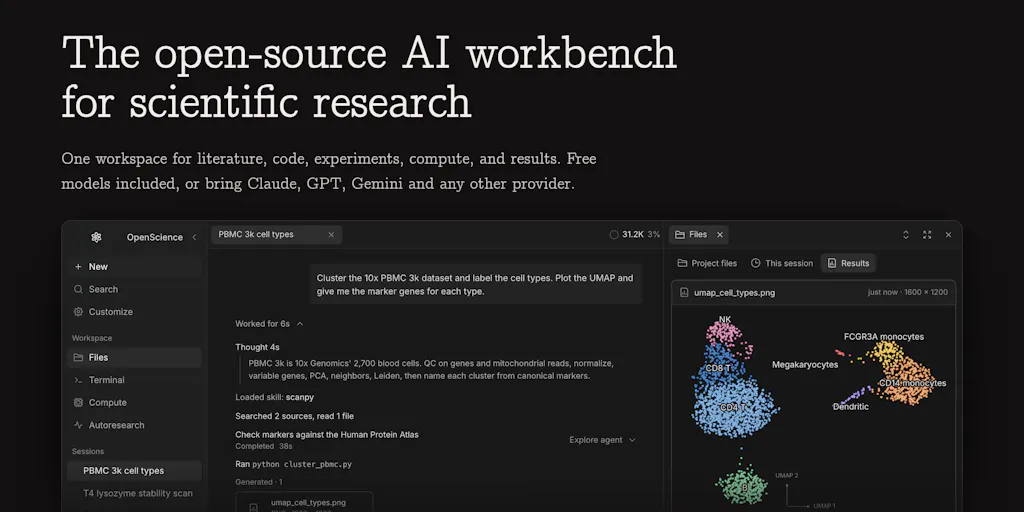
Cross-border sellers have spent the last three years bolting AI onto the edges of the operation — a copy generator here, a review-summarizer there — while the actual bottleneck stayed untouched: the loop between hypothesis, experiment, and logged result. Every serious operator I know runs that loop manually, in spreadsheets, across a dozen browser tabs, and it is the single most expensive habit in the business. That’s why a Product Hunt launch for a computational science IDE matters to people who sell phone cases on Amazon. OpenScience, built by SynScience, shipped an “Autoresearch” mode that takes a metric, forms hypotheses, runs experiments, and logs every attempt. Strip away the protein viewers and what’s left is a general-purpose optimization engine — and optimization engines are exactly what marketplace sellers are missing.
What OpenScience Actually Is, and Why the Wrapper Matters More Than the Science
Let me be blunt about the framing. OpenScience is a computational research IDE. It bundles papers, code, notebooks, a LaTeX editor, a terminal, and 3D protein and genomics viewers into one workspace with an agent sitting alongside all of it. The maker, Ishaan Gangwani, describes the origin problem as copy-pasting between a chat window, a terminal, a notebook, and “whatever cluster you had access to.” That is a workflow complaint, not a science complaint — and it’s the same complaint every FBA brand owner has about their own stack.
The pieces that matter for our purposes:
- Autoresearch: experiment loops that run on Modal GPUs, your own servers, or Slurm and PBS clusters. You give it a metric — validation loss, p99 latency, build time — and it forms hypotheses, runs experiments, and logs every attempt.
- OpenScience Ace: access to 30+ models through one pay-as-you-go wallet, or bring your own keys, your ChatGPT/Codex login, or a local model.
- Tooling: 300+ research skills, 50+ scientific tools and databases, and NVIDIA BioNeMo support.
- Open source and model-agnostic, explicitly positioned against labs that restrict which fields their models will help with and on what terms.
The claim that OpenScience is “currently #1 on agentic scientific research benchmarks, including Terminal Bench Science, TerminalBench 4.0 (Science subset), BiomniBench, and our internal OpenScience Bench” deserves the standard caveat: one of those benchmarks is internal, which means it’s a marketing artifact, not an independent signal. More on that below.
Free credit is gated: sign up with a .edu email for $5 in Ace credit, and the beta was used by researchers at 30+ universities and labs before opening up.
Why Amazon sellers should care more than Shopify ones
Here’s the asymmetry that jumped out at me. A Shopify DTC operator’s experimentation surface is broad but shallow — creative, landing pages, email flows, offer structure. You can A/B test most of it with native tooling or a cheap app, and the feedback loop is hours to days. An Amazon seller’s experimentation surface is narrower but far more consequential and far harder to instrument: listing copy, image stacking, price ladders, coupon depth, ad placement, negative keyword harvesting, buy-box behavior under different fulfillment settings.
The Amazon operator is running a constrained optimization problem against a black-box ranking system, with real money burning on every trial. That is precisely the shape of problem Autoresearch is built for — give it a metric, let it form hypotheses, let it log every attempt. The Shopify operator can mostly get there with Klaviyo flows and a testing app. The Amazon operator cannot, because Amazon Seller Central gives you reports, not an experiment framework, and third-party tools like Helium 10 give you data, not a closed loop.
The Real Competitive Set Isn’t Other Science Tools
If you’re evaluating this as a seller, don’t compare it to lab software. Compare it to what you’re already paying for.
| Job to be done | Typical seller stack today | What OpenScience-style loops imply |
|---|---|---|
| Keyword and listing iteration | Helium 10, Jungle Scout | Metric-driven hypothesis loops with a full attempt log |
| Ad optimization | Amazon Ads console, Perpetua, Teikametrics | Same, but model-agnostic and self-hostable |
| Creative testing | Manual, or a CRO tool like Intelligems | Loop runs unattended against a defined metric |
| Lifecycle messaging | Klaviyo, Attentive | Marginal — this is already well-tooled |
| Agent orchestration | Zapier, Make | Real code execution, not webhook plumbing |
The distinction that matters: Zapier and Make automate transfers. They move data between apps you’ve already decided to use. Autoresearch-style loops automate decisions — they generate the next experiment, not just the next handoff. That’s a different category, and it’s why the “give it a metric” framing is the most commercially interesting sentence in the entire launch post.
The second distinction is model-agnosticism. Every seller I know has been burned by a tool that hard-wired one vendor’s API and then repriced, degraded, or deprecated it. OpenScience’s pitch — pick any model, swap it mid-project, run it locally — is a direct answer to that. It’s also a hedge against the scenario the maker names explicitly: labs restricting which fields they’ll help with and on what terms. For a cross-border seller, “which fields” translates to “which categories, which claims, which markets.” You do not want your listing-optimization engine refusing to work on a supplement or a vape accessory because a model provider got cautious.
Where the math breaks
Run the numbers before you get excited. Autoresearch needs three things: a metric you can measure cleanly, a trial you can run cheaply, and a feedback delay short enough to iterate.
- Ad optimization passes all three. Spend, impressions, conversions, ACOS — clean metric, cheap trial, same-day feedback.
- Listing and creative testing mostly passes, with a caveat: Amazon’s attribution lag and the noise floor on low-volume ASINs will eat your sample size. If you’re doing 15 orders a day, no loop on earth will find signal in a two-week window.
- Pricing fails. Competitor moves and buy-box shifts contaminate the metric faster than you can run trials. This is a monitoring problem, not an optimization problem.
- Product research fails hardest. The feedback delay is months and the trial cost is inventory. Any agent claiming to “autoresearch” your next SKU is selling you a story.
That last point is where I’d push back hardest on the hype cycle this launch will feed. Autoresearch is a tool for optimizing things you’ve already built. It is not a substitute for category judgment.
What Cross-Border Sellers Should Actually Borrow
Three transferable ideas, in order of how fast you can implement them.
1. Write down the metric before you write down the experiment. The Autoresearch framing forces a discipline most sellers skip: name the single number you’re moving. Not “improve the listing” — “raise conversion rate on the 12-image variant from 8.1% to 9.0% over 21 days.” If you can’t name the number, you’re not running an experiment, you’re redecorating.
2. Log every attempt, including the losers. The launch post emphasizes that Autoresearch “logs every attempt so you can see what worked.” Most seller teams remember the wins and forget the failures, then re-run the same dead test eighteen months later. A shared attempt log — even a Notion database — is the cheapest version of this idea and it costs nothing.
3. Insist on model portability in every tool you buy this year. The model-agnostic stance is the part of this launch with the longest shelf life. When you evaluate your next SaaS renewal, ask one question: if the underlying model doubles in price or gets restricted, what happens to me? If the answer is “we migrate you,” get it in writing.
A note on the benchmark claims
”#1 on agentic scientific research benchmarks” is a strong claim, and the list includes an internal benchmark. Internal benchmarks are not necessarily dishonest — teams need them to iterate — but they are not evidence for an outside buyer. If OpenScience publishes methodology and third-party reproductions for Terminal Bench Science, TerminalBench 4.0 (Science subset), and BiomniBench, the claim gets real weight. Until then, treat the ranking as directional. The same skepticism applies to any AI vendor in the e-commerce space claiming a proprietary accuracy benchmark. Ask for the harness, not the headline.
Where My Judgment Says This Falls Short
It is not built for you. OpenScience is for computational research across ML, biology, chemistry, physics, and data science. There is no Amazon connector, no Shopify app, no ad-platform integration. The maker says it directly: “Not a scientist? Autoresearch is probably what you’ll care about.” That’s an invitation, not a product. You will be doing the integration work yourself, and for most seller teams that means it stays a curiosity.
The cluster story is aspirational for sellers. Running loops on Modal GPUs or your own Slurm and PBS clusters assumes infrastructure competence that most seven-figure seller teams do not have and should not build. The realistic path is the pay-as-you-go Ace wallet, and even then you’re paying for inference on experiments whose business value is unproven.
The .edu credit gating tells you who the customer is. Five dollars in free Ace credit for .edu emails is a student-acquisition motion. There’s nothing wrong with that — it’s how developer tools grow — but it signals that the near-term roadmap is academic, not commercial. Seller-specific features are not on the visible horizon.
Model-agnosticism has a hidden cost. Swapping models mid-project sounds great until you try to compare results across runs. Different models, different prompt sensitivities, different failure modes. If your attempt log doesn’t record which model produced which result, your “logged every attempt” dataset becomes noise. This is a solvable problem — version your prompts and pin your model per experiment — but the launch post doesn’t address it.
The open-source claim needs scrutiny. “Open source” plus “pay-as-you-go wallet” plus “bring your own keys” is a business model that works, but the license terms and what’s actually in the repo versus the hosted product are not disclosed in the launch copy. Before you build anything on it, read the license. If the agent orchestration layer is proprietary and only the wrappers are open, your portability hedge is thinner than advertised.
What I’d Watch / Test Next
This week, do three things.
First, run a manual version of the loop on your highest-spend ad campaign. Pick one metric — ACOS on a single ad group, or conversion rate on one ASIN — and for seven days, write down every change you make and the result. You’ll end the week with an attempt log and a much clearer sense of whether your feedback loop is fast enough to automate. If it isn’t, no tool will save you.
Second, audit your current stack for model lock-in. List every tool that touches AI and ask the portability question. Klaviyo, Helium 10, and your ad-automation vendor all have answers; find out what they are before renewal season.
Third, if you have any technical capacity on the team, sign up for OpenScience with a work email and run one non-scientific loop against a metric you already track — page load time, feed sync latency, anything measurable. The point isn’t the result. The point is learning what an autonomous experiment loop feels like before a vendor sells you one wrapped in e-commerce branding. The sellers who internalize this pattern in 2025 will be running circles around the ones still A/B testing by gut in 2026.