The Agent Infrastructure Gap Is Now a Cross-Border Seller Problem
Every cross-border operator I know is running some half-broken stack of AI point solutions: a listing optimizer here, a customer-service bot there, a forecasting script duct-taped to a Google Sheet. What almost nobody has is the boring middle layer — the part that keeps an agent alive when a worker restarts, gives it a safe place to execute code, handles OAuth for every marketplace account, and produces an audit trail a brand owner can actually hand to a tax authority or a marketplace compliance team. Opengeni, launched by Cloudgeni, is an attempt to productize that middle layer and open-source it. For sellers, the interesting question isn’t “should I use this” — it’s “what does its architecture tell me about where my own automation stack will break.”
What Opengeni Actually Solves (And Why It Sounds Familiar)
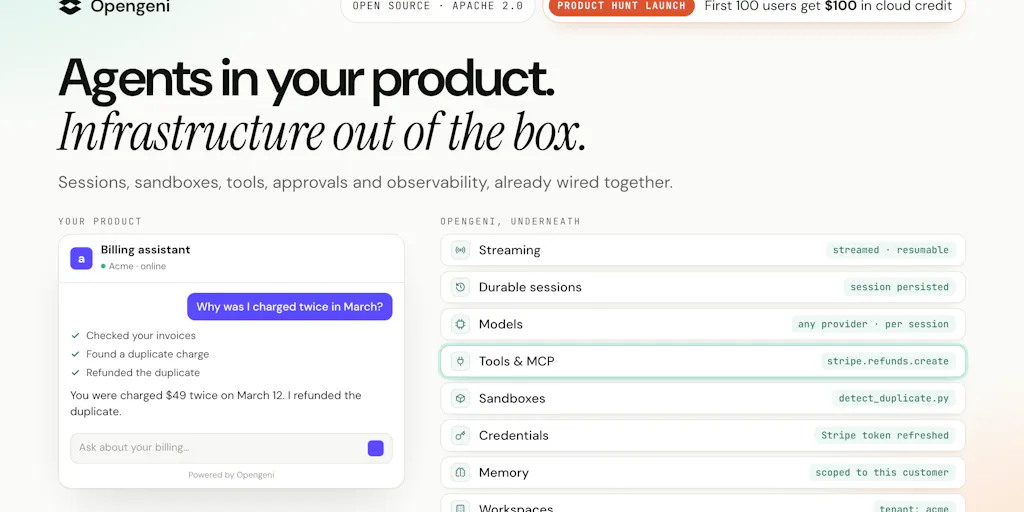
Strip away the developer framing and the pitch is straightforward. The Opengeni team spent two years running AI agents against production cloud infrastructure at Cloudgeni and kept rebuilding the same scaffolding: durable sessions, sandboxes, credential handling, tool wiring, human approval gates, and cost visibility. They turned that scaffolding into a product and released it under Apache-2.0, with a managed cloud priced at model cost plus 5% and no platform or seat fees, plus $100 in cloud credit for the first 100 users during launch.
If you’ve ever tried to run an agent that touches Amazon Seller Central via SP-API, you already recognize every one of those bullet points. OAuth token refresh for a dozen marketplace accounts. A sandbox so the agent doesn’t accidentally fire a bulk price update. A human approval step before it changes a listing. A cost log so you know whether the agent burned $4 or $400 overnight. Opengeni is essentially saying: this is the same shape of problem whether you’re a SaaS company or a seven-figure DTC brand, and you shouldn’t be solving it from scratch.
Why Amazon sellers should care more than Shopify ones
A Shopify merchant can afford to be sloppy. The API surface is friendly, the blast radius of a bad agent action is mostly your own storefront, and rollback is a theme-editor click away. An Amazon FBA brand owner lives in a different risk universe. A mispriced SKU can trigger a Buy Box loss within minutes. A bad inventory feed can create stranded inventory. A misconfigured repricer can train the algorithm against you for weeks. That’s before you get to account health, where a single automated action that violates a policy can put a whole catalog at risk.
This is exactly the gap Opengeni’s “human approvals before risky actions” and “visibility into every step, token, and dollar” features are aimed at. If you’re running agents against Seller Central or Walmart Marketplace, you need the same primitives a fintech needs. The team’s own framing — that “being able to show exactly what an agent did and can we trust them with important stuff is big reason we built this” — is the sentence a compliance-minded seller should underline.
How It Differs From What You’re Probably Using Today
Most cross-border sellers I talk to are choosing between three bad options. The first is a closed SaaS agent — think Jasper for listings, Gorgias for support, or any of the dozens of repricing and PPC tools that have bolted an LLM onto their UI. These are easy to start and impossible to extend. The second is building on a framework like LangGraph or a cloud provider’s agent SDK, which gives you flexibility but hands you back every infrastructure problem Opengeni claims to have already solved. The third is hiring a fractional dev to glue things together, which works until that person leaves.
Opengeni’s bet is that the middle path wins: open-source, self-hostable, model-agnostic, with a managed cloud option for teams that don’t want to run Kubernetes. In the launch thread, a maker contrasts this directly against building on LangGraph or cloud-provider frameworks, arguing that “building AI infrastructure is hard, and there are lots of considerations that only become apparent once you get started.” That’s a fair point, though it’s also exactly what every infrastructure vendor says.
The more interesting comparison is to the emerging agent-infrastructure cohort on Product Hunt itself — tools like Treblle and DiffSense, whose founders show up in the comments asking sharp technical questions. The category is crowding fast, and Opengeni’s differentiator is less “we invented something new” than “we open-sourced the thing we already run in production and priced it at cost-plus-5%.”
What Cross-Border Sellers Can Borrow From the Architecture
Even if you never touch Opengeni, the launch thread is a free architecture review for anyone building seller-side automation. Three ideas are worth stealing outright.
Sessions that survive failure are non-negotiable
The single most underrated feature in the pitch is “sessions that survive errors, with a replayable history so you can reconnect and pick up where you left off.” Cross-border operations run across time zones. Your agent starts a supplier negotiation at 2 a.m. your time, the worker restarts at 4 a.m., and if the session doesn’t survive, you’ve lost the thread. The maker’s answer to a scaling question — that idle sessions are “basically free,” with no workflow left open and nothing polling Postgres for them, and that token writes are batched every 33 ms or 50 events so busy streams don’t fight over the main session row — is the kind of detail you should demand from any vendor whose agent touches your catalog.
Background execution beats long-lived connections
A DiffSense founder asked whether Opengeni supports serverless deployment, given that long-running multi-agent runs over SSE can rack up cloud costs. The answer is worth quoting for any operator paying per-hour for compute: “long multi-agent runs don’t need an open connection at all. You send a message, get a 202 back, and the agent keeps working on a background worker. Close the stream whenever you want, nothing gets cancelled.” The practical takeaway — spelled out in the background agents docs — is that webhooks (turn.completed, session.requiresAction) are cheaper than streaming, and you should never proxy an SSE stream through a serverless function because it stays open and bills you. If you’re running any always-on automation for inventory syncs or review monitoring, this is a direct cost lever.
Cost visibility is a governance feature, not a dashboard
A commenter asked whether you can cap spend per agent and per session. The maker’s reply is telling: Opengeni already tracks cost per user and per session, and “we have limits and guardrails in place, so combining two will be fairly simple.” Read that as an admission that hard budget caps aren’t fully shipped yet — but also as a signal that the tracking layer is there. For a seller running agents across multiple marketplaces, per-account cost attribution is the difference between a tool you can expense and a tool you can’t justify to a CFO.
Where My Judgment Says It Falls Short
Three honest concerns.
First, the “early public preview” label matters. Opengeni is Apache-2.0 and free to self-host, but self-hosting means running Kubernetes or a native cloud deployment — the core “doesn’t scale to zero today” and the workers are long-running. That’s fine for a SaaS company with a platform team. It’s a real lift for a seller whose “engineering team” is one ops manager and a Helium 10 subscription. The managed cloud at model cost plus 5% is the realistic path for most sellers, which means you’re back to trusting a vendor — just a cheaper one.
Second, the integration story is developer-shaped. “Bring an OpenAPI or GraphQL spec, or an MCP server, plus 100+ integrations with built-in OAuth” sounds great until you realize that Amazon SP-API, TikTok Shop, Temu, and SHEIN each have their own auth quirks, rate limits, and approval processes. The 100+ integrations list isn’t disclosed in the launch copy, and I’d want to see which marketplaces are actually covered before betting a catalog on it.
Third, the launch thread’s most enthusiastic testimonials come from other SaaS founders, not sellers. A We Are Learning commenter mentions using Opengeni for a year and recommending it to startups that need SOC 2-grade security. That’s a strong signal for the SaaS use case and a weak one for the cross-border use case. Nobody in the thread is running it against a marketplace account, and that’s the validation I’d want before recommending it to a seller.
Where the math breaks
The pricing sounds almost too clean: model cost plus 5%, no platform or seat fees. But “model cost” is the variable you don’t control. An agent that loops on a stubborn SP-API error can burn tokens for hours. Without hard per-session caps shipped (and the maker’s own comment suggests they’re not fully there), the 5% margin is the least of your worries — the 100% of model spend is. Budget caps aren’t a nice-to-have for sellers; they’re the whole game.
What I’d Watch / Test Next
This week, if you’re agent-curious, do three things. First, try the cloud with a throwaway task — not a live listing change, but something like “summarize this week’s negative reviews across three marketplaces and draft response templates.” Watch the run trace and the cost line. Second, read the docs specifically for the background-agents and webhook sections, and compare the cost model against whatever you’re paying now for always-on automation. Third, if you have any engineering capacity, self-host on GitHub and file an issue for the marketplace integration you most need — the team has explicitly invited that, and issue volume is a leading indicator of whether they’ll prioritize seller use cases or drift toward pure SaaS.
My watch list for the next quarter: hard budget caps per session, a public list of which marketplace APIs are actually wired up, and at least one named cross-border seller (not a SaaS founder) running it in production. Until then, treat Opengeni as a very good architecture reference and a promising managed service — not yet the backbone of your seller stack.