Why This Matters to Every Cross-Border Operator
If you run a brand on Amazon, Shopify, TikTok Shop, or even Temu, you already know the dirty secret of modern e‑commerce: the real work isn’t listing products or running ads—it’s the endless manual glue between platforms. You pull sales data from Seller Central, copy it into Google Sheets, paste it into Klaviyo for a triggered email, then log into Slack to tell your VA to adjust ad spend. Each of those steps lives in a different tab, requires a different login, and feels too simple to automate—until you do it 50 times a week. That’s the gap Quaso is trying to bridge. It’s an AI agent that combines real browser automation (driving a cloud browser like a human) with 3,000+ native app integrations, so a single prompt can, say, scrape your Amazon inventory page, cross‑reference it with Shopify orders, and post a summary in Slack. For sellers who survive on speed and data accuracy, that vision is intoxicating. But the real question is whether it works reliably enough for the workflows that actually make you money.
The Real Problem: Fragmented Workflows That Eat Margins
Every cross‑border seller I talk to has the same bottleneck: data movement. Amazon Seller Central has an API, but it doesn’t expose half the pages you actually care about—account health, advertising placements, category‑specific reports. TikTok Shop’s API is still maturing. Temu basically expects you to use a spreadsheet. Shopify is better, but even there, you’re jumping between the admin panel, analytics, and third‑party apps for fulfillment, reviews, and returns.
The result is a constant context‑switch tax. You spend 30 minutes a day pulling numbers manually, then another 20 minutes reconciling discrepancies. Multiply that across a 10‑SKU brand and you’re losing a full work day per week to tasks that feel like they “should” be automated—but aren’t, because the tools available force you to pick one lane. Zapier and Make (formerly Integromat) are great for apps with open APIs, but they hit a wall the moment you need data from a site that has no API or that puts data behind a login wall. Browser‑automation tools like UiPath or plain Playwright scripts require engineering time, break when the site updates, and can’t talk to your Gmail or Shopify order data without extra wiring.
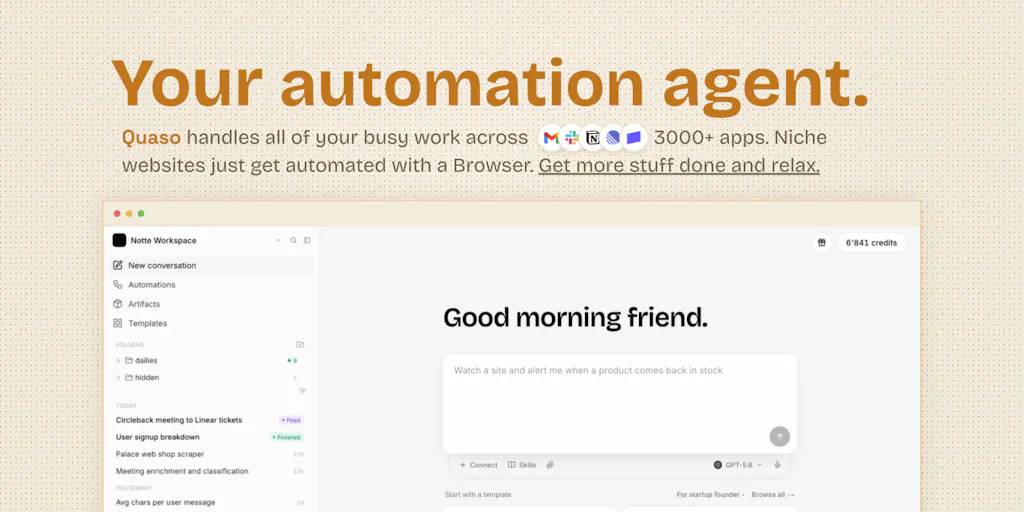
Quaso tries to be both. It drives a real, cloud‑hosted browser that you can watch live, fills forms, clicks buttons, and extracts text from pages that have no API. At the same time, it connects to Slack, Gmail, Linear, Stripe, Notion, and thousands of other apps through pre‑built integrations. And it does it from a single prompt—no coding, no stitching together two separate tools.
How Quaso Differs from Everything Else
The closest competitors are automation platforms like Zapier, Make, and browser‑specific tools like Browserbase or Playwright‑based agents. But Quaso’s architecture has a key twist: integrations first, browser fallback. As the makers explained in the Product Hunt comments, “If an integration exists, the agent picks that up by default, it’s faster and more reliable. If the integration can’t do what’s needed, or none exists, it falls back to browser automation automatically.” That hybrid approach is smart, because the happy path (API calls) is cheap and rock‑solid, while the browser path handles the long tail of sites that resist automation.
For sellers, that means you could build a workflow that:
- Uses the Shopify API to fetch yesterday’s orders.
- Falls back to browser automation to log into Temu’s supplier portal and copy shipping statuses.
- Then posts a summary in Slack with @mentions for your ops team.
All from one description like “Check Temu order updates and notify me of delays.” No specialist needed.
The underlying browser infrastructure comes from Notte, the same company that launched Notte Browser Agents and Anything API. They’ve been building stealth browser infra for over a year, and claim that “200+ companies run their agents on it in production.” That level of production traction matters because browser automation is notoriously brittle—site updates, bot detection, and session expiry kill most agents quickly. Notte’s use of residential proxies, fingerprinting, and persistent cookie profiles (what they call “Notte profiles”) gives Quaso a stronger base than a startup building browser automation from scratch.
But the caveat is real: “It’s still not bulletproof. Heavy bot detection sites (aggressive fingerprinting, active challenge‑response) can still trip it up.” And the self‑repair mechanic—where Quaso retries or recovers when a selector breaks—only fixes “most breaks, not all of them,” as maker Lucas Giordano admitted. So for mission‑critical workflows like checking Amazon account health or processing high‑value returns, you’d want to monitor runs carefully.
Why Amazon Sellers Should Care More Than Shopify Ones
If you sell on Shopify, you already have a decent API for most operations—orders, customers, products, even parts of analytics. You can already automate much of your process with Zapier or Make. The browser fallback is a luxury, not a necessity.
Amazon is a different beast. Amazon Seller Central’s API covers only a subset of the data sellers actually need. Want to see your account health rating? That’s a web page, not an API endpoint. Need to check ad placement performance by keyword? Also a web page. Even scraping inventory reports from the “Manage Inventory” page often requires browser automation because the API returns CSV exports only at certain times.
Amazon also aggressively anti‑bots. It uses CAPTCHAs, fingerprinting, and rate‑limiting. Quaso’s built‑in residential proxies and session persistence are exactly what you need to stay under the radar. A Zapier‑only approach fails here. So if you’re an Amazon seller, Quaso’s browser leg is the real differentiator—it’s the only way to automate those critical pages without writing your own Playwright scripts and managing proxy rotations yourself.
What Every Cross‑Border Seller Can Borrow from Quaso’s Philosophy
You don’t have to adopt Quaso tomorrow to profit from its approach. Here are three lessons that apply to any automation stack:
1. Use APIs for what they’re good at, browsers for what they’re not. Most sellers try to automate everything with one tool and end up with a brittle pile of Zapier zaps. Audit your workflows: which steps involve well‑documented APIs (Shopify orders, Stripe charges, Slack messages)? Those are cheap and reliable. Which steps require clicking through a login, extracting from a table, or submitting a form on a site that hates automation? Those should be handled by a headless browser—either Quaso or a custom script built on Playwright or Puppeteer. Separate the two, and your automation becomes far more resilient.
2. Durable, scheduled agents are the real time‑saver. Quaso lets you turn any task into a “scheduled or event‑triggered agent” that runs while you sleep. That’s huge for cross‑border sellers who need daily price checks, inventory syncs, or ad‑spend reports. Even if you’re not using Quaso, you should set up similar cron jobs—using Make’s scheduling or a simple Google Apps Script that runs daily. The difference between a morning briefing that appears in your Slack versus manually checking ten tabs is the difference between proactive and reactive management.
3. Multiplayer automation saves the team. Quaso integrates with Slack so that any team member can tag @Quaso and trigger an agent. That lowers the barrier to automation from “figure out the tool” to “just ask in the channel.” For a DTC brand, that means your customer support rep can say “@Quaso get me the latest order status for customer X” without learning a single integration. It turns automation into a team superpower rather than a solo engineering project.
Where My Judgment Says It Falls Short
I’ve been testing automation tools for cross‑border operations for two years, and I’m never fully comfortable handing over browser control to a third‑party agent without a fail‑safe. Here are the three places Quaso leaves me cautious:
Reliability for high‑stakes tasks. The makers themselves are honest: “Complex multi‑step browser tasks may need a retry, and self‑repair fixes most breaks, not all.” If a scheduled agent half‑completes a workflow—say, it extracts yesterday’s orders but fails to post them to Slack—you might not notice until a day later. For tasks like processing returns or updating inventory, a silent failure can lead to overselling or delayed refunds. Quaso does flag ambiguous situations (the maker said “the agent will prompt you to log back in rather than silently failing”), but it’s not clear how configurable that alerting is. A seller would want email or Slack notifications on partial completions, ideally with a log of what succeeded and what didn’t.
Pricing and scale economics. Not disclosed in the launch. For high‑volume operations, a per‑run or per‑browser‑session model could get expensive quickly. Scraping 500 product pages daily from multiple marketplaces would mean constant browser sessions. Compare that to self‑hosting Playwright on a cheap VPS—less convenient, but potentially far cheaper. Until Quaso publishes transparent pricing, it’s hard to run a cost‑benefit analysis.
Lack of e‑commerce‑specific templates. The templates shown are “morning briefing, support triage, Stripe revenue reports.” Those are general SaaS workflows, not tailored to Amazon, Shopify, or TikTok Shop. A seller like me would need to build from scratch: “Scrape Amazon BSR for these ASINs and email me if they drop below 100.” That requires writing a good prompt and debugging the browser fallback. It’s doable, but it’s not plug‑and‑play. If Notte eventually releases pre‑made agents for “Amazon inventory monitoring” or “Shopify order‑to‑Slack,” that could tip the scales.
Where the Math Breaks
Let’s say you want to automate daily price monitoring across five competitors with 100 SKUs each. That’s 500 product pages to scrape daily. If each browser session costs $0.10 (hypothetical), that’s $50 per month for scraping alone. Add API calls to Slack and a spreadsheet—maybe $70 total. That’s cheaper than a VA doing it manually for a few hours per week. But if the scraping fails on 5% of pages and you need to manually retry those, your time savings shrink. And if Quaso charges per “run” regardless of complexity, a single multi‑step agent that scrapes 500 pages might count as one run—or 500. Without clarity, the math is fuzzy.
What I’d Watch / Test Next
I’m not a “wait and see” person—I test everything within the first week. Here’s what I’d do with Quaso starting today:
Test a low‑risk browser workflow first. Pick a single Amazon product page (your own, not a competitor’s) and ask Quaso to extract the current price, stock status, and buy box owner. Then verify the data manually. Run it three times to see if session persistence works across days. This costs nothing but time and tells you whether the bot detection tripwire is acceptable for your use case.
Set up a Slack‑based morning report. Connect Quaso to your Shopify account (via its 3,000+ integrations) and ask it to fetch yesterday’s order count, revenue, and top‑selling SKU, then post it to a private Slack channel. Then add a browser step to check your Amazon account health page. If the Amazon piece fails, you’ll see the Slack message still arrive—partially. That’s a good stress test of the “partial failure” scenario.
Compare to a DIY stack. Spin up a Make scenario that does the same Slack report using Shopify’s API (trivial) and a Google Sheets script for manual Amazon data. Measure the time to set up versus time to set up Quaso. The winner might surprise you depending on your team’s technical comfort.
Monitor for templates. If Notte releases Amazon‑specific or TikTok‑specific workflows in the next 90 days, that signals they’re targeting cross‑border sellers. I’d jump in immediately. If they stay focused on SaaS workflows, I’d treat Quaso as a useful but niche tool for edge cases, not a core stack component.
The bottom line: automation that spans API and browser is the missing link for sellers who live across multiple platforms. Quaso is the most promising attempt I’ve seen at making that work with a single prompt. It’s not ready for your most critical revenue‑driving workflows yet—but it’s ready to earn its keep on the dull, repetitive jobs that currently waste your best hours.


