Why an Open-Source Local Inference Engine is a Cross-Border Seller’s Quiet Infrastructure Play
Every cross-border operator I know is drowning in the same paradox: we’re told AI will save us, but the tools we’re handed are cloud-bound, per-token billed, and increasingly suspect when it comes to data privacy. Your Amazon listing copy, your supplier emails, your customer service transcripts — they’re all being fed into someone else’s API, and you’re paying for the privilege of leaking your operational playbook. What if the most important AI tool for your 2025 Q4 planning isn’t another SaaS dashboard, but an open-source inference engine that runs your models on hardware you already own? That’s the contrarian bet worth exploring. The launch of NobodyWho on Product Hunt isn’t just another dev-tool flex; it’s a signal that the pendulum is swinging back toward local control, and for sellers who’ve been burned by API price hikes and data-scraping scandals, that pendulum can’t swing fast enough.
The Real Problem: Your AI Stack Is a Leaky, Expensive Pipe
Let’s be honest about what most cross-border sellers are actually using AI for. It’s not autonomous agents running your entire PPC account (yet). It’s the mundane, high-volume grunt work: drafting response templates for return requests, summarizing competitor reviews across marketplaces, transcribing supplier calls, and generating product descriptions that don’t sound like they were written by a bot in 2022. The problem isn’t the models — it’s the delivery mechanism. Every time you hit an API endpoint for OpenAI or Anthropic, you’re not just paying for tokens; you’re paying for latency, for their margin, and with your data. When you’re sending a draft of your new product launch to a cloud LLM, you’re essentially handing your competitive intelligence to a third party. That’s a non-starter for anyone serious about protecting their sourcing advantages.
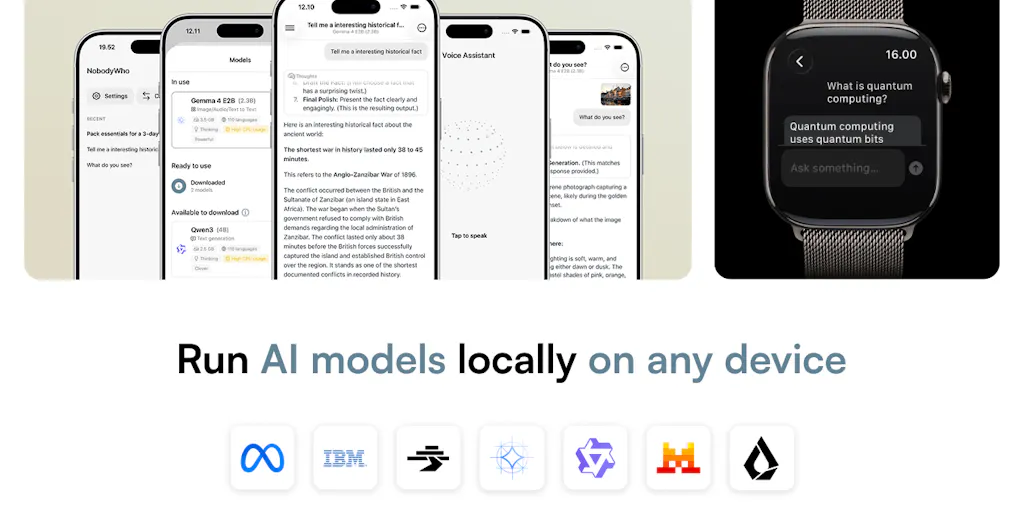
NobodyWho’s pitch is that it makes local inference “production-ready” across six platforms and frameworks, not just a demo that works on one device. For the uninitiated, that means you can run open-weight models like Gemma, Qwen, and LFM directly on your laptop, your server, or even your phone. No cloud round-trip. No per-token meter running. No data leaving your building. The maker, Pierre, frames it as a tool for developers, but the implications for operators are far more practical. This is the infrastructure that could finally make “AI-assisted arbitrage” a private, cost-effective reality.
Why Amazon Sellers Should Care More Than Shopify Ones
If you’re running a Shopify store, you’re already used to a certain level of API flexibility. You’re a tenant in someone else’s house, but you have a key to the back door. Amazon sellers, however, live in a walled garden where every scrap of data you generate is theirs first. The idea of running a local model to analyze your Amazon Seller Central reports — without uploading that CSV to a third-party AI tool that might be scraping it for its own purposes — is not just a nice-to-have; it’s a compliance and security imperative. NobodyWho’s focus on local, private inference is the only sane way to handle the volume of sensitive operational data that Amazon sellers juggle daily. The tool’s ability to handle long conversations via preemptive context shifting is a huge win here, because your seller data isn’t a single prompt — it’s a continuous, multi-month narrative of inventory, pricing, and customer feedback.
The Differentiator: It’s Not Just About Running Models; It’s About Running Them Right
There are plenty of local inference projects out there. I’ve seen a hundred GitHub repos that promise on-device AI and then die on arrival because they only work on a specific Nvidia GPU or a single Python version. NobodyWho’s approach is different because it’s attacking the friction points, not just the raw compute.
First, there’s the platform spread. Pierre mentions support for six platforms, and the comment section highlights Godot — a game engine. That might seem irrelevant to a seller, but think about it: if they can make inference work reliably inside a game engine, they can make it work inside your inventory management tool or your custom Notion dashboard. The breadth signals engineering rigor, not just a hobbyist’s single-platform obsession.
Second, and more importantly, is the focus on guaranteed schema-valid output. This is the killer feature for e-commerce. When you’re building an automated workflow — say, a system that categorizes return reasons from customer emails and then routes them to the correct workflow — you don’t want the AI to occasionally spit out a response that breaks your JSON parser. NobodyWho builds the grammar from your function signature, so the model cannot return malformed JSON. For anyone who has spent a Saturday afternoon debugging a Python script because the LLM decided to add a “Sure, here’s the JSON:” preamble, this is salvation. It moves AI from a “sometimes helpful intern” to a “reliable automated process.”
Third, there’s the preemptive context shifting for long conversations. Anyone who’s tried to use a local model for a lengthy task — like analyzing a full year of ad spend data — knows the pain of hitting the context window wall. The ability to manage that context shift preemptively means you can run longer, more complex analyses without the system crashing or forgetting the initial instructions. This is the difference between a toy and a tool.
Where the Math Breaks
The comment section has a fantastic exchange between Pierre and a user about the latency impact of grammar constraints. Pierre’s data point is revealing: on a Qwen3 0.6B model, time-to-first-token (TFTT) jumps from 20ms to 240ms with grammar constraints. On the 4B variant, it goes from 140ms to 250ms. The absolute numbers are still fast, but the relative cost on smaller models is a 12x hit. This is a crucial caveat. If you’re deploying this on a low-powered device — like a Raspberry Pi in your warehouse running a voice assistant for pickers — that latency might be the difference between a smooth workflow and a frustrating pause. The math only works if you’re using the right-sized model for the hardware. The team’s own analysis suggests Q4 quantization is the sweet spot for quality versus speed, which aligns with the community consensus. Don’t expect to run a 27B parameter model on a phone and get instant responses; the physics just don’t allow it.
What Cross-Border Sellers Can Borrow From This
Even if you never deploy NobodyWho, the principles behind it are a masterclass in operational efficiency that you can apply to your stack today.
1. Take Back Control of Your Data Pipeline. The shift to local inference is a direct response to the anxiety of cloud dependency. You should apply that same anxiety to your other tools. If Klaviyo or Helium 10 is processing your data, know exactly what they’re using it for. Ask for data processing agreements. Understand their sub-processors. The fact that an open-source project can offer privacy and offline capability is a challenge to the big SaaS players to do the same.
2. Demand Schema-Valid Output From Every AI Tool You Use. Stop accepting AI tools that give you free-form text when you need structured data. Whether you’re using an AI-powered repricer or a review-analysis tool, the output should be as clean as a database query. NobodyWho’s grammar-constrained generation is the gold standard. When you’re evaluating new AI tools for your business, ask them how they handle output validation. If they can’t guarantee a clean JSON payload, they’re just a toy with a billing page.
3. Think About the Total Cost of Ownership, Not Just the API Bill. The obvious appeal of local inference is zero per-token cost. But the hidden cost is hardware and maintenance. Pierre mentions running models on an iPhone 15 Pro and getting 27 tokens/sec on a Granite 4 (1B) model — faster than you can read. That’s a compelling argument for edge deployment. But for heavy lifting, you’re looking at a home server or a beefy workstation. The comment from Roman Koropets about running a Qwen 35B model on a home server after “a few sleepless nights” is a reality check. The setup cost is real. The payoff is a permanent, private, high-performance AI cluster that costs you electricity, not API fees. For a 7-figure seller, that math can work out within a year.
Where My Judgment Says It Falls Short
This isn’t a silver bullet. The Product Hunt launch is impressive, but it’s still a developer-centric tool. The starter examples promise a 5-minute setup, but that’s for a developer who knows their way around a terminal. For the average operations manager, the barrier to entry is still too high. You need to be comfortable with model selection, quantization, and debugging inference engines. That’s a skill set most e-commerce teams don’t have in-house.
Furthermore, the “open-source & free” label is a double-edged sword. It means no vendor lock-in, but it also means no dedicated support. When your inference engine breaks at 2 AM during a Black Friday flash sale, you’re on your own with a GitHub issue tracker. The GitHub community is active, but it’s not a managed service with an SLA.
The platform support also has a gap. There’s no mention of Windows support in the launch copy, which is a deal-breaker for a large chunk of the e-commerce tooling world that runs on Windows PCs. The comment section mentions a Rust release is coming, which is promising for cross-platform compatibility, but it’s not here yet.
Finally, the “local AI” story is often a privacy story, but it’s worth remembering that a local model is only as good as its training data. If you’re running a small model, you’re getting a smaller brain. The quality gap between a 7B model and a frontier model like GPT-4o is still massive for nuanced tasks like translating idiomatic marketing copy or understanding sarcastic customer reviews. For high-stakes, high-creativity tasks, you might still find yourself reaching for the cloud.
What I’d Watch / Test Next
If you’re an operator, don’t wait for your CTO to read this. Here’s what I’d do this week:
Download the demo apps. Pierre has built iOS, Android, Apple Watch, and Vision Pro apps. Install one on your phone. Use it for a day. See if the latency and output quality are good enough for you to replace your daily “ask ChatGPT” habit for non-sensitive questions. This is the easiest zero-risk test.
Check the model selection page. Before you even think about deployment, look at the models page and the documentation on quantization. Identify one model that fits your hardware. If you have a Mac with an M-series chip, try a Q4-quantized Qwen 1.5B or 4B model. Use the starter pack to get a simple chatbot running locally. The goal isn’t to build a product; it’s to build confidence in the tech.
Audit your current AI tooling for data leaks. List every AI tool you use in your business. For each one, ask: “Do I have a data processing agreement? Where is this data stored? Who can see it?” If the answer is “I don’t know,” that’s your red flag. The existence of tools like NobodyWho gives you leverage. You can now say to your SaaS vendors, “If you don’t offer a private, local deployment option, I can build it myself.”
Prototype a sensitive workflow. Pick one workflow that involves sensitive data — perhaps your supplier pricing spreadsheet or your internal brand strategy doc. Try to build a local RAG (Retrieval-Augmented Generation) system using NobodyWho to answer questions about that data. If you can get that working, you’ve just cut your data-leak risk to zero and saved yourself a monthly API bill for that use case.
The future of cross-border e-commerce is going to be defined by who owns their data and their AI infrastructure. Tools like NobodyWho are the first step toward that ownership. It’s rough around the edges, and it requires a technical stomach that not every seller has. But the direction is clear: the power is moving back to the operator. I’m watching this space closely, and you should too.