Why a CRM That “Thinks” About Your Customers Changes the Game for Cross-Border Sellers
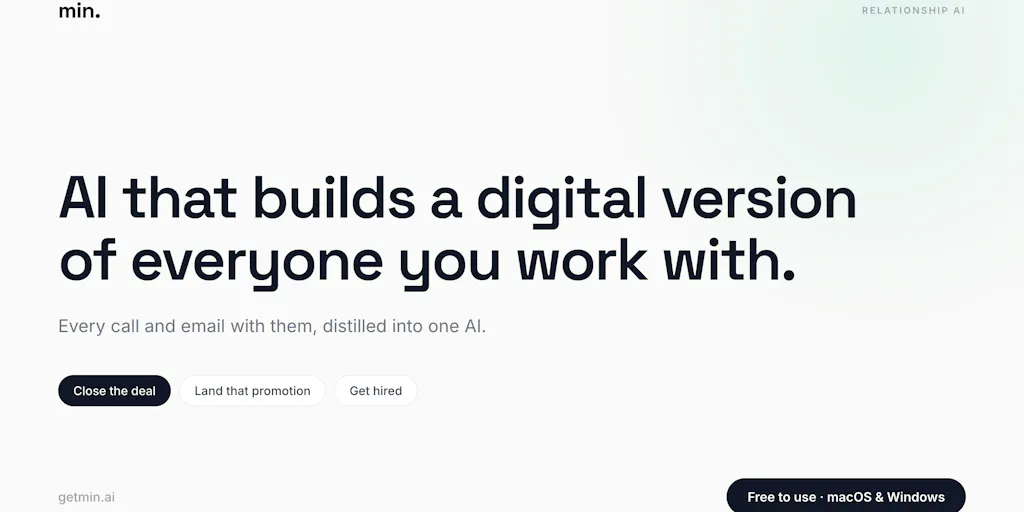
For years, the cross-border e-commerce playbook has been obsessed with the front end: sharper ads, better product images, more aggressive discounting. But the real margin leakage happens in the back office — in the chaotic, undocumented conversations with suppliers, freight forwarders, and the handful of wholesale buyers who actually move your volume. We’ve all been there: a key account manager is on vacation, a customs broker changes a ruling, and suddenly you’re scrolling through six months of disjointed email threads to reconstruct a single decision. The tools we’ve been sold — traditional CRMs — are glorified Rolodexes. They store contact details and deal stages, but they don’t remember anything. That’s why the launch of min. caught my attention. It’s not another dashboard; it’s an attempt to build a persistent memory layer for your customer relationships. For operators managing complex supply chains across time zones, that’s not a nice-to-have — it’s the difference between reacting to a problem and anticipating it.
The Problem: Your “Context” Is a Mess of Half-Remembered Slack Threads
Let’s be brutally honest about how most of us actually run our seller operations. When a supplier in Shenzhen changes a lead time, or a marketplace manager at a major retailer asks for a revised co-op marketing plan, where does that information live? In my experience, it’s scattered across a graveyard of tools: a Slack thread someone half-remembers, a Notion doc nobody updated after week two, and an inbox that’s become a black hole of unanswered follow-ups. The founders of min. — Eric Wang and Fadi Kanaan — describe exactly this pain in their launch notes. Kanaan puts it plainly: catching up after a missed call or a sales sync was “a nightmare,” and sifting through email threads or watching meeting recordings was inefficient. They built min. to solve a specific, universal problem: how do you get the full context of a customer relationship in 60 seconds, without having been in the room?
This resonates deeply with the cross-border reality. We’re not just managing customers; we’re managing intermediaries. Your “customer” might be a distributor in Germany, a retail buyer in the US, or a logistics partner in Vietnam. Each relationship has a history — pricing agreements, quality disputes, seasonal forecasts — that directly impacts your P&L. The cost of losing that context isn’t just an awkward phone call; it’s a missed restock window, a duplicate shipment, or a margin-killing rush freight charge. The existing solutions — HubSpot, Salesforce, Pipedrive — are built for tracking a sales pipeline, not for building a living institutional memory of a business relationship. They tell you where a deal is, but they don’t tell you why the buyer is hesitant, or what they objected to last quarter. Min. is attacking that gap.
Why Your Current CRM Is Lying to You
The fundamental flaw of traditional CRM is that it relies on manual input. You have to type in the notes, log the call, and update the stage. In a busy operation, that data entry is the first thing to get dropped when things get hectic. So the CRM becomes a static snapshot of a deal that closed three months ago, not a living record of the relationship. Min.’s approach is different. It runs on your email and meetings, automatically building context for everyone you work with. It’s not asking you to do more work; it’s doing the work of listening and remembering for you. That’s a paradigm shift. It moves the CRM from a passive database to an active participant in your workflow.
How Min. Differs: From Notetaker to “Persona” Builder
There’s a crowded field of AI notetakers right now — Otter.ai, Fireflies.ai, and Fathom are the ones I see most often in the wild. They do a decent job of summarizing a single meeting. But as Wang points out in the launch thread, “The notetakers could summarize a meeting fine, but none of them knew the customer context on the other side.” That’s the critical distinction. A notetaker gives you a transcript of a conversation. Min. claims to give you a persona — a model of the customer built from every email and meeting they’ve had with you. It’s not just summarizing what was said; it’s building an understanding of who they are, what they care about, and where they’re skeptical.
For a cross-border seller, this is powerful. Imagine you’re about to negotiate a new annual contract with your top US retail partner. Instead of spending two hours prepping by reading through a year of emails, you could query min. with a question like, “Where are they skeptical about our pricing?” or “How do I progress this deal?” The founders even suggest drafting a follow-up email that addresses specific budget concerns. This is the “consult & dive deeper” mode they describe. It’s not just a search function; it’s an analytical tool that surfaces patterns you might have missed because of your own bias. Wang explains this as a deliberate UX choice: “If I’m faced with a persona of a customer, I’d be more inclined to ask the right questions.” That’s a subtle but important insight. We behave differently when we’re talking to a “person” versus querying a database.
The “Claude Code” Integration Angle for the Technical Operator
Wang mentions a specific use case that will resonate with the more technical operators among us: “I have it connected to my Claude Code, bringing every customer context into my building process is a complete game changer.” For those of us using AI coding assistants to automate parts of our operations — whether it’s generating listing copy, analyzing review sentiment, or building internal tools — this is a huge unlock. Instead of manually dumping dozens of meeting transcripts into a context window, you can give your AI agent a direct line to the customer’s history. This means your AI tools can operate with the same knowledge base as your senior account managers. That’s the kind of leverage that separates a solo operator from a team of ten.
What Cross-Border Sellers Can Borrow (Even If You Don’t Buy It)
You don’t have to adopt min. tomorrow to benefit from its philosophy. The core lesson is about the value of unstructured data — the emails, the call recordings, the offhand comments — that we currently discard. Most of us are sitting on a goldmine of customer intelligence that we’re too disorganized to mine. Here are three practical takeaways you can implement this week, regardless of your tooling stack:
- Audit your “context debt” : Identify your top five customers or partners. For each one, ask yourself: if your point of contact went on vacation tomorrow, could someone else step in and handle a critical negotiation in the next 24 hours? If the answer is no, you have a context problem. Start by creating a simple, living document (even a Google Doc) that captures the why behind the relationship — not just the orders, but the objections, the preferences, and the history.
- Automate your meeting summaries with a bias toward action: If you’re using a notetaker, don’t just save the transcript. Create a standard operating procedure that extracts “Skeptical Points,” “Action Items,” and “Budget Constraints” from every call. This forces you to process the information, not just store it.
- Experiment with “persona” prompting: Even if you’re just using a generic LLM like ChatGPT, try framing your analysis around a persona. Instead of asking, “Summarize this email thread,” try asking, “Act as the buyer on this thread. What are their top three unspoken concerns about our proposal?” You’ll be surprised at the different insights you get.
Where I’m Skeptical: The Ethics and the Math
The launch thread isn’t without its critics, and one question from a commenter named Gal Dayan is particularly sharp. They ask about the “other side of the call”: if min. is building a “standing profile” of a customer’s doubts and skepticism, does the customer have any visibility into that? Wang’s response is that “everything you query is completely private” and that it’s a “UX choice we made to steer user behavior.” But Dayan pushes back, noting that the issue isn’t about who can see the answers, but “whether the person being modeled knows a profile of their doubts exists at all.”
This is a legitimate ethical gray area. In B2B sales, we’re used to taking notes and building profiles, but there’s something different about creating an AI model that can “interrogate” a persona of a buyer to find their weaknesses. It feels closer to psychological profiling than traditional CRM. For cross-border sellers, this could be a double-edged sword. On one hand, understanding a supplier’s pressure points is part of negotiation. On the other, if this becomes common practice, it could erode the trust that’s essential for long-term partnerships — especially in cultures where personal relationships are paramount. I’d advise caution here. Use the tool to improve your preparation and empathy, not to manipulate.
Where the Math Breaks for the Solo Seller
Let’s talk about the price. The Product Hunt launch mentions a special offer: “PH gets 6 months of recall history for free instead of the typical 3 on the free tier!” That’s a nice hook, but it also tells me the free tier is limited. For a solo seller or a small team, the cost of another SaaS subscription adds up. We’re already paying for Shopify, Amazon Seller Central fees, Helium 10, Klaviyo, and a dozen other tools. The value proposition has to be crystal clear. For a solo operator handling 20 emails a day, the “AI persona” might be overkill — you already have the context in your head. The math only works when you have a team, or when the volume of communication exceeds what any single human can track. That’s when min.’s value — the ability to be “in every conversation” — starts to pay for itself.
What I’d Watch / Test Next
Min. is an interesting product, but it’s still early. Here’s what I’d do this week to evaluate it for my own operation:
- Run a “shadow test” on your top account: Connect min. to the email and calendar of your most complex account — the one with the most threads, the most stakeholders, and the most at stake. Don’t change your workflow. Just let it run for a week. At the end of the week, ask it the hard questions: “What are the top three risks to this account?” and “What objections did the buyer raise in the last month?” Compare its answers to what your account manager says. If it surfaces something you missed, it’s worth the subscription.
- Check the API and integrations: Wang mentioned connecting it to Claude Code. For cross-border sellers, I’d want to see integrations with your e-commerce stack. Can it ingest data from your Shopify backend or your Amazon Seller Central messages? If it can only see email and meetings, it’s missing a huge part of the customer context. The best use case would be a unified view that includes order history and support tickets.
- Have an honest conversation about your team’s workflow: The biggest risk isn’t the tool; it’s the adoption. If your team is used to “raw dogging it in their head,” as Wang puts it, they might resist a system that makes their knowledge transparent. The pitch needs to be about reducing their stress, not about surveillance. If you can frame it as “an assistant that never forgets,” you’ll get buy-in.
The bottom line: min. is tackling a real problem — the death of context in a fast-moving, multi-threaded business world. It’s not perfect, and the ethical questions around modeling real people are ones the entire industry will need to grapple with. But for the cross-border operator who lives and dies by the strength of their relationships, a tool that actually remembers is worth a serious look.
![Theos[RFM]](https://ph-files.imgix.net/6c7c6c41-57ef-46ff-8765-3b6415509a07.jpeg?auto=format&fit=crop&frame=1&h=512&w=1024)


