Why an AI Fundraising OS Actually Matters to a Cross-Border Seller
If you sell on Amazon or run a Shopify DTC brand, your immediate reaction to a product called an “AI-native operating system for founders raising venture rounds” is probably: Not my circus, not my monkeys. But that instinct is wrong. The real product here isn’t fundraising—it’s relationship intelligence. Every cross-border operator spends staggering amounts of guesswork on supplier discovery, influencer outreach, and marketplace partnership development. You email a Shenzhen factory because a YouTube thumbnail said it was legit. You cold-DM a TikTok creator based on a follower count. You waste weeks on Amazon account managers who never respond. Meanwhile, the core mechanic of Metal—replacing hunches with data-driven network mapping, automated context gathering, and pipeline prioritization—is exactly the playbook your sourcing and partnerships workflow is crying for. The fact that it was built for VC fundraising is almost incidental; what matters is the architecture of decision intelligence that most e‑commerce tooling still lacks.
The Problem Metal Actually Solves (and Why It Maps to Your Daily Grind)
The maker of Metal recounts having raised $120 m for his first startup across seven rounds and describes fundraising as “a game of guesswork—you hit up people that you think may be able to introduce you to investors.” Replace “investors” with “suppliers” or “affiliates” and you’ve described exactly how most cross-border sellers manage their B2B pipeline today. You scrape Alibaba reviews, you cross‑reference export records in Panjiva, you ask around in WhatsApp groups—and you still end up with five factories that all claim to be the “No. 1 OEM partner for U.S. brands.”
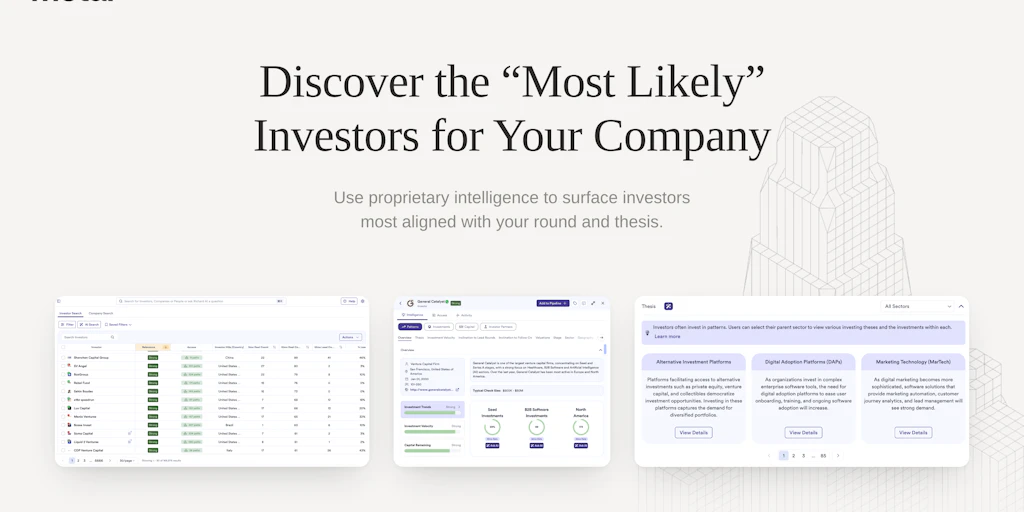
Metal’s approach is to collapse that guesswork into three layers: investor discovery and research, relationship intelligence (to get the most out of your network), and pipeline management in a single view. For the fundraising founder, that means the platform ingests context about your company, your pitch deck, and your traction, then surfaces investors who are a fit by stage and thesis and maps who in your network can make an introduction. One user on the Product Hunt launch called the “round copilot” a feature that “actually pulls context from past conversations instead of being a blank prompt box.”
For me as an e-commerce operator, that translates to a tool that could ingest my product catalog, my Amazon storefront, my sales data, and my past supplier emails, then tell me: You have a warm connection to a packaging manufacturer in Vietnam through your former logistics partner, and here is the personalized outreach template referencing the specific volume you discussed three months ago. That is a step change from the current reality, where I keep supplier conversations scattered across Gmail threads, WhatsApp, and Alibaba messages, and my “pipeline” is a Google Sheet with 200 rows and no logic.
How It Differs From Everything You Already Use
There is no shortage of tools that sell “supplier relationship management.” Helium 10 gives you supplier data from Alibaba and keeps track of your sourcing contacts—but it’s a spreadsheet with a search engine. Jungle Scout does product research and supplier identification, but its pipeline is lightweight. Both sit on top of static data; neither is an AI-native system that learns from your conversations and your network graph.
What makes Metal different—and what makes it dangerous as a competitive signal—is that it treats relationship mapping as a first-class data layer. It doesn’t just ask you to fill in a CRM field; it pulls data from your existing comms and third‑party profiles (LinkedIn, perhaps deeper integrations with CRMs like Affinity or Attio, as a commenter asked). The result is a live map of who knows whom, who owes you a favor, and who is most likely to respond. In a cross-border context, that’s the difference between cold-emailing “Dear Sir/Madam” and getting a warm intro from a shared freight forwarder.
What Cross-Border Sellers Can Borrow From Metal’s Playbook
You don’t need to raise venture capital to apply Metal’s core insight. Here are three direct take‑aways an operator can implement this week.
1. Build a “relationship intelligence” layer into your sourcing process. Start by mapping your existing network—not just the factories you’ve worked with, but every person who has touched your supply chain: freight brokers, customs brokers, sourcing agents, trade show contacts, even competitors who subcontract to the same manufacturer. Use a tool like Notion or a lightweight CRM such as Pipedrive to tag each contact with “introducible to” links. Then run a simple script or use an AI wrapper like Zapier to pull in recent email exchanges and identify the top five people who could open a door for you in a new category.
2. Apply the “copilot” concept to your outreach templates. Metal’s round copilot doesn’t give you a blank text box; it fetches context from previous interactions and drafts message that aligns with the recipient’s specific interests. When emailing a potential supplier in a new region, stop sending variants of “We are looking for a reliable partner.” Instead, use the same technique: pull up their recent export data (via ImportGenius), note which U.S. brands they already produce for, and customize your pitch around their capacity for your product type. A one‑paragraph personalized message will outperform a five-paragraph generic one 10:1.
3. Create a pipeline that prioritizes by “warmth” instead of spreadsheet order. Most sellers rank suppliers by price or lead time. Metal ranks investors by the likelihood of a positive outcome based on network proximity and historical fit. You should do the same for manufacturer discovery. Before emailing 20 cold factories, ask your existing partners (or a service like SourceMyGarment) for introductions. Then use a simple weighted scoring system: +3 for a warm intro, +2 for a previous collaboration in a similar category, +1 for positive reviews on Alibaba’s Trade Assurance. Test this against your current cold‑outreach conversion rate.
Why Amazon Sellers Should Care More Than Shopify Ones
On the surface, the DTC crowd on Shopify might think they need this more—they’re constantly chasing influencers, affiliate partners, and wholesale buyers. But Amazon sellers face a more fragmented and high-stakes version of the same problem: managing relationships with Chinese manufacturers, compliance auditors, Amazon account managers, and freight partners across time zones, languages, and trust levels. A bad supplier relationship can destroy a listing’s cash flow for a quarter; a good one can get you priority allocation during peak season. Metal’s relationship intelligence is essentially a risk-management tool for anyone who operates across borders. Amazon sellers, who often juggle 5–10 active suppliers and 2–3 3PLs, are the ones who would see the highest return from systematizing who knows whom and how to turn a cold lead into a warm one.
Where the Math Breaks (and Why Metal Isn’t Ready for You Yet)
I have to be honest: I wouldn’t buy Metal today and try to retrofit it for supplier sourcing. The platform is built explicitly for venture fundraising, and its data sources (VC databases, Crunchbase, LinkedIn) don’t map neatly to Alibaba, Global Sources, or TradeKey. A commenter asked whether the investor relationship mapping “pulls in data… mostly LinkedIn scraping or are there deeper integrations with CRMs like Affinity or Attio.” The maker didn’t answer in the visible thread, which suggests the integration story is still thin for non‑VC use cases.
Moreover, the pricing is not disclosed on the launch page—always a red flag for e-commerce operators who need to calculate ROI before committing. If it’s priced like a fundraising tool (think $50–$100 /month per user), it might be worth experimenting with for a large seller who also wants to track brand partnerships. But for most operators, the immediate practical value is lower than the insight value.
There’s also the issue of data privacy. If you feed your supplier conversations, pricing agreements, and product designs into a third‑party AI system, you need to be comfortable with how that data is processed and stored. Metal’s privacy page is not linked in the launch material, so I’d want to see a SOC 2 report or at least a clear statement on data retention before I upload a list of my Chinese vendors.
Where Metal Could Go Next (and What I’d Watch)
If the team at Metal decides to adapt their model for B2B supply‑chain relationships, they could disrupt the sourcing tools category faster than any single-vertical product. Imagine an AI that scrapes trade data, dives into your email and WhatsApp history, maps your freight forwarders’ networks, and recommends the three factories in Yiwu that are most likely to meet your margin and IP‑protection requirements. That’s a tool I would pay for immediately.
Until then, I’m watching for two signals: (1) an API or integration with e‑commerce platforms (Shopify, Amazon SP‑API, or at least Alibaba’s open API), and (2) any case study where a cross‑border business has used Metal for anything beyond fundraising. If those appear, the analogy I’ve drawn turns into a direct replacement.
What I’d Watch / Test Next
If you’re running an Amazon FBA brand with more than $1 m in annual revenue, here’s what you do this week:
- Audit your current supplier pipeline for “relationship depth.” List your top 10 factories. For each, note who introduced you, how many mutual contacts you share, and the last time you had a non‑transactional conversation. You’ll likely find that 80 % of your orders come from the 2–3 suppliers you have the most network overlap with. That’s your data—now formalize it.
- Test a lightweight relationship‑mapping tool. Instead of buying Metal, try a combo of Clay (for enrichment) and Salesforce or Notion (for pipeline). See if you can replicate the “round copilot” concept by using a GPT‑4 powered template that pulls in the last three emails with a supplier and drafts a reorder request or a negotiation script. Measure whether it reduces your email‑writing time by 30 %.
- Reach out to Metal directly and ask whether their roadmap includes non‑VC use cases. The “raised $120 m” founder has network that extends into e‑commerce—they might be open to a pilot if enough respondents ask.
The real point of this essay isn’t to sell you on Metal. It’s to sell you on replacing guesswork with relationship intelligence in your own operations. The tool that does that for cross‑border e‑commerce probably doesn’t exist yet, but Metal’s architecture shows you the blueprint. Don’t wait for the perfect product—start building the logic today with the data you already have.