The inbox is the last unbundled stack in e-commerce — and somebody just tried to rebundle it
Cross-border sellers run three email systems and pretend they run one. Your team inbox lives in Google Workspace. Your transactional mail — order confirmations, shipping updates, password resets, refund notices — fires out of Postmark, Brevo, or Resend. Your campaigns and abandoned-cart flows live in Mailchimp or Klaviyo. Three vendors, three bills, three DNS configurations, three deliverability dashboards, and zero shared context. When a customer replies to a shipping notification, that reply lands in a tool your support agent has never opened. That fragmentation is the actual problem Mailyte is attacking, and it’s worth a cross-border operator’s attention not because the product is finished, but because the category is overdue for someone to try.
What Mailyte is actually trying to solve
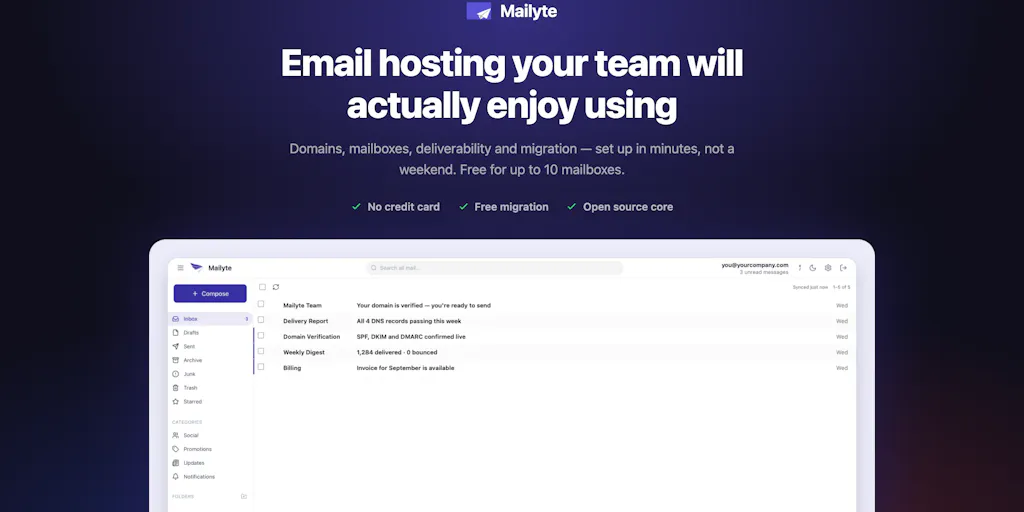
The pitch from maker David Asiru is blunt: your team’s inbox lives in Google Workspace, the emails your app sends live in Postmark, Brevo, or Resend, and your newsletters live in Mailchimp — three tools, three bills, none of them talking. Mailyte, built by the team at Techies Africa out of Lagos, collapses all three into one product on your own domain: real team inboxes, transactional email your app fires automatically, and campaigns you send to customers.
The mechanics matter more than the marketing. It’s open source under AGPL-3.0, so you can self-host for free on your own hardware or let the team run it for you — same product either way, no lock-in. Deliverability is positioned as built-in rather than bolted on: SPF, DKIM, DMARC, and a live view into whether mail is actually landing. And it’s free for up to 10 mailboxes, no credit card required.
For a seller doing $50K–$5M a year across Shopify plus Amazon plus a marketplace or two, that’s a coherent thesis. The question isn’t whether the thesis is attractive. It’s whether the execution survives contact with a real sending domain.
Why Amazon sellers should care more than Shopify ones
Here’s the counterintuitive part. A pure Shopify DTC brand already has a decent answer: Klaviyo eats most of the campaign and flow layer, Shopify Email covers the cheap end, and transactional mail routes through whatever ESP the app stack uses. The pain is real but the switching cost is high and the alternatives are mature.
Amazon FBA sellers live in a different world. You don’t own the customer relationship — Amazon Seller Central owns it, and your ability to email buyers is throttled by Buyer-Seller Messaging rules. So your email stack is fragmented in a different way: a team inbox for supplier and freight-forwarder correspondence, a transactional layer for whatever off-Amazon storefront you run, and a campaign tool for the list you’re legally allowed to build. Three tools, three bills, and no shared view of who your customer actually is. A unified inbox-plus-transactional-plus-campaign product on your own domain is more valuable to that operator than to a Klaviyo-native DTC brand, because the Amazon seller has less infrastructure to begin with.
Where the math breaks
Free for 10 mailboxes sounds generous until you price the alternative. Google Workspace Business Starter runs roughly $6–7 per user per month; a 10-seat team is $60–70/month before you’ve sent a single transactional email. Layer on Postmark or Resend for transactional and Mailchimp for campaigns and you’re at $150–250/month for a small operation. Mailyte undercuts that on paper.
But self-hosting isn’t free. You’re paying for a VPS, backups, monitoring, and — most expensively — someone’s time when the sending IP gets blocklisted at 2 a.m. during a Black Friday flow. The “free” tier only wins if you treat your own labor as free, which is exactly the accounting mistake that kills small operators.
The deliverability problem is the whole product
Read the Product Hunt comments and you’ll find the sharpest critique already sitting there. Gal Dayan, a maker at Dial, raises the exact objection any experienced operator would raise: the self-host-or-managed split with no lock-in is a nice hedge, but self-hosting transactional and marketing email means owning IP and domain reputation, and Postmark and Mailchimp spend real money keeping shared infrastructure out of spam folders. His question — is Mailyte doing anything to warm up a new sending domain’s reputation, or is that entirely on the user — is the question that determines whether this product is usable by anyone who isn’t already an email engineer.
I’d extend that. Deliverability isn’t a feature you bolt on with SPF, DKIM, and DMARC records. Those are table stakes — every ESP configures them. What Postmark actually sells is a warmed shared IP pool, a reputation team that negotiates with mailbox providers, and a decade of sender history that gets your order confirmations into Gmail’s primary tab instead of Promotions. A self-hosted product can’t replicate that by default. It can only give you the tools to build it yourself, one IP and one domain at a time.
The embarrassing part
There’s a comment on the launch thread that any operator should read before signing up. Dennis Lewis reports that a support request sent through Mailyte’s own website bounced, with a mailer-daemon reply from smtp05.cbsolt.net stating the message could not be delivered — and his reaction is the one every seller would have: “Kind of embarrassing for a company that only does email, no?”
That’s one data point, and bounce-backs happen to everyone. But it’s the single most revealing thing on the page. If your product’s entire value proposition is “we handle your email better than three separate tools,” your own outbound email is your only proof. A bounced support request is a live demo of the failure mode your customers fear most.
What cross-border sellers can actually borrow from this
Forget whether you adopt Mailyte. The launch is a useful mirror for how you’ve structured your own stack, and there are three things worth stealing regardless.
Consolidate the domain, not necessarily the vendor
The strongest idea in the pitch isn’t the unified inbox — it’s the insistence that everything runs on your own domain. If your transactional mail goes out from a subdomain of your store and your campaigns go out from a different subdomain of the same root, you’re already halfway to the consolidation Mailyte is selling. You don’t need one vendor to get one domain reputation. You need to stop letting three vendors fragment it.
Audit what you’re actually paying for
Pull your last three months of email invoices. Google Workspace seats you’re not using. A Postmark plan sized for peak that you’re paying for in February. A Mailchimp tier that auto-upgraded when your list crossed a threshold. Cross-border operators accumulate email spend the way warehouses accumulate pallets — one at a time, until someone counts. The Mailyte pitch is a prompt to count.
Treat deliverability as a first-class metric, not a vendor promise
The live view into whether mail is landing is the feature I’d want from any vendor, incumbent or challenger. If you can’t answer “what percentage of my order confirmations reached the inbox last week” without opening a support ticket, you’re flying blind on the one channel that touches every customer.
Where my judgment says it falls short
Three honest reservations.
First, the open-source, self-host-or-managed model is a hedge that only works if the managed tier is genuinely good. Every open-source email project — Mailcow, Mail-in-a-Box, Postal — has the same shape: a committed core of self-hosters, a long tail of people who try it once and retreat to Gmail, and a managed tier that either becomes the real business or withers. Mailyte is early enough that we don’t know which path it takes.
Second, the category has a graveyard. Zoho Mail has been bundling inbox, transactional, and campaign email for years at prices that make self-hosting look irrational. Google Workspace plus Amazon SES plus a cheap campaign tool is the DIY version of Mailyte, and it’s what most sophisticated operators already run. The differentiation has to be the unified UI and the deliverability tooling, not the bundling itself.
Third, and this is the one that matters most for cross-border sellers: nothing on the launch page addresses international deliverability, regional data residency, or GDPR/CAN-SPAM compliance workflows. A seller shipping to the EU, UK, and Australia needs consent management, unsubscribe handling, and data processing agreements that a Lagos-based open-source project hasn’t demonstrated yet. That’s not a knock on the team — it’s a gap a cross-border operator has to weigh before migrating anything customer-facing.
What I’d watch / test next
This week, do three things. First, pull your email stack inventory: list every tool that sends or receives mail on your behalf, what it costs, and which domain it sends from. You’ll almost certainly find at least one redundant subscription. Second, if you’re curious about Mailyte, spin up the self-hosted version on a throwaway domain and send a few hundred transactional emails to seed addresses across Gmail, Outlook, and Yahoo — watch where they land before you point a real customer flow at it. Third, ask the Mailyte team directly, in their comment thread, the question Gal Dayan asked: what does domain warm-up actually look like on your managed tier, and what happens to my sending reputation if I migrate off? Their answer to that question — not the pricing page — is what tells you whether this is a real alternative to Postmark and Mailchimp or an interesting experiment.