The On-Device AI Shift Is Coming for Your Fulfillment Stack — Are You Ready?
Every cross-border operator I know is drowning in the same problem: the tools that are supposed to make us faster now require a per-seat SaaS subscription, a cloud API key, and a reliable internet connection to do anything useful. A 3PL warehouse in Shenzhen with spotty Wi-Fi, a customer-service agent in Manila handling returns at 2 a.m., a listing-optimization workflow running on a laptop in a co-working space in Ho Chi Minh City — none of these are well-served by a stack that assumes fat pipes and unlimited token budgets. So when a foundation-model release lands that explicitly optimizes for small, cheap, offline-capable inference, I pay attention — not because I’m going to fine-tune my own model next Tuesday, but because it signals where the tooling layer underneath commerce operations is heading. That’s the lens I want to use on Liquid AI’s LFM3 release.
What LFM3 Actually Is — and the Operational Problem It Solves
Let me strip the launch copy down to what a seller can act on. LFM3 is Liquid AI’s third generation of “Liquid Foundation Models”: small, open-weight models built to run on devices rather than in a data center. The first release is six 2B-class models, all branched from a single 1.7B base — a text model, a vision-language model (the first LFM to accept video input), an audio model for speech in and out across 18 languages, an omni model that handles vision, audio and language together, and two decision models.
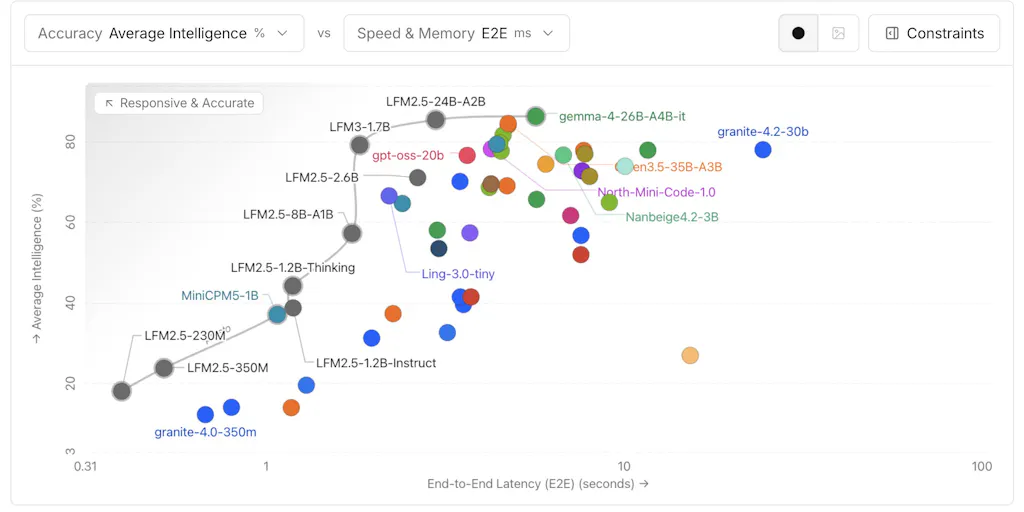
The headline spec that matters for anyone running lean operations: the text model fits in about 1 GB at 4-bit precision, and every model can be fine-tuned on a single GPU. Per Liquid, on-device decoding runs 1.8 to 2.8 times faster than the next-fastest compared model, and the text model has a 256K context window.
Why should a seller care about any of that? Because the operational bottleneck in cross-border commerce has quietly moved from “getting data” to “processing data where it lives.” Your warehouse scanner sees a damaged carton. Your returns desk photographs a product. Your customer-service agent needs to translate a Spanish complaint into an English refund decision in under 30 seconds. Today, every one of those moments gets routed to a cloud API, which means latency, per-call cost, and a hard dependency on connectivity. A 1.7B model that runs locally and can be fine-tuned on a single GPU changes the economics of those micro-decisions.
Why Amazon sellers should care more than Shopify ones
Here’s a judgment call I’ll defend: this release matters more to Amazon FBA operators and marketplace account managers than to pure DTC Shopify brands. Why? Because Amazon sellers live inside a fragmented tool ecosystem — Helium 10, Jungle Scout, Seller Central reports, ad-console exports — where the pain is repetitive pattern-matching on structured data: keyword clustering, review sentiment tagging, competitor price-delta detection. Those are exactly the tasks a small fine-tuned model handles well, and exactly the tasks where per-seat SaaS pricing gets punishing at scale. A Shopify DTC brand, by contrast, is usually better served by a hosted stack like Klaviyo for lifecycle and a managed AI feature baked into the platform. The on-device pitch lands hardest where the work is high-volume, low-creativity, and privacy-sensitive — which describes marketplace back-office work almost perfectly.
How It Differs From What You’re Already Using
The obvious comparison set is the incumbent small-model world: Meta’s Llama family, Google’s Gemma, Microsoft’s Phi, and the quantization tooling around llama.cpp and Ollama. Liquid’s differentiation claim is architectural: it designed the model around real hardware using a hardware-in-the-loop search across 14 device and backend combinations — phones, a Raspberry Pi 5, laptops, a Qualcomm NPU and GPUs — rather than training first and optimizing later. It was pre-trained on 22T tokens, and the vision model reportedly averages 71.4 across 62 vision benchmarks, within 2 points of GPT-5.6 Luna (73.4), per Liquid.
That last number is the one I’d flag hardest. “Within 2 points of a frontier model” on a benchmark suite is a marketing-friendly framing, and benchmark averages hide enormous variance by task. For a seller, the relevant question isn’t the average — it’s whether the model can reliably read a supplier invoice, classify a return reason, or extract a tracking number from a blurry photo. Those are narrow tasks where a fine-tuned 2B model can genuinely beat a general-purpose giant, but only after you’ve done the fine-tuning work yourself.
Where the math breaks
The KV cache story is where the launch narrative gets honest, and I appreciate that a commenter on the thread pushed on it directly. A full 128K-token KV cache needs 1.6 GB, per Liquid. That’s fine on a laptop or an edge device; it’s tight on a phone. So the “256K context on a phone” framing is technically true and practically misleading — most phone deployments will run far shorter contexts. For a seller, the practical read is: don’t plan any workflow around giant document contexts on mobile hardware. Plan around short, task-specific prompts — a product photo, a 200-word customer email, a single SKU record. That’s where the form factor actually shines.
What Cross-Border Sellers Can Borrow From This
I don’t expect many readers to fine-tune a model this quarter. But there are three concrete patterns here worth stealing for your own stack.
The “one backbone, many heads” pattern for your tooling
Liquid’s design — a single 1.7B base with text, vision, audio, omni and decision variants branched off it — is a useful mental model for how you should think about your own SaaS sprawl. Most sellers run five to fifteen disconnected tools that each re-ingest the same product catalog and order data. The smarter architecture, and the one the best operators are moving toward, is a single source of truth (your PIM or catalog) with thin, specialized tools hanging off it. You don’t need to build this yourself; you need to stop buying tools that refuse to read from your canonical data layer.
Local-first for privacy-sensitive workflows
The audio model handles speech in and out across 18 languages, with time to first token as low as 50 ms, per Liquid. For a cross-border seller, that’s a preview of where multilingual customer service is heading: voice agents that run locally, don’t ship customer audio to a third-party cloud, and don’t rack up per-minute API charges. If you’re handling EU customer data under GDPR or dealing with marketplace rules about customer PII, a local-first transcription and response layer is a genuine compliance advantage, not just a cost saving. I’d watch this space closely if your support volume is high and your margins are thin.
Fine-tuning on a single GPU is the real unlock
The claim that every model can be fine-tuned on a single GPU is the sentence I’d underline. It means the barrier to building a task-specific model — a return-reason classifier, a listing-title optimizer trained on your own winning SKUs, a supplier-email parser — has dropped from “hire an ML team” to “one competent ops engineer with a rented GPU.” That’s a meaningful shift for mid-size sellers who’ve been priced out of custom AI. The catch, and it’s a big one: fine-tuning requires clean labeled data, and most sellers’ data is a mess. The model isn’t the bottleneck anymore; your data hygiene is.
Where My Judgment Says It Falls Short
I’ll be blunt about the gaps, because the launch copy won’t be.
First, “open weights on Hugging Face” plus an API plus a playground is a developer story, not a seller story. There is no shrink-wrapped product here for a merchant. You need engineering capacity to turn this into anything operational — which means it’s relevant to sellers with an in-house tech team or a trusted agency, and mostly noise for everyone else. If you’re a solo operator running a Shopify store, this release does not change your week.
Second, the benchmark claims are self-reported by Liquid. The vision model “within 2 points of GPT-5.6 Luna” is a claim from the company, not an independent eval. I’d treat every performance number in the launch as directional until third-party testing lands. The commenters on the thread asking “which phones have you actually run it on?” are asking exactly the right question, and the launch doesn’t answer it with a device list.
Third, the “on-device” framing conflates very different hardware classes. A Raspberry Pi 5, a Qualcomm NPU, a laptop, and a phone are not interchangeable deployment targets, and a model that runs acceptably on one may be unusable on another. Until there’s a clear compatibility matrix and real-world latency numbers per device class, the “runs on a phone” claim is aspirational.
The missing piece: no commerce-native tooling
The most telling absence in the launch is any mention of e-commerce, retail, or logistics use cases. The stated audience is “developers building on-device agents, edge and robotics applications.” That’s fine — but it means the seller-adjacent tooling layer (a returns classifier, a listing optimizer, a multilingual support agent) doesn’t exist yet. Someone will build it. The question is whether it gets built by a commerce-native team that understands SKU data and marketplace quirks, or by a generic AI shop that doesn’t. I’d bet on the former, and I’d bet it happens within twelve months.
What I’d Watch / Test Next
Here’s what I’d actually do this week if I were running a mid-size cross-border operation, in priority order.
1. Audit where your AI spend is going. Pull your last three months of API and SaaS bills and tag each line by task type. If more than 30% of spend is going to repetitive, narrow tasks — classification, extraction, translation, tagging — that’s your candidate pool for a small fine-tuned model down the road. You don’t need to build it yet; you need to know the size of the prize.
2. Run a data-hygiene sprint. Fine-tuning on a single GPU is only as good as your labels. Pick one workflow — say, return-reason categorization — and manually label 500 historical tickets cleanly. That dataset is the asset; the model is commodity. Do this before you evaluate any vendor.
3. Test the local-inference stack, not the model. Install Ollama or llama.cpp on a spare laptop and run a small open model against your own product data. The point isn’t to productionize it — it’s to build your team’s intuition for what local inference can and can’t do before a vendor sells you a bill of goods.
4. Put a watch on the tooling layer. Follow Liquid AI’s launch page and the Hugging Face model cards. The moment a commerce-native wrapper appears — a returns classifier, a listing optimizer, a multilingual support agent built on these weights — evaluate it against your incumbent SaaS on cost-per-decision, not feature count.
The on-device AI wave is real, but it’s arriving through developers first and merchants second. Your job this quarter isn’t to adopt LFM3. It’s to make sure your data and your cost baseline are ready for the moment someone hands you a shrink-wrapped version of it — because that moment is closer than the launch thread suggests.


