The doomscroll economy is coming for your product education stack
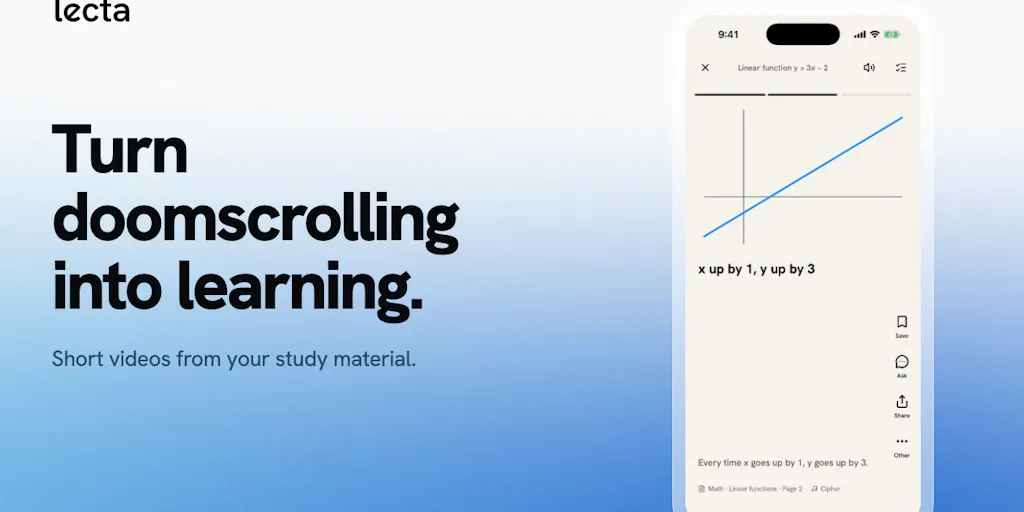
Cross-border sellers have a dirty secret: the hardest part of the job is no longer sourcing or even ads — it’s getting anyone on the team to actually finish the training material. New hires skim the SOP. Brand owners skim the compliance PDF. Nobody reads the 40-page supplier handbook. So when a tool shows up promising to turn “doomscrolling into learning” by converting a PDF or a lecture recording into short scrollable videos, my ears prick up — not because I need exam prep, but because the same behavioral mechanics that make TikTok addictive are the ones that make onboarding and product knowledge stick. Lecta, built by a developer who goes by TOMO, is a mobile-first learning app that does exactly that. Here’s why an operator running Amazon FBA, a Shopify DTC brand, or a TikTok Shop account should care — and where I think it falls short.
What problem Lecta actually solves
The pitch is disarmingly simple. You upload a PDF, a photo of a handout, or a lecture recording. Lecta converts that material into short learning videos you scroll through vertically, the way you’d scroll a feed. You follow graphs and diagrams, then answer quick questions drawn from your own material. Then you play — solo or with friends — through games the maker names as Formula Race, Hyperlane, Quiz Rush, and Jeoparty. Deeper down there are notes, quizzes, flashcards, and an AI tutor working off the same source material, with cards you can save for later review. It’s on iPhone in English and Japanese, with a free plan, and web is “coming soon.”
If you strip away the education framing, the underlying insight is this: completion rates are a design problem, not a motivation problem. Every cross-border operator I know has tried to solve internal knowledge transfer with a Notion page, a Google Drive folder, or a Loom video that nobody watches past minute two. Lecta’s bet is that the feed format — short, scrollable, interleaved with micro-quizzes — beats the document format for retention. That’s a bet worth taking seriously regardless of whether you ever install the app.
Why Amazon sellers should care more than Shopify ones
Here’s a distinction that matters. A Shopify DTC brand’s institutional knowledge lives mostly in marketing: creative angles, ad account structure, email flows. That knowledge is largely tacit and gets transmitted through the tools themselves — you don’t need a learning app to teach someone Klaviyo flows, you need them to build one.
Amazon FBA is different. The operational surface area is enormous and unforgiving: listing compliance, category-specific requirements, Amazon Seller Central policy updates, inventory reconciliation, reimbursement claims, A+ content rules, Brand Registry enforcement. A single misread PDF about a restricted product category can cost you a suspension. The material is dense, text-heavy, and updated constantly. That’s precisely the kind of content that benefits from being chopped into scrollable chunks with comprehension checks. If Lecta works for exam prep, the closest cross-border analogue is compliance and platform-policy training — not brand storytelling.
How it differs from the incumbents you’re already paying for
Let’s be honest about the competitive set, because “AI tutor” is a crowded shelf in 2025.
The most obvious comparison is NotebookLM, Google’s source-grounded research assistant. You feed it documents, it answers questions and generates summaries and audio overviews. It’s excellent for synthesis and genuinely useful for competitive research — I’ve used it to digest long supplier contracts. But it is not built around a completion loop. There’s no game layer, no scrollable feed, no spaced-repetition flashcards designed to make you come back. NotebookLM assumes you’re a motivated researcher; Lecta assumes you’re a distracted human with a phone.
Then there’s the flashcard lineage: Anki remains the gold standard for spaced repetition, but its interface is a wall of configuration that repels anyone who isn’t already a convert. Quizlet sits in the middle — friendlier, but still fundamentally a study tool you have to decide to open. Lecta’s differentiation is that it tries to meet you inside the behavior you already have, the doomscroll, rather than asking you to build a new habit from scratch.
On the corporate side, the incumbent is the LMS category — Docebo, TalentLMS, and the training modules buried inside a Shopify or Amazon agency’s onboarding. These are built for compliance tracking and admin dashboards, not for engagement. Nobody has ever described an LMS module as “fun.” Lecta is attacking from the opposite end: consumer-grade engagement first, structure later.
Where Lecta genuinely diverges is the game layer. Formula Race, Hyperlane, Quiz Rush, Jeoparty — these are social and competitive by design, and the maker explicitly says the goal was to make “boring exam prep a bit more fun with friends.” That multiplayer angle is the piece none of the incumbents have. Anki is solitary. NotebookLM is solitary. An LMS is solitary and surveilled. If Lecta can make team learning feel like a game, that’s a real wedge.
What cross-border sellers can borrow from it
You don’t need to install Lecta to steal its playbook. Here’s what I’d lift directly into your operation this quarter.
Chunk your SOPs into 60-second units. The reason nobody finishes your supplier onboarding doc is that it’s a monolith. Break it into single-concept chunks — “how to file a reimbursement claim,” “how to read a stranded inventory report” — and deliver them one at a time. The format matters less than the granularity.
Interleave comprehension checks. The single most effective thing in Lecta’s loop is the quick question after each chunk. In your own onboarding, that’s a two-question quiz at the end of each SOP section. It sounds trivial. It roughly doubles retention in my experience, because it forces active recall instead of passive skimming.
Make it social. The multiplayer games are the most interesting part of the product. In a cross-border team, that translates to leaderboards for who completes policy training fastest, or a Friday quiz on platform updates. Competition is a cheaper motivator than a compliance mandate.
Ground everything in your own source material. The AI tutor only answers from what you uploaded — no hallucinated outside knowledge. That’s the right architecture for compliance training, where a confident wrong answer is worse than no answer. If you’re building any internal AI assistant, constrain it to your actual documents.
Where the math breaks
Here’s my skepticism, and it’s structural. Lecta is iPhone-only right now, in English and Japanese, with web “coming soon.” For a cross-border operation, that’s a real constraint. Your warehouse team in Shenzhen, your VA in the Philippines, your 3PL contact in Poland — none of them are going to onboard through an iPhone app in English. Language coverage is two languages against a business that by definition spans many. Until web ships and language support widens, the practical use case is narrow: a founder or a small English-speaking team studying on their own phones.
There’s also the question of whether the game layer survives contact with real material. Turning a handout photo into a game is a cute demo — the maker’s own comment thread calls it “such a cute idea lol” — but cute demos and durable learning are different things. The hard part isn’t generating a quiz from a PDF; LLMs do that trivially now. The hard part is generating a good quiz that tests the thing that actually matters, and doing it consistently across messy real-world documents. I’d want to see how it handles a genuinely gnarly source: a 90-page Amazon category style guide, or a supplier contract full of cross-references. My guess is the output quality degrades fast on documents that aren’t already well-structured.
And the business model is unproven. A free plan with no disclosed pricing for the paid tier means we don’t know what the conversion economics look like. For a consumer learning app, that’s the whole ballgame — engagement is cheap to fake, retention is expensive to earn.
What I’d watch / test next
Three concrete things an operator can do this week.
First, stress-test the format on your own worst document. Take the densest, most-ignored PDF in your operation — the one nobody reads — and manually chunk it into ten 60-second units with a recall question each. Don’t use any tool. Just do it in a doc. If your team’s completion rate doesn’t improve, the problem isn’t the tool, it’s the material, and no app fixes that.
Second, if you’re on iPhone and English or Japanese works for you, actually try Lecta on one real compliance document and one messy one. Watch specifically for where the generated quizzes get shallow or wrong. That tells you whether the AI layer is production-grade or demo-grade.
Third, watch the web launch. For any cross-border team, web is the unlock — it’s where your multilingual, multi-device workforce actually lives. Until then, treat Lecta as a signal about where learning tooling is heading, not as infrastructure you can build a training program on. The direction is right. The coverage isn’t there yet.


