The Hardware Review Gap Is Your Supply Chain Blind Spot — And KiHub Just Built the Missing Layer
Every cross-border seller I know has felt this specific kind of dread: the product that looked perfect in the render, sailed through the sampling round, and then arrived at the 3PL with a PCB that has a trace routed 0.2mm too close to a mounting hole. The boards work. Until they don’t. And when they don’t, you’re not just out the unit cost — you’re out the air freight, the Amazon FBA prep fees, the listing photography, and the week of PPC spend you burned while the listing sat in “Currently Unavailable.” For most of us, hardware is a black box managed by a factory engineer on the other side of a time zone, and the review process is a WhatsApp thread with screenshots. That’s not a process. That’s a prayer. So when I see a tool that treats hardware change review with the same rigor that software teams treat code review, I stop scrolling. Because the gap between “the factory says it’s fine” and “it actually is fine” is where margin goes to die — and KiHub is building the bridge across that gap.
What KiHub Actually Solves: The Review Layer Hardware Never Had
Let me be clear about what KiHub is not. It’s not another EDA tool. It’s not trying to replace KiCad, and it’s not pretending to be a PLM system. The maker, Andrei Man, frames it precisely: KiCad projects can live in Git and move through GitHub, but the review process is still stuck in the manual dark ages — opening files locally, comparing revisions by eye, passing screenshots around Slack, and trying to reconstruct design decisions from a comment thread that’s three platforms deep.
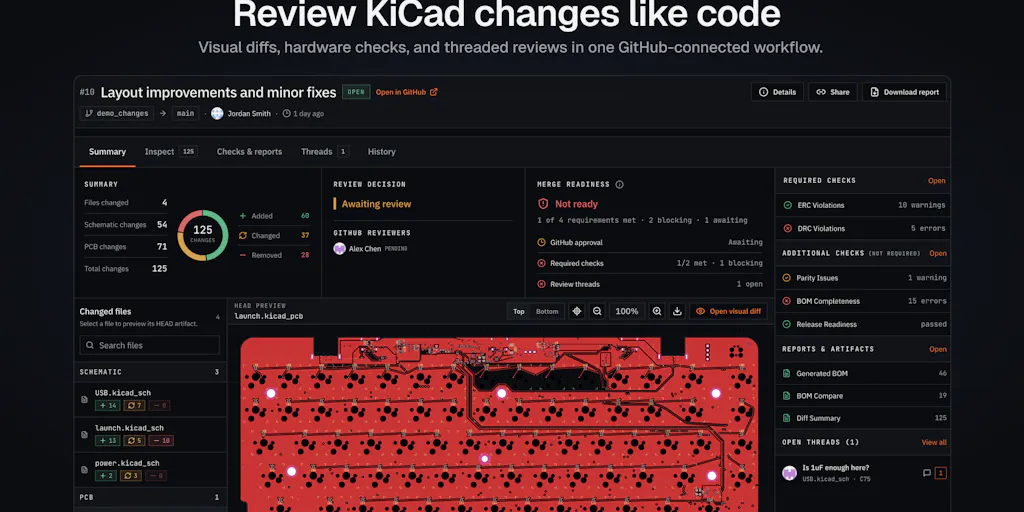
KiHub adds the missing review layer on top of that existing workflow. The core value proposition is that it brings the pull request mentality to hardware. Instead of asking “what changed in this PCB revision?”, you can compare schematic and PCB revisions visually in the browser — no more downloading a .kicad_pcb file, opening it in the desktop app, and squinting at two windows side by side. Instead of “can you check this?” in a Slack DM, you can start reviews automatically from a GitHub pull request or manually from any two branches, tags, or commits.
This matters more than it sounds. For a cross-border seller, the difference between “the factory sent an updated board file” and “we can see exactly what changed on the board” is the difference between trusting and verifying. And in my experience, the factories you can trust without verification are rare enough to be a competitive advantage in themselves.
The Threaded Comment Problem: Context Is Everything
The feature that caught my eye is the threaded comments pinned directly to a schematic sheet or PCB location. This is the kind of thing that sounds minor until you’ve lived the alternative. I’ve been on calls where a factory engineer is trying to explain a change to a power delivery network by saying “the capacitor near the connector” — and you’re both looking at different PDF exports, and the connector in question is one of twelve on the board.
Pinning discussion to a specific location on the board is the hardware equivalent of code review comments on a specific line. It removes the ambiguity that causes rework, and rework in hardware is not a 10-minute fix. It’s a new board spin, a new prototype run, a new DHL shipment, and a two-week delay in your launch calendar. The cost of context loss in hardware review is measured in weeks, not hours.
How KiHub Differs From What’s Already Out There
The existing landscape for hardware collaboration is fragmented, and that’s being generous. On one end you have the heavyweight PLM systems — Arena, Windchill, Teamcenter — which are designed for enterprises with dedicated documentation teams and budgets that make a startup CFO weep. They solve the problem but they solve it with so much process overhead that a five-person hardware team would spend more time entering data than designing.
On the other end you have the ad-hoc stack: GitHub for version control, Slack for discussion, Google Drive for PDF exports, and email for everything that gets lost. This works, sort of, until it doesn’t — and the failure mode is always the same: a revision mismatch, a lost comment, a decision that can’t be traced back to who approved it and why.
In between, there are some interesting attempts. Altium has its own cloud collaboration features, but it’s locked to the Altium ecosystem. Upverter tried to be a browser-based EDA with collaboration built in, but it never achieved the design capability to be a primary tool. What KiHub is doing differently is positioning itself as the shared workspace where the hardware review happens — not as a design tool, not as a version control system, but as the review layer that sits between KiCad and GitHub, which already work well for their respective jobs.
That’s a smart wedge. KiCad is free, open-source, and increasingly capable — it’s the tool of choice for a huge portion of the hardware hobbyist-to-professional spectrum, and it’s not uncommon to see it in production designs from contract manufacturers who don’t want to pay Altium seat licenses. GitHub is the de facto standard for version control. KiHub is betting that the pain point isn’t in either of those tools — it’s in the gap between them.
Where the Math Breaks: The Cost of a Missed Review
Let’s put some numbers on this. A typical four-layer PCB prototype run from a Chinese fab runs somewhere between $50 and $200 for the boards themselves, depending on size and quantity. But the real cost is the assembly — stencil, solder paste, components, labor — which can easily push a small prototype batch to $500-$1,500. And that’s if the design is right.
If the design has an error that should have been caught in review — a missing pull-up resistor, a swapped differential pair, a BOM mismatch where the wrong value capacitor gets populated — you’re looking at another prototype cycle. That’s another $500-$1,500 in manufacturing, plus 7-14 days of lead time, plus the opportunity cost of your engineering team not moving forward on other work. For a seller who’s launching a hardware product on Amazon, that delay could mean missing a seasonal window, which costs real revenue.
The hardware-aware checks in KiHub — ERC, DRC, schematic-to-PCB parity, BOM completeness, and release readiness — are designed to catch these issues before they become prototype cycles. The fact that you can set review and merge gates means the process is enforced, not hoped for. If a check is set to “must pass” and it doesn’t, the merge is blocked. That’s the kind of automated gatekeeping that software teams take for granted and hardware teams desperately need.
What Cross-Border Sellers Can Borrow From KiHub’s Approach
Here’s where I get to the part that’s actually useful for the DTC operator who doesn’t design their own boards. Because I know a lot of you are thinking, “This is for hardware engineers, not for me.” And you’re half right. But the principles KiHub is applying are directly transferable to how you manage your supply chain, your contract manufacturers, and your product development process — even if you never open a schematic.
The first principle is contextual review. KiHub pins comments to specific board locations. The cross-border equivalent is pinning comments to specific line items in a BOM, or specific steps in a manufacturing process. When your factory sends you a revised quote with a different component substitution, do you have a way to discuss that change in context — or does it get lost in a chain of emails where the attachment is named “quote_v2_FINAL_rev3.xlsx”?
The second principle is automated gates. KiHub lets you define which checks are informational and which must pass before a merge. The cross-border equivalent is defining which quality checks are non-negotiable before you approve a production run. If the factory’s inspection report shows a failure rate above your threshold, that should be an automatic stop — not something you debate over WeChat at 11 PM because the production manager says they need to ship tomorrow.
The third principle is traceability. KiHub preserves compared revisions, check results, discussions, decisions, and activity in one place. For a cross-border seller, this is your audit trail. When a product fails in the field and you need to determine whether it was a design issue, a manufacturing issue, or a component sourcing issue, you need to be able to reconstruct the decision-making history. Did someone approve a component substitution without updating the BOM? Did the factory use a different solder mask color that affected thermal performance? Without traceability, you’re guessing. With it, you’re investigating.
Why Amazon Sellers Should Care More Than Shopify Ones
If you’re selling on Shopify, you can iterate quickly — a product change is a new listing, a new supplier, a new batch. The cost of a hardware mistake is real, but the timeline is compressed. You can test, learn, and pivot in weeks.
On Amazon, the stakes are different. The platform’s review system, the FBA inventory model, and the advertising cost structure mean that a hardware failure isn’t just a bad batch — it’s a rating hit that can take months to recover from, and it can trigger a listing suppression that kills your momentum. The hardware-aware checks and review gates that KiHub offers are exactly the kind of preventive diligence that Amazon sellers need to bake into their product development process, because the platform doesn’t give you a second chance to make a first impression.
A seller who ships 1,000 units of a product with a subtle hardware flaw isn’t just dealing with returns — they’re dealing with negative reviews that mention the specific failure mode, which then shows up in the Q&A section, which then gets picked up by the algorithm and shown to more shoppers. The compounding effect of a hardware miss on Amazon is brutal. Anything that reduces the probability of that miss is worth paying attention to.
Where My Judgment Says KiHub Falls Short
I want to be clear that I’m impressed by the thinking here, but there are gaps, and you should know what they are before you get too excited.
The first is the KiCad-only limitation. The maker explicitly positions this as a KiCad tool, and that’s a deliberate and sensible choice for a startup — focus on one ecosystem, do it well, win that audience. But for a cross-border seller working with a contract manufacturer, the reality is that the factory is often using Altium or another commercial EDA tool. If your CM’s design files are in Altium format, KiHub is not going to help you review them. You’d need to either convert to KiCad (which is not always clean for complex designs) or find another solution. That limits the practical applicability for sellers who aren’t in full control of their design toolchain.
The second gap is the onboarding friction for non-engineers. The tool is built for people who work with KiCad and GitHub daily. For a seller who’s not an engineer — who just wants to know “is this board ready to manufacture?” — the mental model of branches, tags, commits, and pull requests is a barrier, not a convenience. The demo gallery helps, but it’s still a tool that assumes a certain level of technical fluency. If you’re a non-technical founder trying to oversee a hardware project, you’ll need your engineering lead to be the primary user, and you’ll need to figure out how to get visibility without being in the weeds.
The third concern is ecosystem lock-in risk. KiHub is a startup, and startups pivot, get acquired, or shut down. If you build your hardware review process around a tool that disappears, you lose not just the tool but potentially the review history, the decision log, and the audit trail that you’ve accumulated. The maker says GitHub remains the source of truth, which is good — but the review data, the comments, the check results, and the gate configurations live in KiHub. That’s a dependency you should be aware of before you commit your process to it.
Finally, there’s the question of whether visual diffing is enough. The tool shows you what changed on the schematic and PCB, and it runs automated checks. But it doesn’t tell you whether the change is good — that still requires human expertise. For a cross-border seller, that means you still need a competent engineer on your side to interpret the diffs and make the call. KiHub makes the review process more efficient and more traceable, but it doesn’t replace the need for someone who actually knows what they’re looking at.
What I’d Watch / Test Next
If you’re a hardware seller or a DTC operator with a physical product in development, here’s what I’d do this week — not next quarter, this week.
First, spend 20 minutes in the KiHub demo gallery. Even if you’re not a KiCad user, look at how the visual diffs are presented, how comments are pinned to board locations, and how the review history is structured. This will give you a concrete sense of what a professional hardware review process looks like — and it will immediately expose how manual and fragile your current process is by comparison.
Second, run a pilot on your next revision cycle. If you have an active KiCad project, connect it to KiHub and run your next review through the tool. Don’t change your process — just add KiHub as the review layer and see how it feels. The key question to answer: does it reduce the time from “revision submitted” to “revision approved”? If it does, you’ve found your tool. If it doesn’t, you’ve learned something about your workflow.
Third, steal the gate concept even if you don’t adopt the tool. Define three checks that must pass before you approve any hardware change — for example, BOM completeness, DRC with zero errors, and a parity check between schematic and PCB. Write them down, share them with your engineering team and your CM, and make them non-negotiable. You don’t need a tool to enforce this; you just need the discipline and a shared document. KiHub makes it easier and more traceable, but the discipline is the actual competitive advantage.
Fourth, ask your contract manufacturer about their review process. If they don’t have a structured way to show you what changed between revisions, that’s a red flag. A CM that can’t articulate how they review design changes is a CM that will eventually ship you a bad batch — and you’ll be the one explaining to Amazon why your product has a 15% defect rate.
The hardware review gap is real, and it’s expensive. KiHub is a thoughtful, well-scoped attempt to close it for the KiCad ecosystem. The principles it embodies — contextual review, automated gates, full traceability — are ones every cross-border seller should adopt, whether or not they ever open a schematic. The tools change, but the discipline of verifying before you trust is timeless. And in a business where one bad board can sink a listing, that discipline is worth more than any tool.