The Reminder Layer Is Where Cross-Border Operations Quietly Break
Every cross-border seller I know runs the same invisible risk: the deadline that lives in a PDF, a screenshot, or a supplier’s WeChat message, and nowhere else. Amazon’s Account Health page watches your metrics; nobody watches your documents. Miss a VAT filing window, a supplier deposit cutoff, or a Section 321 de minimis threshold change and you find out via a frozen disbursement, not a notification. That’s the gap Invited — built by Kraftostech — is poking at, and it’s worth ten minutes of an operator’s attention even though it wasn’t built for us.
What Invited Actually Does — and What It Doesn’t
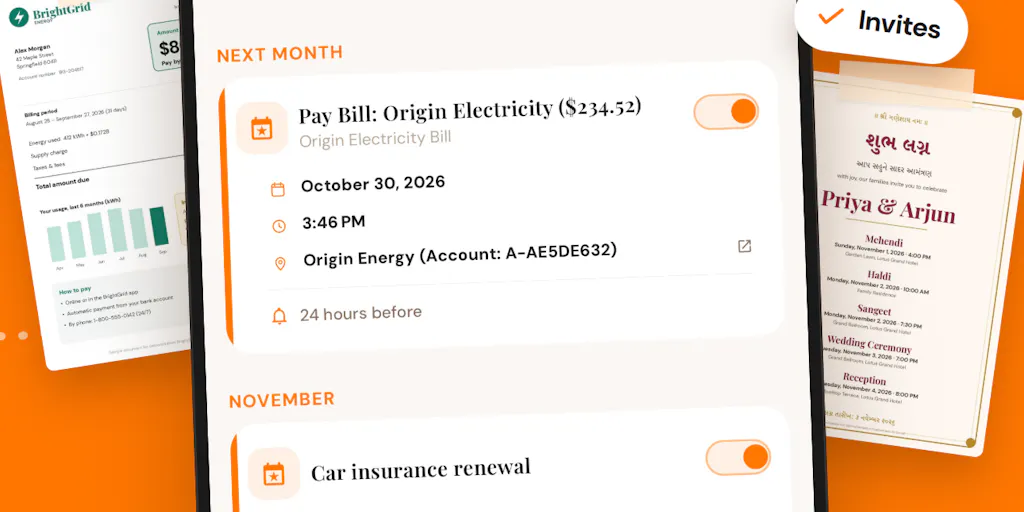
Strip away the launch-page framing and the product is one loop: you feed it a photo, screenshot, or PDF (or share a document directly to the app), its AI extracts the dates, times, places, and amounts, you review and correct, and it reminds you before each one matters. The maker, Himanshu, describes the origin problem plainly — important dates are everywhere, but creating reminders manually is annoying, and a single wedding invitation can contain five separate events while a utility bill carries both a due date and a late-fee date.
Two design choices separate it from the reminder app you already ignore. First, multi-date extraction: it turns one document into multiple reminders rather than stopping at the first date it finds, which the team says was a big focus because a single document can have multiple important dates. Second, localization depth — 80+ languages and 9 calendar systems, including Gregorian, Vikram Samvat, Hijri, Hebrew, and Chinese Lunar. No account is required to start, and the reminder list stays on-device. It’s on iPhone and Android.
On error handling, the maker’s answer to a direct question is the most operationally honest thing on the page: we treat AI extraction as a suggestion, not the final truth, with review-before-save and confidence checks still being improved for unclear documents. That’s the right posture. Hold onto it, because it’s also the wedge for my skepticism below.
Why Amazon sellers should care more than Shopify ones
A Shopify operator’s calendar is mostly marketing cadence — Klaviyo flows, promo windows, restock alerts — and most of that already lives inside tools that fire their own triggers. An Amazon seller’s calendar is compliance-shaped: IPI windows, invoice defect deadlines, FBA reimbursement claim cutoffs, EPR and VAT registrations per marketplace, Product Compliance document expiries. Those arrive as PDFs from accountants, spreadsheets from freight forwarders, and scanned certificates from factories — exactly the input format Invited was built around. A Shopify store that misses a promo date loses a week of revenue. An Amazon account that misses a compliance date loses the account.
How It Compares to What You’re Already Paying For
Let’s be precise about the competitive set, because “AI reminder scanner” sounds like a category with no moat.
- Google Calendar + Gmail: Gmail already extracts flights and hotel bookings, and Calendar surfaces them. But Gmail’s extraction is shallow, English-centric, and doesn’t handle a scanned supplier invoice or a WeChat screenshot. It also won’t produce two reminders from one utility bill.
- Todoist, TickTick, Things: excellent task managers, terrible at document ingestion. You’re still the parser.
- Notion databases: teams I know run a “compliance calendar” in Notion. It works until someone forgets to update it, which is always.
- Vertical compliance tools: Avalara for tax, Hellotax or J&P Accountants for EU VAT representation, Assent for product compliance. These own specific deadline categories authoritatively — but they’re expensive, narrow, and none of them will read a photo of a factory certificate.
Invited sits underneath all of those as a capture layer, not a replacement. That’s a defensible position, and it’s also why I don’t think the incumbents will bother attacking it directly.
Where the math breaks
Here’s the honest operator’s read. Invited’s own maker concedes that for relative dates like “third Monday of next month,” the current version works best with explicit dates — natural-language date understanding is on the roadmap, not in the product. For a US-based seller scanning a clean PDF invoice, that’s fine. For a seller dealing with Chinese-language supplier contracts, Arabic-language shipping notices, or handwritten customs paperwork, “explicit dates” is doing a lot of work in that sentence.
The second gap is distribution. The most-requested feature in the comments — from Christian Mardan — is an email forward-to address or mail extension, because most of his dates arrive by email. The maker agrees it’s “one of the most obvious next steps.” Until it ships, you’re manually screenshotting your inbox, which is exactly the friction the product exists to remove. And when Juan Viera Garcia asked about agent integration, the answer was no direct integration yet, with API/webhook access high on the list. For an operator already wiring Zapier or Make between systems, that’s a real ceiling.
What Cross-Border Sellers Should Borrow From This
Forget the app for a second. The architecture is the lesson, and it’s one most cross-border teams get wrong.
Treat extraction as a suggestion, not truth. The maker’s phrasing is the single best line on the launch page. Every AI tool in your stack — Helium 10 for keyword data, Jungle Scout for demand estimates, whatever LLM you’re using to draft listings — should be modeled the same way: machine proposes, human disposes. Teams that skip the review step are the ones filing appeals.
Build a document-to-deadline pipeline before you build a dashboard. Most operators I meet have beautiful BI on sales and nothing on obligations. The obligations are where the account-ending risk lives.
Multi-date extraction is a mental model, not a feature. One supplier PO contains a deposit deadline, a production cutoff, a ship-by date, and a balance-payment trigger. If your ops process captures one date per document, you’re structurally leaking three.
Localization isn’t a nice-to-have when your suppliers are overseas. The 9-calendar-systems detail matters more for cross-border than for the consumer wedding-invitation use case the product was designed around. Lunar New Year factory shutdowns, Ramadan-adjusted shipping schedules, Hebrew-calendar Israeli holidays — these are real planning constraints that Western tools flatten into “public holiday.”
The uncomfortable strategic question
If a $5/month consumer app can extract structured dates from a multilingual PDF, why is your $50k/year ERP still asking a human to type them in? The answer is integrations and audit trails, not extraction quality. But that gap is closing, and it’s closing from the consumer side first. That’s the pattern to watch across the whole tooling stack right now.
Where My Judgment Says It Falls Short
Three things, in order of how much they’d bother me as an operator.
No team layer. Reminder lists stay on-device, which is a privacy win for a wedding invitation and an operational dead end for a seller with a VA in Manila, an accountant in Shenzhen, and a founder in Austin. Compliance deadlines are inherently shared. Until there’s a shared workspace, this stays a personal productivity tool, not an ops tool.
No audit trail. If Invited reminds you and you miss it anyway, there’s no evidence chain. For Amazon POA appeals or customs disputes, “my reminder app didn’t fire” is not a defense. Real compliance tooling logs who saw what, when.
The confidence-check gap is the whole ballgame. The maker says they’re working on improving confidence checks for unclear or ambiguous documents. Until that ships, the failure mode is silent: a misread date that looks plausible, gets saved, and fires a reminder on the wrong day. A missed reminder is recoverable. A confidently wrong one is worse than no reminder at all, because it manufactures false assurance.
None of these are fatal. All of them are the difference between a useful consumer app and something a cross-border team would pay real money for.
What I’d Watch / Test Next
This week, before you install anything: export your last 90 days of operational pain. Pull every PDF, screenshot, and email attachment that contained a date you nearly missed — supplier POs, VAT notices, freight quotes with expiry windows, certificate-of-analysis docs, marketplace policy update emails. Count them. That number is your actual deadline surface area, and most operators have never measured it.
Then run a two-week manual test: forward every one of those documents to a single Google Drive folder and have a VA extract dates into a shared Airtable base with a “source document” field. If that process saves you more than four hours a month, you have a real problem worth buying software for — and you’ll now know exactly which features to demand. If it doesn’t, you’ve learned your compliance risk is lower than you feared, which is also worth knowing.
Watch Invited specifically for three releases: the email forward-to address, API/webhook access, and shared team lists. The first two turn it from a personal app into a pipeline component. The third turns it into something your ops team can actually run on. Until then, borrow the mental model, keep your human review step, and don’t let a confident AI date lull you into skipping the calendar check that’s been saving you all along.


