The account-switching problem is now a cross-border ops problem
If you run a cross-border e-commerce brand in 2026, your real bottleneck is no longer ad spend, supplier lead times, or even Amazon’s ever-shifting fee schedule. It’s the number of AI-assisted workstreams your small team is trying to keep alive at once. One operator is drafting Amazon A+ content in Claude, another is generating TikTok Shop hooks in ChatGPT, a third is debugging a Shopify Liquid snippet in Codex, and the founder is quietly burning through an Opus allowance on a supplier negotiation email that should have taken four minutes. Multiply that by three accounts per tool because everyone signed up with a different email, and you have a very modern kind of operational chaos: nobody knows which seat has quota left, and everyone finds out at the worst possible moment.
That’s the exact seam that ilha, a small macOS utility from maker Rafael Khalil, is trying to wedge itself into. It is not an e-commerce tool. It has nothing to do with product research, fulfillment, or attribution. But the problem it solves — knowing which AI account still has headroom before you start a task — is the same class of problem cross-border operators already solve for ad accounts, marketplace seats, and warehouse capacity. And that’s why I think it’s worth ten minutes of your attention even if you never install it.
What ilha actually solves (and what it doesn’t)
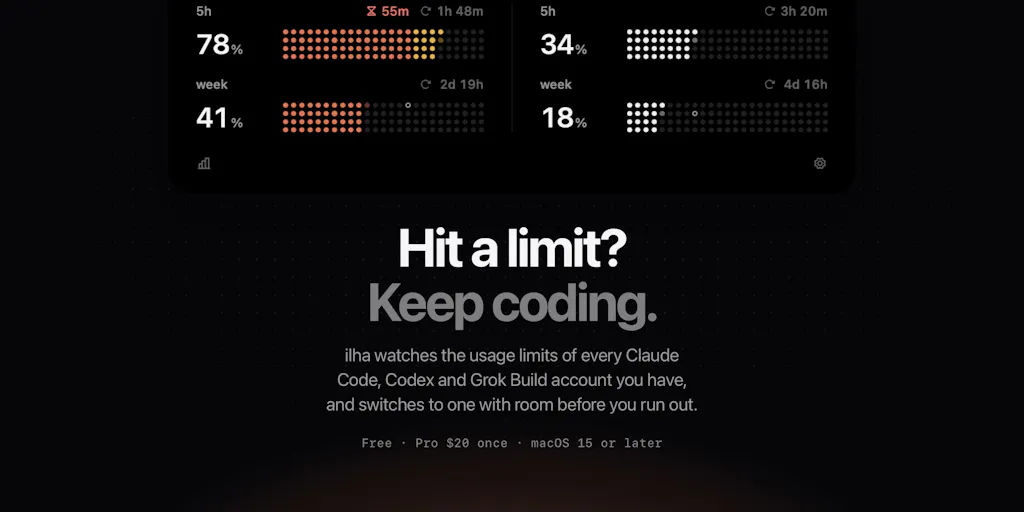
Strip away the notch-app aesthetic and ilha is a quota dashboard for people who pay for multiple AI subscriptions. Per the maker’s own launch post, it sits in the macOS notch and shows each saved account’s 5-hour and weekly usage windows across Anthropic, OpenAI, and xAI. When one account runs low, it offers to switch. When it hits the limit, it switches for you, swapping the CLI’s login in place so running Claude Code sessions carry on without a logout. It reads usage directly from the providers using logins already on your Mac, and per the maker, nothing about your usage, logins, or logs ever leaves the machine.
Pricing is refreshingly boring: free covers one account per CLI, and Pro is a one-time $20 for every account, switching, and an Insights view, with a 14-day trial and no account required. That’s it. No seat-based SaaS treadmill, no per-token markup.
Why this matters more to Amazon sellers than Shopify ones
Here’s the part I’d push back on if I were advising the maker. The framing on Product Hunt is developer-centric — Claude Code, Codex, CLI sessions — but the operator who feels this pain most acutely is not a solo dev. It’s the two-to-five person Amazon FBA brand where one person owns listing optimization, another owns PPC, and a third owns creative. They’re all using the same handful of AI subscriptions under different logins, and they’re all hitting the 5-hour window mid-task during a launch week. A Shopify DTC team with a dedicated growth hire probably has one or two seats and a manager watching them. An Amazon seller juggling Seller Central cases, Helium 10 exports, and a dozen AI-drafted appeal letters has no such manager. The quota visibility gap is wider there.
How it differs from the existing options
The obvious comparison is to the native usage dashboards inside each provider — Anthropic’s console, OpenAI’s usage page, xAI’s billing view. Those are fine if you have one account and check them once a day. They are useless if you have four accounts across three providers and need to know, right now, which one has room. The second comparison is to the CLI’s own login-switching flow, which is manual, stateful, and disruptive to running sessions. ilha’s whole pitch is that it removes the logout-and-guess loop.
The third comparison — and the one I’d watch most closely — is to the emerging class of AI cost-observability tools aimed at teams: Helicone, Langfuse, and similar. Those are built for API-key spend and production workloads, not for consumer subscription seats. They’ll tell you what your inference costs, but they won’t tell you that your personal Claude Pro seat is 80% through its weekly window at 2pm on a Tuesday. ilha is pointed at a different buyer: the individual operator or small team paying retail subscription prices, not the platform team paying per token.
The “on pace to run out” feature is the real product
Buried in the comment thread is the feature I think actually matters. A commenter asks whether the pace estimate learns from weekly work patterns or is a straight line, and the maker answers honestly: it’s a straight line from the average usage rate since the current window started, it doesn’t learn your schedule, and it holds the forecast back for the first 10% of the window because there’s too little data. That’s a rough estimate, and the maker says so.
I respect the honesty, but I’d argue this is the feature worth investing in, not the account switching. Switching is table stakes once you’ve built the dashboard. The forecast — “you’ll run out at 3:47pm” — is what changes behavior. It’s the difference between a tool that tells you your tank is empty and a tool that tells you to fill up before the highway. For a cross-border operator, that’s the difference between a listing rewrite that gets finished before the supplier call and one that gets abandoned halfway through.
What cross-border sellers can borrow from this
Even if you never touch ilha, the design pattern is worth stealing for your own ops stack. Three things stand out.
Local-first data handling. The maker is explicit that usage, logins, and logs never leave the Mac. For a cross-border seller handling supplier contracts, customer PII, and marketplace credentials, this is the right default posture. When you evaluate any AI-adjacent tool — a listing optimizer, a review-request automator, a TikTok Shop script generator — ask where the data lives. If the answer is “our cloud,” ask harder. The ilha approach, where the tool reads from provider APIs using credentials already on your machine, is a model more vendors should copy.
One-time pricing for utility software. A $20 one-time fee for a year of updates is a deliberate rejection of the SaaS subscription model. For a small brand watching every dollar of margin, that’s a meaningful signal. It also tells you something about the maker’s confidence: they’d rather sell you a tool than rent you one. I’d like to see more e-commerce tooling — especially the long tail of Shopify apps and Amazon repricers — experiment with this. The $29/month app that does one thing is a tax on small operators.
The notch as a surface. This is a small thing, but the placement matters. The maker and a commenter both call out the notch placement as a strength. For an operator who lives in a browser with 40 tabs open, a persistent, glanceable status indicator is worth more than a dashboard you have to remember to open. Think about where your own team’s critical numbers live. If your inventory days-of-cover, your ad spend pacing, and your return rate are buried three clicks deep in a reporting tool, they’re not really being watched.
Where the math breaks
I want to be clear-eyed about the limits. The maker confirms that Claude Code can switch before the limit and running sessions follow it, but Codex switches at the limit and you need to restart open Codex sessions afterward. That’s a meaningful asymmetry. If your team’s workflow is Codex-heavy, the “nothing gets logged out” promise is softer than it sounds. And the forecast, as noted, is a straight line that can be thrown off by a long break followed by a heavy session — which is exactly the pattern of a cross-border operator working across time zones.
Where my judgment says it falls short
Three concerns, in order of how much they’d affect a real operator.
First, the account model assumes you have multiple paid seats. The free tier covers one account per CLI. The value proposition only kicks in when you’re already paying for two or more subscriptions across providers. A solo seller with one Claude Pro and one ChatGPT Plus account gets a nice dashboard and not much else. The switching feature — the headline — is Pro-only.
Second, the platform lock-in. This is a macOS notch app. If your ops team runs Windows, or if your warehouse manager is on a Chromebook, you’re out of luck. For a cross-border brand with staff in Shenzhen, Manila, and Dallas, that’s a real constraint. I’d want to see a menu-bar-only mode for non-notch Macs and, eventually, a Windows build before I’d recommend it as team infrastructure rather than a founder’s personal toy.
Third, the observability gap on the provider side. The maker notes that ilha reads the values OpenAI reports, and in the thread a user describes a confusing pattern where their allowance appears to reset early — possibly due to a promotional double-quota period. The maker’s response is appropriately cautious: check the reported values before guessing. But this points to a structural issue. If the providers’ own reporting is inconsistent or promotional, any dashboard built on top of it inherits that noise. ilha is a mirror, not an oracle.
The comparison I’d actually make
If you’re an operator deciding whether to care, the honest framing is this: ilha is to AI subscriptions what a multi-account ad dashboard is to Meta Ads Manager and Google Ads. It doesn’t replace the native tools, and it doesn’t do anything they can’t do individually. It collapses the cognitive overhead of checking four places into one glance. That’s a real but modest value. The $20 price reflects that modesty, which I appreciate.
What I’d watch / test next
This week, if you’re curious, the concrete moves are simple. First, audit how many AI subscriptions your team is actually paying for — pull the card statement and count the recurring charges to Anthropic, OpenAI, and xAI. Most small brands I talk to are surprised by the number. Second, if it’s more than two, install the free tier of ilha on one Mac and watch the notch for a week. You’ll learn more about your team’s real usage patterns than any survey will tell you. Third, and most importantly, use the forecast feature as a forcing function: if the tool tells you a seat will run out at 3pm, that’s a signal to batch your AI-heavy tasks earlier in the day rather than discovering the wall mid-task.
What I’d watch from the maker’s side: whether the forecast ever learns weekly patterns, whether a Windows build ships, and whether the Insights view surfaces anything actionable beyond raw usage. The honest straight-line estimate is fine for v1, but the operators who’d pay for this are the ones whose work is bursty and time-zone-fragmented — exactly the pattern a straight line handles worst. If ilha can close that gap, it stops being a clever notch widget and becomes the kind of quiet infrastructure a cross-border team actually standardizes on.


