The Laptop Is the New Bottleneck: Why Cloud Agents Will Reshape How Cross-Border Teams Build
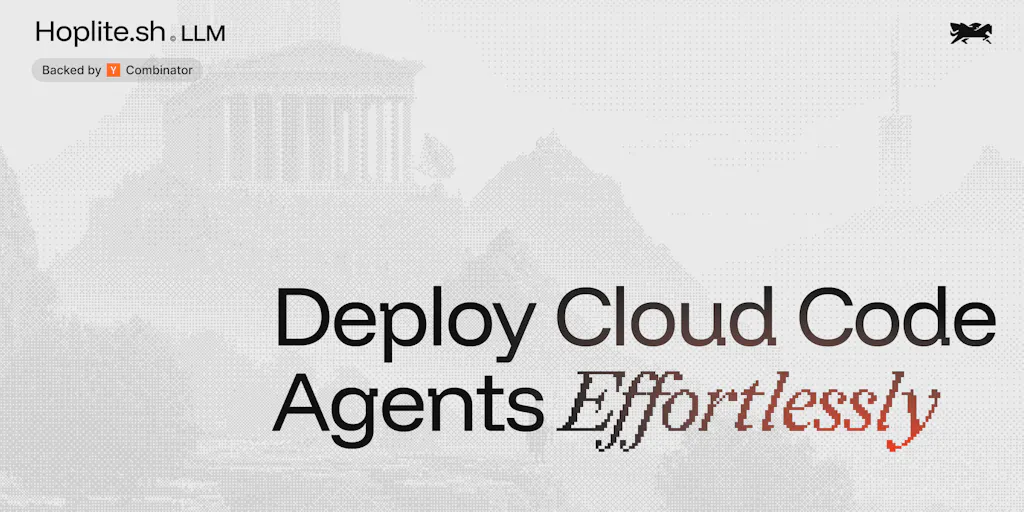
Every serious cross-border operator I know has hit the same wall. You’ve got a Shopify storefront that needs a custom integration with a 3PL, an Amazon listing that requires a script to scrape your competitor’s pricing, and a TikTok Shop back-end that’s begging for automation. The tools exist, but the execution is stuck on someone’s local machine. Your developer — or your own late-night coding session — is chained to a laptop that crashes, sleeps, and runs out of battery. That is the unglamorous reality of modern e-commerce operations: the infrastructure is in the cloud, but the work of building and fixing it is still stubbornly local. This is why the launch of Hoplite, a tool that ports your local coding agent sessions to the cloud, matters far beyond the developer-tool echo chamber. For the cross-border seller, this isn’t just a convenience; it’s a signal that the bottleneck in our ops stack is about to shift from hardware to orchestration.
The Problem: Your Ops Stack Is Only as Fast as Your Weakest Laptop
Let’s be honest about what most of our tech stacks look like. We run Shopify for the store, Amazon Seller Central for the marketplace, and a patchwork of scripts and Python notebooks for everything from inventory forecasting to repricing. The problem isn’t the platforms; it’s the glue. That glue — the custom code that connects your ERP to your listings, or your ad platform to your analytics — is usually written and run on a developer’s workstation. It works until it doesn’t. The moment a script needs to run for hours, or you want to spin up ten variations of a scraper to test against different marketplaces, the local machine becomes a liability.
The founders of Hoplite, Ryan Morrissey and Bence Redmond, frame this perfectly in their launch post: “Your laptop can only crash so many times before you get sick of it.” They built Hoplite after spending months “wrangling and shimming cloud coding providers” for their previous venture, an agentic harness for financial markets that used $1.5M in OpenAI credits. That figure is the key insight. They weren’t running a small script; they were orchestrating a fleet of AI agents that needed to run concurrently, reliably, and without a human holding the power button. For us, the scale is smaller, but the principle is identical. If I want to run a batch of AI agents to rewrite product descriptions for five different marketplaces, each with its own tone and compliance rules, I shouldn’t have to keep my MacBook plugged in overnight.
Hoplite’s core pitch is that it “port[s] over your local sessions/memories/MCP servers, so you can just pick up right from where you left off, but now you can close your laptop lid!” This is the operational shift that matters. It’s not about writing better code; it’s about decoupling the execution of that code from the physical presence of a machine. For a solo DTC operator or a small team, this is the difference between a process that requires constant babysitting and one that runs autonomously in the background.
Why Amazon sellers should care more than Shopify ones
If you’re a Shopify-first operator, you’re probably using a lot of SaaS apps that handle the heavy lifting. You don’t need to run a headless browser to edit a product page; you just use the admin panel. But Amazon is a different beast. The Amazon Marketplace Web Service (MWS) and the newer Selling Partner API (SP-API) are clunky, rate-limited, and often require custom tooling to manage bulk operations, feed submission, and report retrieval. If you’re doing serious volume, you have scripts. Those scripts are usually running on a cron job somewhere, but if they’re running on a local machine, they’re fragile. Cloud agents that can manage these API interactions, retry on failures, and scale horizontally are not a luxury; they’re a necessity for anyone trying to automate the monotonous parts of account management.
How Hoplite Differs from the Incumbent Chaos
The developer-tool space is crowded, and the “cloud agent” category is already getting noisy. When I look at the landscape, I see two main approaches. First, there are the local-first tools like Cursor or the GitHub Copilot ecosystem, which are great for writing code but keep you tethered to your IDE. Second, there are the full-platform cloud IDEs like Gitpod or GitHub Codespaces, which give you a cloud environment but often require you to reconfigure your setup, rebuild your context, and lose the “memory” of what you were doing.
Hoplite sits in a different lane. A commenter on the Product Hunt page, Jack O’Regan Kenny, noted that Hoplite was “one of the easiest cloud agents to onboard onto” and that the ease of getting to a place where he could switch from local was something he “ha[d] not had from Factory, Orb, etc.” This is the crucial differentiator. It’s not just about giving you a cloud shell; it’s about preserving the state of your work. The product claims to port over your local sessions, memories, and MCP servers. For the uninitiated, MCP (Model Context Protocol) servers are the connectors that give AI agents access to your tools and data. If Hoplite can genuinely migrate these, it solves the “cold start” problem that plagues every other cloud environment.
Most cloud tools force you to start from a blank slate. You have to clone your repo, reinstall dependencies, and re-establish the context of the task you were working on. That friction is why many of us still default to local. Hoplite’s value proposition is that it eliminates that friction. It’s a “pick up where you left off” model, which is exactly how a busy operator thinks. I don’t want to re-explain my business logic to an AI agent every time I spin up a new session; I want it to remember the SKU structure, the marketplace quirks, and the tone of voice I’ve already taught it.
Where the math breaks
However, I have to poke at the economics. The founders mention their background with $1.5M in OpenAI credits. That is an enterprise-scale burn rate. For a small cross-border team, running hundreds of concurrent agents could rack up a significant API bill. The product page doesn’t disclose pricing, so we’re left to guess. But the cost of cloud compute plus AI inference is non-trivial. If you’re running a simple script to update inventory levels, a cloud agent might be overkill. The math only works if you are running many agents or long-running tasks that would otherwise tie up your local machine for hours. For a solo seller, this might be a luxury; for a team managing multiple marketplaces, it could be the only way to scale.
What Cross-Border Sellers Can Borrow from This
Even if you never touch Hoplite, the philosophy behind it is something you should steal. The idea of moving your “agentic workflows” to the cloud is directly applicable to how you handle your e-commerce operations. Think about the repetitive tasks you do every day: checking for price changes on competitor listings, monitoring review sentiment, updating inventory counts across Etsy, eBay, and TikTok Shop, and generating daily performance reports. Each of these is a candidate for a cloud-based agent that runs on a schedule, not on your personal machine.
The key takeaway is the concept of stateful automation. Most of us use scripts that are stateless — they run, they finish, they forget. Hoplite’s approach is to maintain a persistent memory. For cross-border sellers, this is a game-changer. Imagine an agent that remembers that a specific supplier in Shenzhen always takes 48 hours to respond, or that a particular product category on Amazon has a higher return rate during the holiday season. If your automation can retain that context, it can make smarter decisions. It can adjust its scraping frequency, modify its alert thresholds, or even draft a different response to a customer review based on past interactions.
This is the “thousands of agents by the end of next year” vision that Bence Redmond talks about. He believes the number of agents we run concurrently will grow exponentially. For us, that means moving from a world where we have one script for one task, to a world where we have a small army of specialized agents, each handling a niche part of the operation. The challenge is managing that army. Hoplite’s dashboard is designed for that, but the underlying principle is that you need an orchestration layer. You can’t just have a hundred scripts running wild; you need a system that monitors them, restarts them on failure, and gives you a single pane of glass.
The “Linear” Obsession and UX for Ops
Ryan Morrissey mentions that Hoplite is a “passion project driven by our love for dev tools (especially ones that feel incredible to use, like Linear).” This is a subtle but important point. Linear is beloved because it’s fast, intuitive, and doesn’t get in the way. Most e-commerce tools are the opposite — they are clunky, slow, and require a manual to navigate. The fact that Hoplite is prioritizing user experience is a signal that we should demand more from our own tooling. If a developer tool can make complex orchestration feel simple, why can’t a Klaviyo flow or a Helium 10 dashboard feel the same way? The bar for UX is being raised, and it’s going to force everyone in the e-commerce SaaS space to up their game.
Where My Judgment Says It Falls Short
For all the promise, I have reservations. First, the target user is still a developer. The product page is full of jargon like “MCP servers” and “local sessions.” For a non-technical founder or a marketing manager, this is still inaccessible. The promise of “effortlessly use cloud coding agents” is great, but it still requires you to have a coding agent setup in the first place. It doesn’t solve the problem of what to automate; it only solves the problem of where to run it. So, if you don’t have a technical partner or a willingness to get your hands dirty with code, this tool is not for you yet.
Second, the reliability of cloud agents is still a question mark. The founders are essentially offering a managed service for running AI agents. If their infrastructure goes down, your automation goes down. For a cross-border seller, that could mean missing a critical repricing window or failing to respond to a customer service ticket. The “close your laptop lid” freedom comes with a trade-off: you are now dependent on another company’s uptime. It’s the same trade-off we make with AWS or Google Cloud, but it feels more acute when it’s a startup managing a niche layer of the stack.
Finally, the security implications are significant. You are porting your “memories” and your MCP server configurations to a third-party cloud. For e-commerce, this means your inventory data, your pricing strategies, and potentially your customer data are now sitting on Hoplite’s infrastructure. They don’t disclose their security certifications on the launch page. For a seller dealing with GDPR or CCPA compliance, this is a red flag. You need to know where your data is stored, who has access to it, and what happens if they get breached. The convenience is high, but the risk profile needs careful assessment.
What I’d Watch / Test Next
This week, if you’re intrigued by the concept, don’t just sign up for Hoplite and call it a day. Start by auditing your own “agentic” workflows. List out the top five tasks that you run on your local machine that are repetitive and time-consuming. Are they price checks? Inventory syncs? Report generation? Once you have that list, think about whether they need to be stateful. Do they need to remember past interactions, or are they simple fire-and-forget scripts?
Next, test the onboarding process. The commenters praised the ease of onboarding. If you have a technical background, spin up a small, non-critical task on Hoplite — something like a script that fetches your daily sales report from Amazon and posts it to a Slack channel. See how long it takes to port over your existing setup. If it takes more than 15 minutes, the friction is still too high.
Finally, keep an eye on the cost. Since pricing isn’t disclosed, I’d reach out to the founders directly and ask about their usage-based pricing model. Estimate your monthly API costs for running your top five tasks. If the cost of running them on Hoplite is less than the cost of your developer’s time babysitting a local script, it’s a win. If not, wait for the market to mature. The idea is sound, but the execution is still early. The future of e-commerce ops is in the cloud, but we’re still figuring out the price of admission.