The AI Demo Stack Is Quietly Becoming a Seller-Side Moat
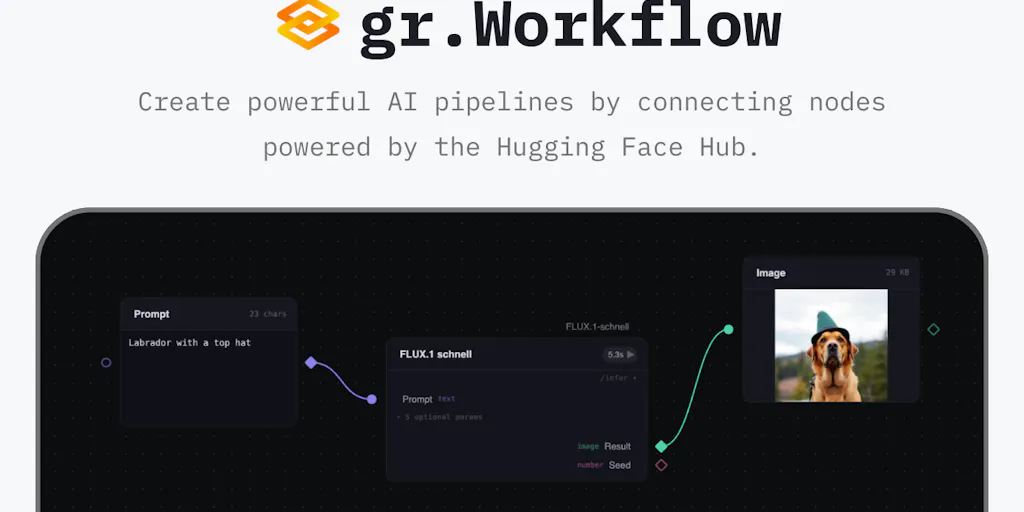
If you sell across borders, your real bottleneck in 2025 is not ad spend or freight — it is the gap between “an AI idea that could cut my costs” and “a working tool my ops team can actually click.” Most sellers I talk to have a folder of half-built scripts, a ChatGPT tab, and a nagging sense that competitors are automating circles around them. That gap is exactly what the latest wave of Python-first app builders is attacking. Gradio, the open-source interface layer from the Hugging Face orbit, has been the quiet workhorse behind countless internal demos and public model playgrounds for years. Its newest launch — a visual, graph-based workflow builder from maker hannah — is worth your attention not because it is flashy, but because it collapses the distance between “prompt experiment” and “shareable internal tool.” For a cross-border operator juggling listing localization, review triage, supplier QC image checks, and returns classification, that is a bigger deal than another ad-network feature drop.
What This Actually Solves (And Why “Works On My Machine” Is a Seller Problem)
The maker’s own framing is refreshingly honest: “every multi-step ai thing i’ve built ends up as something that works on my machine and nowhere else.” That sentence should resonate with any seller who has paid a freelancer to build a scraper, a translation pipeline, or a review-summarization bot, only to discover the deliverable is a Jupyter notebook nobody on the team can run.
The new Gradio workflow tool addresses this by treating the pipeline itself as the shareable artifact. You build it as a graph — inputs, steps, outputs — and that graph is the app. There is no separate front-end to write afterward. It taps directly into the Hugging Face Hub, so any model served by inference providers, any public Space, and any dataset drops onto the canvas as a node. Nothing to download, nothing to wrap. Your own Python functions sit right next to them. And because it is built on Gradio, anyone who has shipped a Gradio app already knows most of the interface.
For a cross-border seller, translate that into concrete workflows:
- Listing localization QA: a graph that pulls a product title from your PIM, runs it through a translation model, then a tone-check model, then a compliance keyword filter, and outputs a flagged CSV.
- Review triage: ingest Amazon or Shopify review exports, classify sentiment and topic, route negative ones to a Slack channel, and summarize weekly themes.
- Supplier image QC: batch product photos through a vision model to flag color mismatches or missing packaging before they hit a freight forwarder.
- Returns reason clustering: feed return notes into an embedding model, cluster them, and surface the top five root causes per SKU.
None of these are exotic. All of them currently die at the “how do I let my ops lead run this without me” stage. A graph-as-app model is a genuine fix for that specific failure mode.
Why Amazon sellers should care more than Shopify ones
Shopify merchants have an embarrassment of app-store riches: Klaviyo for retention, Gorgias for support, a dozen review apps. The marginal value of a custom internal tool is lower because the ecosystem already covers the common cases.
Amazon sellers live in a different world. Amazon Seller Central gives you raw data and almost no automation surface. Helium 10 and Jungle Scout cover research and keyword tracking, but they do not touch your internal ops. If you are running a private-label brand with 40 SKUs across three marketplaces, your highest-leverage automations are bespoke: supplier scorecards, ad-bid anomaly alerts, listing-change audits. That is precisely the territory where a graph-based builder that anyone on your team can open in a browser beats a $200/month SaaS seat you have to beg a vendor to customize.
How It Differs From the Incumbents You Already Pay For
Let me be specific about the comparison set, because “AI workflow builder” is a crowded phrase.
Zapier and Make are the default answers for ops automation. They are excellent at connecting SaaS APIs — “when a Shopify order lands, add a row to Google Sheets, send a Slack message.” They are weak at anything involving custom model inference, embeddings, or Python logic that is not already packaged as an integration. If your workflow needs a specific open-source model, Zapier is the wrong tool.
n8n sits closer to the target. It is open-source, self-hostable, and has AI nodes. But it still treats AI as a step inside a broader integration graph, and the learning curve for a non-technical ops hire is real. The Gradio approach inverts this: AI is the native primitive, and the graph is the app.
LangFlow and Flowise are the closest direct competitors — visual builders for LLM pipelines. They are powerful and have loyal followings. Where the Gradio workflow tool appears to differentiate is the tight coupling to the Hugging Face Hub (models, Spaces, and datasets as first-class nodes) and the fact that the output is a Gradio app, which means it inherits Gradio’s sharing, hosting, and embedding story. For a seller who wants to hand a tool to a warehouse team via a URL, that last point matters more than node count.
Retool and Appsmith are the internal-tool incumbents. They are better than any of the above at building CRUD dashboards over your own database. They are worse at model orchestration. If your problem is “I need a UI over my Postgres returns table,” use Retool. If your problem is “I need to chain three models and a Python function and share it,” this is a different category.
The honest positioning: this is not a Zapier killer, and it is not trying to be. It is a faster path from “I have a Python script” to “my team has a tool,” with Hugging Face as the model pantry.
What Cross-Border Sellers Can Borrow From This
Even if you never open the tool, three operating principles from this launch are worth stealing.
1. Treat the pipeline as the deliverable
Most sellers commission automations as one-off scripts. That is a trap. The moment the freelancer disappears, you own an unmaintainable artifact. The graph-as-app model forces you to think of the workflow as a living, editable object. When you brief your next automation hire — internal or agency — ask for a visual, editable pipeline, not a script. Even a Make scenario or an n8n workflow satisfies this. The point is auditability by non-engineers.
2. Keep your models swappable
The Hugging Face Hub integration is a quiet argument for model portability. If your listing-translation pipeline is hardcoded to one vendor’s API, you eat every price change and every deprecation. If it is a node you can swap, you can move from a hosted inference provider to a self-hosted model when volume justifies it. Cross-border sellers especially should care: your Chinese-language support workflows may be better served by a different model than your German-language ones, and you want that to be a config change, not a rewrite.
3. Ship internal tools to non-technical staff via URL
The single biggest automation ROI killer I see in seller ops is that the person who needs the tool cannot run the tool. A browser-accessible, login-gated app that a warehouse supervisor or a VA in Manila can open is worth ten clever scripts sitting on a founder’s laptop. Gradio’s sharing model is built around exactly this. Whatever stack you use, make “can a non-technical hire open this in a browser” a hard requirement.
Where the math breaks
Be clear-eyed about cost. Model inference is not free, and a visual builder makes it dangerously easy to build a graph that quietly burns tokens on every run. A review-triage pipeline processing 50,000 reviews a month through a mid-tier LLM can easily cost more than the human VA it replaced. Before you build, estimate tokens per run, runs per month, and compare against your current labor cost. If the automation only saves 10 hours a month of low-wage work, the model bill will eat the savings.
Where My Judgment Says It Falls Short
Three concerns, in order of how much they should worry you.
Beta status is not a footnote. The maker states plainly that it is still in beta and directs users to a GitHub repo and Discord for issues. For a hobbyist, fine. For a seller whose Black Friday listing-localization pipeline depends on it, you need a fallback. Do not put this on the critical path of revenue-generating operations until it has a stable release cadence.
The Gradio inheritance is a double-edged sword. “If you’ve shipped a Gradio app you already know most of it” is a genuine advantage for the developer audience. But Gradio’s history — visible right there in the launch page’s own archive, from the Gradio 3 demo-your-model launch in 2022 back to the GPT-NEO web demo in 2021 — is a research-and-demo tool. Production-grade, multi-tenant, permissioned internal apps are a different beast. Sellers should assume they will need to handle auth, audit logging, and data residency themselves.
The “no separate UI” promise has limits. Graph-as-app works beautifully for linear pipelines. The moment you need a real form with validation, role-based views, or a mobile-friendly warehouse interface, you are back to writing UI. For a lot of seller use cases — a returns classifier, a review summarizer — that is fine. For anything customer-facing or used on a warehouse floor, budget for front-end work anyway.
Ecosystem lock-in to Hugging Face. The deep Hub integration is the differentiator, but it also means your workflow’s portability depends on Hugging Face’s continued openness. That is a reasonable bet today. Just do not pretend it is neutral infrastructure.
What I’d Watch / Test Next
This week, pick one narrow, high-pain workflow and prototype it — not because you need this specific tool, but because the exercise will tell you whether your team can absorb AI automation at all. My suggested test: export 500 recent reviews from Amazon Seller Central or your Shopify admin, and build a graph that classifies them by topic and sentiment and outputs a one-page weekly summary. Time-box it to four hours. If you cannot get a shareable URL in front of your ops lead by the end of that window, the tool is not your bottleneck — your data plumbing is, and that is the real project. Watch three signals over the next quarter: whether the beta graduates to a stable release with auth built in, whether the Hugging Face node library expands to cover the vision and embedding models seller ops actually needs, and whether anyone in the seller-tooling ecosystem — the Helium 10s and Jungle Scouts of the world — starts shipping native integrations. If that third signal fires, this stops being a developer curiosity and becomes a genuine line item in your ops stack.


