Why a Sandbox That Breaks On Purpose Is the Most Important Tool You’re Not Using
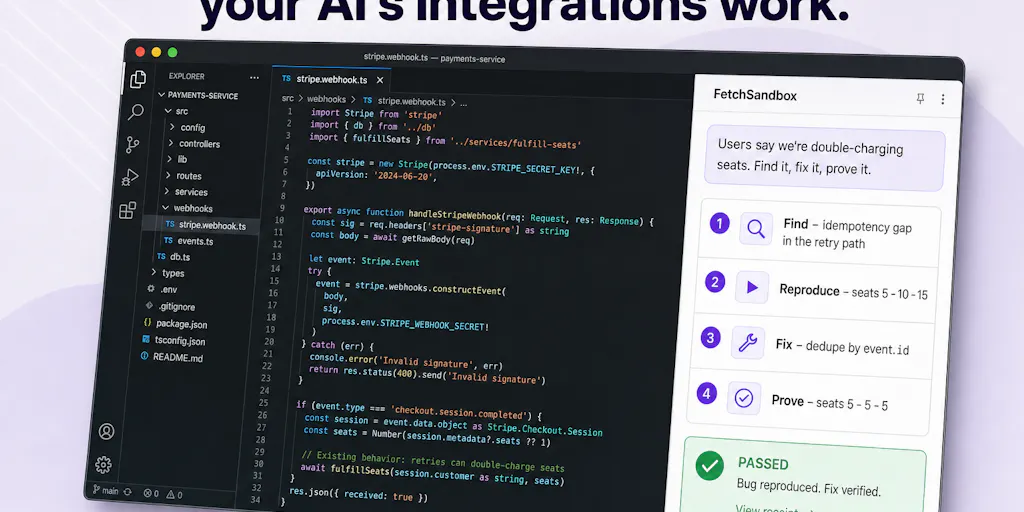
Every cross-border seller I know has a story about the integration that looked perfect in staging and then blew up at 3 AM on a Saturday. A payment webhook fires twice, and suddenly fifty customers in Germany get charged for the same order. A shipping carrier API returns a 200 but silently drops the tracking number, so your Shopify orders sit in “unfulfilled” for three days while support drowns. The reason is always the same: you tested the happy path, but production runs on chaos. The AI era makes this worse, not better. Your agent can write a Stripe integration in thirty seconds, but it has no idea that a duplicate webhook event will break your idempotency key logic. That’s why FetchSandbox — a tool that doesn’t just simulate a 200 OK but actually runs the full lifecycle of an API call with real failure modes — is the kind of infrastructure cross-border operators should care about right now, even if it sounds like a developer tool you’d delegate to engineering. Because the cost of a silent integration bug in a multi-market, multi-currency stack isn’t a ticket; it’s lost revenue, refund fees, and marketplace account health hits that take months to recover.
The “200 OK” Lie That Costs You Real Money
Most API testing tools — Postman, mock servers, even the basic integration tests in your CI pipeline — all subscribe to the same fiction: if the API returns a 200, everything is fine. That’s fine for a toy app. For a cross-border operation where you have payment gateways, tracking services, marketplace order feeds, and tax calculation endpoints all wired together, the 200 is the least informative response you could ask for. The real bugs live in the lifecycle: the webhook that arrives twice because of a retry, the event that lands five seconds late and messes up your order sequencing, the token that was valid when you checked it but expired before the next request.
FetchSandbox, built by Raj Nagulapalle (ex-PayPal, so he’s seen payment integration failures at scale), calls this out directly. As Raj puts it in a Product Hunt comment: “instead of stopping at ‘the API returned 200,’ FetchSandbox runs the actual integration flow — webhooks, retries, state changes, and failure scenarios — and shows what breaks before you ship.” That’s a fundamentally different philosophy. It doesn’t just send a request and check the status code; it reproduces the exact conditions that cause production incidents. For a seller who has Stripe handling payments in multiple currencies, or Twilio for SMS order confirmations, or any of the 60+ APIs the tool currently supports, the difference between “green in sandbox” and “works at 2 AM with a retry storm” is the difference between keeping your Black Friday revenue and explaining to your bank why you have so many chargebacks.
Why Amazon Sellers Should Care More Than Shopify Ones
Not all API integrations are created equal. Shopify’s API surface is relatively clean and well-documented, and most Shopify sellers use a handful of apps that handle the integration spaghetti for them. Amazon sellers, on the other hand, live inside a beast. Amazon Seller Central’s SP-API is notorious for throttling, inconsistent error codes, and webhook-like push notifications that are anything but reliable. If your inventory sync or order fulfillment pipeline depends on Amazon’s APIs, a duplicate event can pull inventory from your FBA warehouse twice, or a stale state can mark a shipped order as “pending” indefinitely. FetchSandbox’s ability to simulate retries, duplicate deliveries, and stale state is a direct antidote to the kinds of bugs that cause ASIN suppression or late shipment rate spikes. Shopify sellers benefit, but Amazon operators have a higher probability of a single integration failure turning into a account health violation.
How FetchSandbox Differs From Everything Else
If you’re a seller who has outsourced tech decisions to a head of engineering or a dev agency, you might think “we already test API integrations.” But you probably don’t test them like this. Here’s what’s different:
- It’s MCP-native. The Model Context Protocol (MCP) is the new standard for connecting AI agents to tools. FetchSandbox works inside Cursor, Claude Code, and Codex CLI with a one-line install — no keys, no accounts. That means when your AI coding agent writes a payment integration, it can immediately verify that integration against a sandbox that actively tries to break it. For cross-border sellers using AI to generate Shopify app integrations or TikTok Shop API connectors, this closes a dangerous feedback loop.
- Failure library, not just mocks. Most mocks are static — they return a canned response. FetchSandbox’s failure library is curated from real integration failures that have been reproduced in sandbox runs. Raj explains in a thread that the patterns “actually happened, not ones I imagined.” The tool then proves the failure by re-running your code against it. That’s a subtle but critical difference: it doesn’t just say “this could happen”; it demonstrates that your specific handler breaks when it does.
- Reproduce → fix → rerun loop. A CI pipeline that fails on a mock test often requires manual debugging to understand why. FetchSandbox encodes the failure scenario, lets you apply a fix, and reruns the exact same scenario until it passes. For an operator who needs to patch a webhook handler quickly during a promotion, that deterministic replay is gold.
- Persistent memory per API. The tool learns failure patterns globally for each API (Stripe, Resend, Descope, etc.) and compounds that knowledge as more integrations run against it. Raj notes that “the global per-API library is real and shipped” — so when you test Stripe checkout, you inherit the knowledge that a duplicate delivery on
invoice.paidcan double-grant credits, without having to discover that yourself.
What Cross-Border Sellers Should Borrow From This Approach
You don’t need to be a developer to get value from FetchSandbox’s philosophy. The core insight — test the failure lifecycle, not just the happy path — applies to every integration you depend on. Here are three practical borrows for your operational playbook:
Inject failure scenarios into your QA process for every new marketplace or payment integration. Don’t just test that orders sync correctly. Test what happens when the eBay API returns a 500 on the third retry. Test what happens when Temu’s webhook fires twice while you’re in the middle of a warehouse update. You can write these tests manually if you have the engineering bandwidth, but FetchSandbox automates the hard part: generating the failure conditions and proving your code handles them.
Treat “200 OK” as the beginning, not the end of a bridge. When your Helium 10 tool syncs Amazon data, or your Klaviyo integration pushes customer profiles, the immediate response matters less than the chain reaction. A 200 from Klaviyo’s API doesn’t mean the email actually queued. FetchSandbox’s lifecycle simulation — webhooks, retries, state changes — mirrors what happens after the initial call.
Use the failure-library concept for your own internal runbooks. Even if you never install FetchSandbox, start documenting the real integration failures you’ve experienced. “Stripe charge doubled because of missing idempotency key” becomes a runbook entry. Next time your agent writes a new checkout flow, you can say “here are the three ways this breaks” instead of hoping for the best.
Where the Math Breaks: The Drift Problem
The most honest criticism of FetchSandbox came from a commenter named Gal Dayan, who asked: if FetchSandbox simulates Stripe’s behavior, what happens when Stripe changes its retry semantics or adds a new webhook edge case? If the sandbox drifts from the real API, you get a false sense of security — green in the sandbox, still breaks in prod. Raj’s response was refreshingly direct: “a fully automated per-api drift monitor that continuously diffs our simulation against the live api is not there yet. today when stripe changes retry semantics it’s closer to catch-and-correct than an automated watchdog.”
This is the gap every cross-border seller should watch. If you rely on FetchSandbox to gate merges, you need to know that your sandbox is in sync with the live API. For payment gateways and marketplace APIs that change rapidly — Amazon SP-API gets updates weekly — the drift window could be hours or days. Raj has drift detection on the roadmap, but it’s not there yet. The honest takeaway: use FetchSandbox today for known failure patterns (duplicate webhooks, retries, stale state) that are relatively stable across API versions. For bleeding-edge endpoints, supplement with real integration tests in a staging environment.
The Real Opportunity for Cross-Border Operators
The biggest shift FetchSandbox represents isn’t about testing; it’s about trust in AI-generated code. As Raj notes in another post, “agents don’t just call integrations, they depend on them mid-task. when an upstream API changes a field name or drops an endpoint, a human engineer notices in the next sprint. an agent just fails silently at 2am.” For a seller running TikTok Shop ads on autopilot with an AI agent managing budget adjustments through the API, that silent failure means your ad spend runs unchecked for hours. FetchSandbox doesn’t solve that monitoring problem (yet), but it does make the initial integration more robust against lifecycle failures.
What I’d really like to see is FetchSandbox evolve to include a “production shadow mode” — run the failure library against live traffic in read-only mode to detect drift in real time. That’s the feature that would make it indispensable for marketplace operators who can’t afford downtime. But even in its current state, it’s the first tool I’ve seen that addresses the specific pain of “my AI wrote the integration, now how do I know it won’t break?”
What I’d Watch / Test Next
If you run a cross-border operation — whether on Shopify, Amazon, Etsy, or eBay — here’s a concrete two-step plan for this week:
Grab the MCP install for FetchSandbox. It takes one line and no account. Point it at your payment webhook endpoint (Stripe, PayPal, whatever). Run the duplicate delivery and stale state scenarios. Watch your handler break. Fix it. Then run the same scenario again until it passes. That loop alone will likely catch a bug you didn’t know you had.
Audit your top three API integrations for lifecycle gaps. Ask your team: if a webhook fires twice, does our code handle it atomically? If a token expires mid-workflow, do we retry with a new one? If an event arrives out of order, does our state machine recover? Use the failures you find to populate your own internal failure library. If FetchSandbox supports the API, use it to prove the fix.
The tool is free to try, and the feedback from early users like Ryan Davis — who caught a double-grant race condition in his invoice handler within a day — suggests it’s already production-ready for the most common failure patterns. For cross-border sellers, the cost of not testing those patterns is hard dollars and marketplace penalties. Start testing the chaos, not just the happy path.