Why a Cloud Agent API Is Quietly Relevant to Every Cross-Border Seller
If you run an e-commerce operation that touches more than one marketplace, you already know the real bottleneck isn’t sourcing products or writing listings — it’s the glue code. The scripts that reconcile inventory between Amazon and Shopify, the webhooks that sync orders to your 3PL, the scraping jobs that watch competitor pricing on Walmart and Temu, the AI agents you’ve tried to build to automate review responses. Every one of those projects dies the same death: not because the AI can’t do the thinking, but because the environment around it collapses. You need a sandbox, you need dependencies installed, you need API keys wired up, you need retry logic when the provider hiccups. That’s the unsexy infrastructure work that eats weeks. So when I see a product that treats “run an AI agent in a reliable, pre-configured cloud sandbox” as a primitive — as a POST request — my ears perk up. Not because I want to build AI analysts, but because the same operational pain that plagues software teams is the exact pain that plagues a serious cross-border operation. This is a tool about removing friction between intent and execution, and that’s a language every seller understands.
The Problem: Agents Are Only as Good as the Sandbox They Run In
Let me paint a picture that will feel familiar. You’ve got a product data spreadsheet with 40,000 SKUs. You want an AI agent to audit every listing for compliance issues — missing HS codes, inconsistent brand names across marketplaces, descriptions that violate Amazon’s style guides. You’ve heard about Claude Code, and you’re excited. You spin up a cloud sandbox from a provider, and then the real work begins. The machine is bare. You need to install the runtime, configure the agent, clone your repository, set up environment variables, and pray that the API rate limits don’t bite you mid-run.
The founder of Epho — Burak Karakan, who’s also behind the Bruin project — describes this exact pain point in the launch post. He notes that “sandboxes give you bare machines; you need to configure them for agentic workloads”. This is the dirty secret of the AI agent boom: the models are impressive, but the operational layer around them is still 2015-era DevOps. Each agent behaves differently — Claude Code has its own conventions, Codex has its own, OpenCode has its own. Building integrations with each one is a full-time job. And even if you get one working, the sandbox provider might be unreliable, forcing you to build a multi-provider strategy just to avoid a single point of failure.
For a cross-border seller, this isn’t an abstract engineering problem. It’s the difference between a one-week automation project and a three-month one. You don’t have a dedicated platform team. You have a lean operations crew that’s already stretched thin managing listings, ads, and logistics across time zones. The promise of AI agents has been “automate the boring stuff,” but the reality has been “automate the boring stuff, but first spend six weeks building the boring infrastructure.”
What Epho Actually Does — and How It’s Different
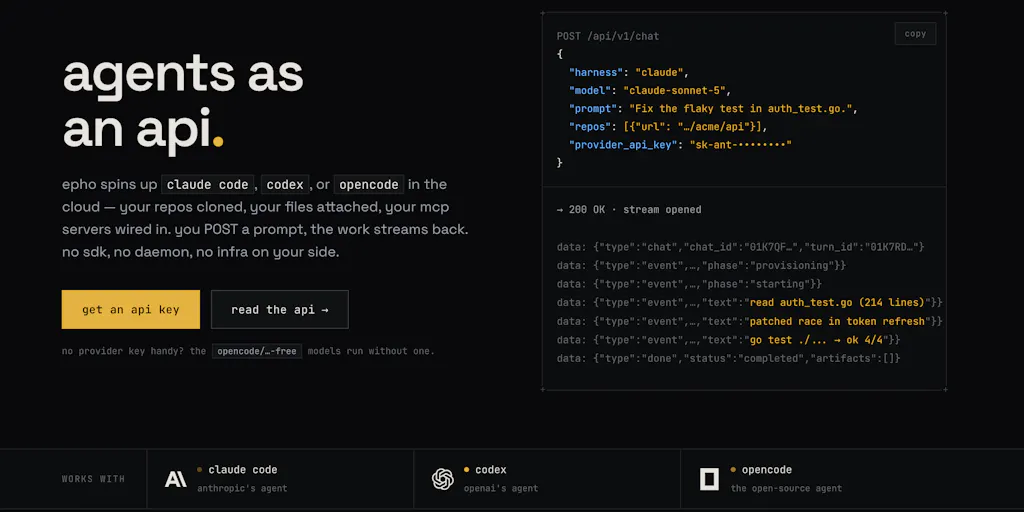
Epho’s core proposition is simple: send a POST request, get events streaming back to you. The service spins up a sandbox, configures the chosen harness — whether that’s Claude Code, Codex, or OpenCode — clones your repositories, attaches files, and kicks off the agent. It handles the automatic fallbacks across providers, manages auth, and streams back the events and outputs. You don’t manage infrastructure. You manage prompts.
The pricing model is where things get interesting for operators who’ve been burned by opaque AI billing. Epho uses your own API keys, which means you pay for the AI tokens directly to Anthropic or OpenAI. Epho charges for infrastructure per second, not per token. As one commenter, Lucas Pols, noted: “The keys stay yours and the bill is compute by the second rather than tokens. Congrats on charging only for the part you actually run.” That’s a meaningful distinction. Most agent platforms wrap the AI costs into a per-seat or per-token markup, which makes cost forecasting a nightmare when you’re running batch jobs at scale. With Epho’s model, the infrastructure cost is transparent and the AI cost is whatever your key usage says it is.
There’s also a free entry point: you get $10 in free compute when you sign up and verify your email, and you can use Opencode’s free models to experiment without even providing an API key. That’s a low-friction way to test whether the workflow actually solves your problem before you commit real money.
Why Amazon Sellers Should Care More Than Shopify Ones
Shopify sellers live in a walled garden with apps for everything. Amazon sellers live in a swamp. Seller Central is powerful but notoriously clunky, and the API is functional but not exactly delightful. If you’re managing a multi-currency, multi-marketplace operation, you’re constantly writing scripts to pull data from Seller Central, transform it, and push it somewhere else. The Amazon Seller Central API is the kind of integration that eats weekends. An agent that can be pointed at your repository, given a task like “audit all listings for missing HS codes,” and run in a reliable sandbox without you babysitting the infrastructure — that’s genuinely valuable. Shopify has a cleaner ecosystem, but Amazon sellers have more pain to automate away.
What Cross-Border Sellers Can Borrow From This Playbook
Even if you never touch Epho, the way this product is built offers lessons for how you should think about your own automation stack. The first lesson is about abstraction. Epho isn’t trying to be the best AI agent. It’s trying to be the most reliable way to run an AI agent. That distinction matters. You don’t need to build the smartest model — you need the most dependable pipeline. For a seller, that translates to: don’t build your own in-house tool for everything. Use the best-in-class tool for each layer of the stack, and focus your engineering energy on the integration layer that ties them together.
The second lesson is about cost transparency. The per-second infrastructure pricing is a reminder that you should push back on opaque pricing models from any SaaS vendor. If a tool can’t tell you exactly what you’re paying for and why, it’s going to surprise you eventually. When you’re evaluating Helium 10 or Jungle Scout or any of the other seller tools, ask yourself: what am I actually paying for here? Is it the data, the compute, or the convenience? If the answer is “all of the above, bundled,” you’re probably leaving money on the table.
The third lesson is about the multi-provider strategy. Epho’s automatic fallbacks across providers is a feature that sounds boring until you need it. If you’re running a batch job at 2 AM and your primary provider has an outage, do you have a fallback? For sellers, this applies to everything from Klaviyo email sends to Flexport freight bookings. Redundancy isn’t a luxury; it’s the difference between a minor inconvenience and a lost sales day.
Where the Math Breaks: The Repo Context Problem
One commenter, Shabnam Katoch, made a sharp observation: “The repo context part is what stands out. An agent that can start with the right context is much more useful than a blank workspace.” That’s true, but it’s also where the math gets tricky. Cloning a large repository — especially one with years of history, media assets, or generated files — can blow up your compute costs before the agent even starts doing useful work. If you’re pointing this at a monorepo with 10,000 files, the initial context loading could eat a significant chunk of your $10 free credit. The product would benefit from a way to scope the context — maybe a “lightweight clone” mode that skips history or excludes certain directories. Until that exists, you’ll want to be deliberate about what you point it at.
My Judgment: Where Epho Falls Short
Let me be clear about what this product is not. It’s not a no-code tool. If you’re a seller who doesn’t write code, this is not for you. The “send a POST request” model assumes you have some engineering capability, even if it’s just a basic understanding of APIs. There’s also a question of trust. The product is brand new — launched a day ago on Product Hunt. The founder is Burak Karakan, and the team behind Bruin seems credible, but “credible” and “battle-tested” are different things. If you’re going to rely on this for production workloads, you need to verify that the multi-provider fallback actually works when it matters. A day of public availability isn’t enough to establish that track record.
There’s also the question of what happens when your agent needs to interact with services that aren’t just code repositories. For a seller, the most valuable agents are the ones that can talk to Seller Central, read your ad spend from Google Ads, and pull inventory levels from your 3PL’s API. Epho handles the sandbox and the agent harness, but you still need to wire up the external integrations yourself. That’s not a criticism — it’s a scope limitation. But it means the value proposition for a typical seller is indirect. You’re not going to use Epho directly to automate your Amazon listings. You’d use it to build the tool that automates your Amazon listings.
The Operational Stack: Where This Fits in a Seller’s Toolbox
Let me sketch a realistic architecture for a mid-sized cross-border operation. You’ve got Shopify for your DTC store, Amazon Seller Central for the marketplace side, and maybe a TikTok Shop presence for the impulse-buy audience. Your data lives in a mess of spreadsheets, a SQL database, and whatever your ERP spits out. You want to build an AI agent that monitors your entire catalog for pricing inconsistencies across all three channels.
Here’s where Epho fits. You write a prompt that says: “Pull all product data from these three sources, compare prices, flag discrepancies over 5%, and generate a report.” Epho spins up a sandbox, configures Claude Code, clones your integration repository, and runs the agent. The agent makes API calls to the three platforms, does the comparison, and streams back the results. You get a report without having to maintain a persistent server or worry about the sandbox environment drifting out of sync with your codebase. That’s genuinely useful.
Compare that to the alternative. You could use a tool like Zapier for simple automations, but it falls apart when the logic gets complex. You could spin up a DigitalOcean droplet and configure it yourself, but that’s the six-week project I mentioned earlier. Epho sits in a middle ground: more powerful than no-code, less heavy than full DevOps.
The “Agents-as-an-API” Trend: What It Means for E-Commerce
The broader trend here is worth watching. Epho calls itself an “agents-as-an-API” product, and that’s a category that’s going to explode. As AI agents become more capable, the bottleneck shifts from “can the model do it” to “can I reliably deploy it at scale.” For e-commerce, this means the next wave of tools won’t be “AI-powered spreadsheets” or “AI listing generators.” It’ll be infrastructure that lets you build custom agents for your specific operational quirks — your weird shipping rules, your unique return policies, your idiosyncratic product taxonomy. The sellers who win will be the ones who can harness this infrastructure early.
What I’d Watch / Test Next
If you’re an operator who’s intrigued but not ready to commit, here’s what I’d do this week. First, sign up for Epho and claim the $10 free credit. Don’t build anything ambitious. Just test the workflow: connect a small repository, run a simple agent task, and see how the event streaming feels. Pay attention to latency and error rates. Second, identify one repetitive task in your operation that’s currently manual and could be automated with an agent. Write down the exact prompt you’d use. It doesn’t have to be perfect — just get the shape of it. Third, compare the per-second infrastructure cost against what you’re currently paying for any automation tool. If you’re paying a monthly subscription for a tool that only does one thing, the math might surprise you. Fourth, keep an eye on how Epho handles the repo context problem I mentioned. If they add a scoped-clone feature, that’s a signal they’re listening to real users. Finally, don’t build your entire stack around a one-day-old product. Run it in parallel with your existing tools, validate the results, and only then consider making it a core part of your infrastructure. The promise of AI agents is real, but the discipline of testing before trusting is what separates profitable operators from the ones who chase every shiny launch.


