The Video Is the New SKU — Why Every Cross-Border Seller Should Care About Local-First Video Search
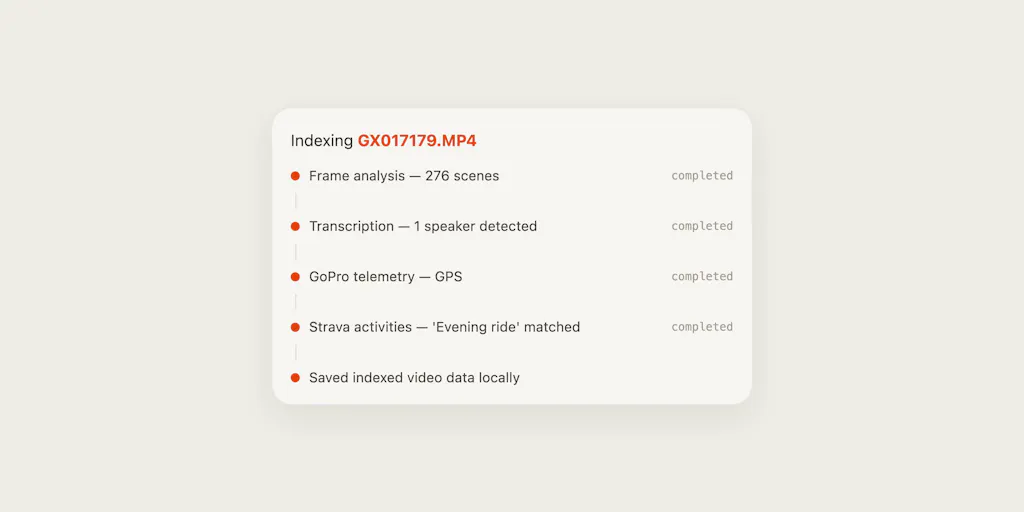
Every seller I know is sitting on a graveyard of raw footage. Unboxing videos shot on iPhones, warehouse walkthroughs from a GoPro, TikTok UGC that never got clipped, Amazon Live streams that were never tagged, product demos that exist only as a timestamp on a hard drive. We spend thousands on video production, yet the moment you need to find “the clip where the customer holds the product at a 45-degree angle and smiles,” you’re scrubbing through a timeline like it’s 2005. That’s the gap Edit Mind is aiming to fill — and while it’s not built for e-commerce (it’s a tool for athletes who want to match GoPro footage to Strava telemetry), the underlying architecture is the most interesting thing I’ve seen this quarter for anyone who manages video at scale. It’s a local‑first, natural‑language video search engine that indexes footage using metadata like speed, heart rate, elevation, or GPS coordinates — then lets you query it like you’d describe a moment to a friend. No cloud upload. No manual keywording. For a cross-border operator drowning in unlabelled footage from factories, fulfilment centres, and creator partnerships, that concept is worth a lot more than a glance.
What Problem Edit Mind Actually Solves
The core pain point is simple: video is the richest customer-engagement asset we have, but it’s also the hardest to search. If you run a Shopify store selling fitness gear, you might have dozens of influencer videos showing your product during a run, a yoga session, a HIIT workout. Each clip is a few raw files with a timestamp and maybe a filename like “IMG_0422.MP4”. To find “the moment the runner hits top speed wearing our leggings,” you either watch every second or you hire a video editor to manually tag frames. Edit Mind attacks that from the metadata side. It ingests the telemetry from a source like Strava (speed, elevation, heart rate, distance, power) and matches it to the video’s GPS or creation-date timestamps at the frame level. Then it lets you search using natural language: “Give me clips where I hit my peak heart rate,” or “Show me the moments my speed dropped below 10 mph on a steep climb.”
For the indie maker and cyclist Ilias Haddad who built it, the use case is deeply personal — syncing GoPro and phone footage to his bike rides. But unpack the abstraction: any video that can be paired with structured metadata becomes instantly queryable. For cross-border sellers, that metadata could be product SKUs, packing station IDs, quality‑control pass/fail flags, or customer sentiment scores from a post‑purchase survey. Imagine shooting 50 hours of unboxing videos in your Chinese factory, each tagged with the product ASIN and the inspector’s ID, then being able to say “show me every unboxing where the sealing tape was crooked” and getting a three-second clip. That’s the promise.
How It Differs from Existing Video Management Tools
The incumbent landscape is fragmented. Cloud‑based platforms like Wistia and Vimeo offer AI‑powered search, but they require upload — and for a seller in Shenzhen or Ahmedabad with a 500‑GB dataset, that’s a non‑starter. AI transcription tools like Descript let you search by spoken word, not by visual or telemetric metadata. Google Photos does auto‑tagging for cats and sunsets, but not for “pallet count” or “shipping label orientation.” Edit Mind’s differentiator is local‑first indexing and cross‑modal search — it’s searching inside the video based on time‑aligned external data, not just pixel analysis. The product is described as “100% local” — no cloud processing, no upload, no data leaving your machine. For e‑commerce operators who deal with confidential product designs, unfinished packaging, or supplier‑side operations, that’s a privacy win you can’t get from any SaaS video tool.
The maker’s comment about using “GPS data to match the Strava activity to the video” and “the creation date as a fallback” reveals a clever dual‑mode synchronization strategy. For action cameras (like GoPro) that embed GPS, the match is frame‑accurate. For phone footage, where clock drift is a known headache, it trusts the file timestamp but implicitly relies on the user having a reasonably accurate clock — a point raised by commenter Gal Dayan. This isn’t a turnkey e-commerce solution, but the architecture is portable. If you can pair any time‑series data (order timestamps, Amazon Shipment IDs, TikTok view peaks) with a video file, you can search it.
What Cross-Border Sellers Can Borrow from Edit Mind
The practical takeaway isn’t to install Edit Mind and start indexing your GoPro footage (though if you record warehouse operations, you might). It’s to understand the metadata‑first video strategy that Edit Mind enables. Here’s how I’d apply it:
Tag factory QC videos with product SKUs and defect codes.
If your supplier records a 10‑minute quality check of every batch, you can’t easily find “the one where the zipper failed” without watching the whole thing. But if you overlay a CSV of pass/fail timestamps, you could search for “show me the frames where the zipper test failed.” Edit Mind’s approach shows it’s possible — and local‑only means you don’t need to trust a third‑party AI with your product images.Sync influencer UGC with performance data.
You pay a creator to film a 30‑second clip using your product during a workout. The raw file is useless without context. But if you pull the Strava (or Garmin) activity from the same session, you can search for “the part where the heart rate spiked while wearing our hydration vest.” That’s the emotional peak for a fitness‑gear ad.Index Amazon Live and TikTok Shop streams.
Every live stream is a goldmine of product demos, but rarely do you have a way to find “the clip where the host showed the sizing chart” six months later. If your streaming software records timestamps alongside viewer drop‑off rates, you can build a local index similar to Edit Mind’s — search for “moments where engagement dropped below 10%” to find dead air.
The maker’s comment to Kamil — “you could use Strava data points to search and get the video moments, not only the video files” — is the key insight. The value is not in the video file; it’s in the aligned metadata. Every cross-border seller already has metadata: order IDs, SKUs, timestamps, warehouse locations, inspection results. The missing piece is a tool that lets you search across that metadata + video locally, without sending your data to a cloud.
Where the Math Breaks — My Honest Skepticism
I like the concept, but I’m not going to pretend it’s ready for a 7‑figure Amazon seller’s workflow. Here’s where the math breaks:
For non‑sports footage, the fallback is weak.
Edit Mind’s primary matching uses GPS — fine for outdoor action cameras. But if you’re filming in a warehouse with no GPS signal, you fall back to file creation timestamps. As commenter Gal Dayan pointed out, “phone clocks are the part I’d worry about — travel across timezones without updating settings, or a phone that’s just a few minutes off, would throw the match off in a way you wouldn’t notice until playback looks wrong.” The maker responded that there’s “no sanity check” against the activity’s start/end window — it trusts the file timestamp as‑is. For a seller mixing footage from multiple iPhones, Android devices, and cheap action cameras across different time zones, that margin of error can ruin your index.
No audio‑based search.
Commenter Ruby James nailed it: “adding some kind of waveform or audio‑based search so you can pull clips based on what’s being said, not just what’s on screen.” Edit Mind deliberately doesn’t touch spoken content. For a product demo video, the most valuable queries are often about the host’s words: “Show me where the seller says ‘guaranteed delivery by Christmas.’” Without speech‑to‑text, you’re limited to metadata that’s external to the video.
Scalability is untested for multi‑camera, multi‑activity sessions.
Commenter Omri Ben‑Shoham asked about back‑to‑back activities with no gap — e.g., a bike ride immediately followed by a run. The maker didn’t give a clear answer on how Edit Mind splits footage cleanly at the transition. In a warehouse context, you might have ten cameras recording overlapping shifts. Boundary fuzziness becomes a real problem.
It’s built for one person, not a team.
There’s no mention of multi‑user access, role‑based permissions, or a shared workspace. For a DTC brand with a distributed team (product sourcing in Vietnam, content team in the US, logistics in Germany), a local‑only tool is a non‑starter. It’s a solo‑maker mindset, not an enterprise one.
The economy of video at scale.
If you have 5,000 hours of UGC footage, indexing everything locally takes serious compute — you’re not storing it on a laptop. The product’s “100% local” claim is a privacy advantage, but it’s also a scalability disadvantage. Cloud tools like Google Cloud Video Intelligence or Amazon Rekognition can index a petabyte of video in hours, albeit at a cost. Edit Mind’s approach works for an individual creator; for a cross‑border operation, it needs to be a server‑side tool with cloud sync options.
Why Amazon Sellers Should Care More Than Shopify Ones
Amazon is built on visual search — customers find your product through the main image, the video carousel, and customer‑uploaded videos. But Amazon’s own video search is a black box. You cannot search inside a seller’s video catalog for “the moment where the packaging was damaged” or “the frame showing the barcode clearly.” Amazon Seller Central offers basic video management, but no metadata tagging or intelligent search.
For a Shopify seller, the stack is more flexible — you can embed Wistia or Vimeo and use their AI search if you upload. But for Amazon FBA sellers, every piece of video content lives outside the platform until you upload it to a listing. In‑house video libraries from your factory QC, from unboxing tests, from competitor‑analysis footage — they’re all unstructured. Edit Mind’s local‑first model is appealing precisely because Amazon sellers are paranoid about data leaving their control. You can index your own footage, query it offline, and only upload the perfect ‑second clip to your listing. It’s a logical workflow that no current Amazon‑approved tool provides.
What I’d Watch / Test Next
If I were running a cross-border operation this week, I’d run three experiments:
Test Edit Mind on a small batch of GoPro footage from a real warehouse tour.
Record a 15‑minute walkthrough of your fulfilment centre, sync it with a GPS log from a phone (even if GPS is only approximate indoors), and see if you can query “show me the pallet storage area” by matching elevation or distance. If it works, you’ve proven the concept for location‑based video search.Build a prototype using Edit Mind’s logic for SKU‑tagged videos.
Don’t use Edit Mind itself — use its approach. Write a script that overlays a CSV of timestamps (e.g., “ASIN_B00X, start=00:02:15, end=00:02:30”) on top of raw MP4 files usingffmpegand a local search index like whoosh or tantivy. The goal is to get a natural‑language query interface like “crooked tape” that returns aligned clips. That’s the muscle memory you need.Watch for the next iteration.
If Ilias Haddad keeps building, I’d bet he adds audio search and multi‑session support. I’d keep an eye on Edit Mind’s Product Hunt page and see whether the community asks for an API. If an API drops that lets you pass arbitrary metadata arrays, this becomes a legitimate tool for e‑commerce workflows.
The bottom line: Edit Mind isn’t for you today, but the pattern it proves is for you tomorrow. Local‑first, metadata‑driven video search is the missing link between the footage graveyard on your hard drive and the video assets that actually convert. I’ll be testing it with a single GoPro and a single Strava activity this weekend — and I’ll report back on whether the creation‑date fallback burns me. If it doesn’t, I’m going to start tagging every pallet with a timestamp.